
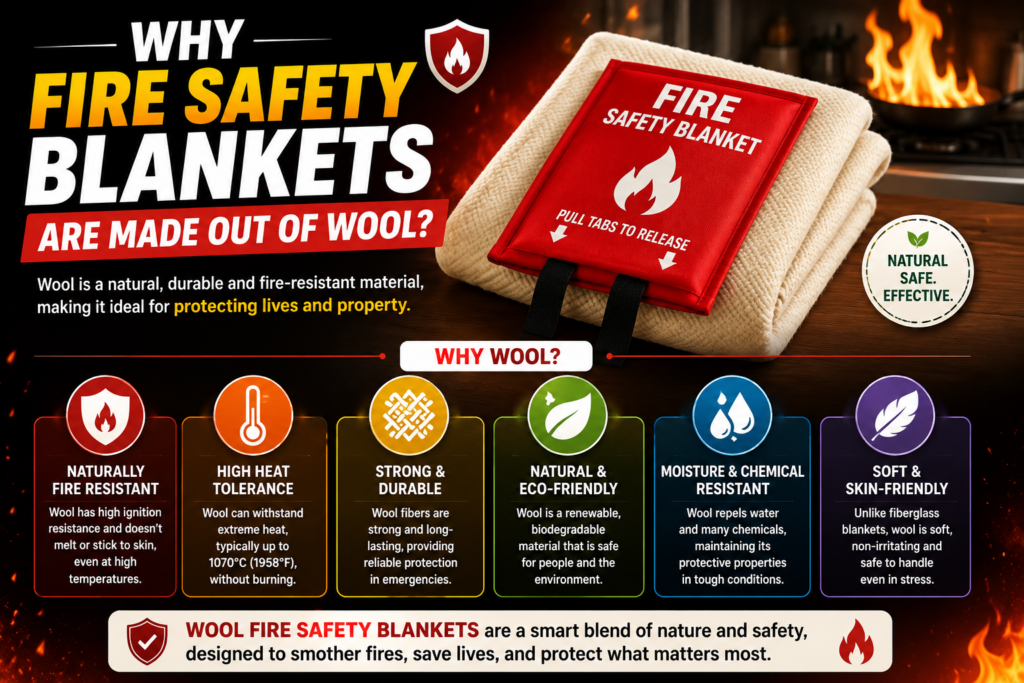
Fire safety blankets are easy-to-use, highly effective fire extinguishers for small fires. They act by sealing off oxygen, thus preventing the spread of fire. Of the various materials which are used for fire blankets, wool is one of the oldest and most dependable.
Even today, many people ask an important question: why would fire safety blankets be made out of wool when modern materials exist? The key is the intrinsic fire resistance of wool, its safe performance in a fire and its special role in safeguarding people and property in emergencies. Let’s delve into this further.
What Is a Fire Safety Blanket?
Fire Safety Blanket is a fire extinguishing device that is used to extinguish small fires. Typically composed of materials that resist fire and used in emergency situations.
It does so by taking away one of the components of fire, oxygen. Fire will not burn without oxygen.
Fire blankets are commonly used in:
- Kitchens (particularly for Oil or Grease Fires)
- Laboratories
- Workshops and factories
- Emergency rescue situations
Prior to the availability of modern fiberglass blankets, wool was one of the first types of materials used.
Why Would Fire Safety Blankets Be Made Out of Wool?
Fire safety blankets contain wool, which is a natural fire retardant that won’t burn when it gets hot. Wool is unlike synthetic materials which will melt or drip. Rather, it chars slowly and aids in the prevention of fires.
Because of this it is a good choice to use on small fires and to protect people in emergency situations.
The main reasons are:
- Natural flame resistance
- High ignition temperature
- No melting or dripping.
- Skills in covering fires.Skill in covering fire.
- Safe behaviour for heat exposure
Wool is a natural fire resistant material
One of the most important reasons wool is used is its natural resistance to fire. The protein-based fibre wool consists of keratin, which is like human hair.
This is the reason that wool is different from cotton or synthetic fibers. Not easily ignitable and slows the rate of burning.
When exposed to flame:
- Wool does not burn easily.
- Does not explode or catch fire quickly; smolders,
- It is capable of self- extinguishing when the flame is extinguished.
This innate durability makes wool a safer fabric than many others.
High Ignition Temperature of Wool
Wool is relatively high in its ignition temperature as compared to many common items. It needs a temperature of about 570–600°C to ignite.
This means:
- It will withstand heat for a longer time.
- It delays ignition
- It provides additional reaction time in times of emergency.
Even few seconds count in fire emergencies. Wool adds the added security.
Wool Does Not Melt or Stick to Skin
Melting fabric is one of the greatest hazards of fire. Numerous synthetic materials have a melting point that is low and adhere to skin, leading to serious injuries.
Wool is more safe:
- It does not melt
- Will not drip hot liquids.
- It does not produce a protective char layer, rather
This is particularly beneficial in protective fire blankets where human life is at stake.
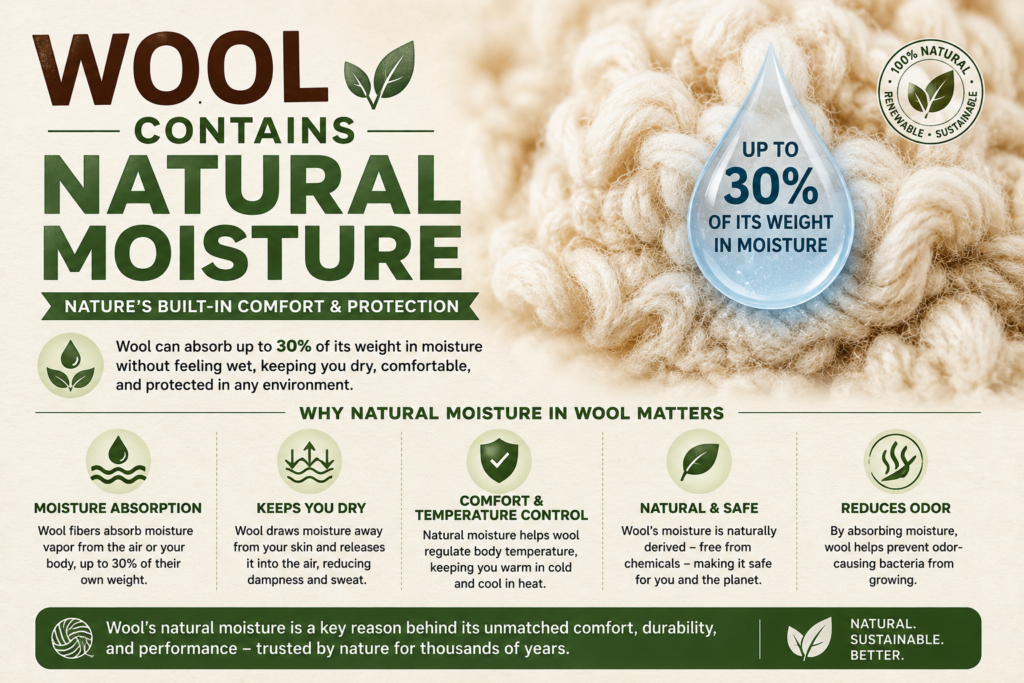
Wool Contains Natural Moisture
Wool fibers have a small amount of moisture content. This is an important factor in fire resistance.
If exposed to heat:
- Water enters the vapor phase.Water changes from a liquid to a gas.
- Steam helps cool the fiber
- This reduces the rate of burning.
This natural dampness makes wool less prone to catching fire than do other synthetic fibers.
Wool Helps Smother Fire Effectively
Fire safety blankets are used to smother fire. The dense fiber structure makes wool a good material.
If applied to a flame:
- It obstructs the flow of oxygen.
- Helps to decrease heat exposure.
- It has the ability to hold fire below the blanket.
This suffocation process helps to quickly and safely prevent small fires.
Wool does not give off toxic fumes readily
Another great benefit of wool is that it does not release as many toxic fumes as many other synthetic products.
In fire situations:
- Wool burns slowly
- Generates less polluting smoke.
- It is safer in case of an emergency at home.
This makes it more appropriate for settings such as homes and classrooms.
Historical Use of Wool in Fire Safety
Wool was much used as the material for protection against fire and heat before the modern development of fire resistant materials.
It was used in:
- Industrial workplaces
- Early firefighting equipment
- Protective clothing
- Emergency blankets
The material selected was wool, as it was readily available, long lasting and safer than cotton or synthetic fabrics of the era.
Wool vs Modern Fire Safety Blanket Materials
Today, most fire safety blankets are made from fiberglass or advanced heat-resistant fibers. These materials have more extreme performance.
Wool Advantages:
- Natural and eco-friendly
- Non-toxic
- Does not run or drip when heated
- Suitable for low risk fires.Appropriate for low risk fires.
- Comfortable and flexible
Wool Limitations:
- The material is not as heat resistant as fiberglass.
- May deteriorate with frequent use
- More durable than synthetic materials.
- Not suitable for heavy duty, high temperature applications in industry.
So, wool is still useful, but for only low to moderate risk environments.
Does wool still exist?
Of course, but not as frequently as formerly.
Fiberglass blankets are the recommended choice for modern fire safety systems due to their ability to withstand high temperatures. However, wool is still used in:
- Demonstrations of fire safety for education purposes
- Fire Protection Products that are environmentally friendly.
- Household emergency kits
- Some of the traditional safety equipment.
Despite its natural qualities it remains useful in certain circumstances.
Why Wool was a smart early solution?
Wool was one of the earliest fire resistant materials that was used because it was widely available and it was naturally safer than other fibres.
It offered:
- Strong fiber structure
- Natural insulation
- Resistance to burning
- No need for chemical treatment in water tanks.
This was a convenient option before the advent of modern engineering materials.
A scientific explanation of why wool is fire resistant?
In the structure of wool, there is N2 and moisture. These are components that help to retard combustion.
In the event of a fire:
- The outer layer burns to ash
- A char layer helps to shield inner fibers.
- The amount of oxygen is decreased.
- The fire is weakened and extinguished.
This self-protective reaction is what differentiates wool from other natural fibres.
Final Thoughts
Wool is naturally fire resistant, non-melting and will smother fires if used properly, which is why there are fire safety blankets made from wool. It is a safe, natural and non-toxic means to put out small fires.
Today, materials such as fiberglass are used more, but in some safety uses, wool is still an important material for its historical significance.
Knowing the rationale behind the use of wool gives us an appreciation of the development of fire safety technology and the importance of natural materials in saving human life.
National Fire Protection Association
Why would wool be used for fire safety blankets?
Wool is used because it acts as a natural fire retardant, cannot melt and blocks oxygen from the fire.
Is wool better than fiberglass for fire blankets?
Fiberglass is suitable for high-temperature industrial applications. Wool is more appropriate for natural, low risk and eco-friendly uses.
Is wool flammable?
No, wool does not burn as quickly as cotton or synthetic fabrics, and has a higher ignition temperature.
Why is it that wool doesn’t melt in a fire?
DON’T think of wool as a plastic-based product; it chars rather than melts.
Can wool be used in a kitchen fire?
Yes, wool blankets can be used for small kitchen fires, but modern fire blankets are more likely to be safe.
What is the natural fire resistance of wool?
It has a keratin structure, moisture and nitrogen content which slow the rate of combustion and heat spreading.