
Fires may arise at any time and it is important to take prompt and effective action to prevent loss of life and property. Many organizations utilize the RACE fire safety procedure to assist people in responding in an appropriate manner when a fire occurs. In a fire safety emergency, it may be beneficial for employees, building occupants, healthcare professionals and safety personnel to know what race stands for in fire safety.
The RACE acronym offers a straightforward procedure and helps individuals through the most critical steps during a fire incident. Commonly used in hospital, school, office, factory, hotel, and other places where fire safety is required.
You will be reading about RACE, what it means, and why it is vital in emergency response planning in this guide.
What is the meaning of RACE in Fire Safety?
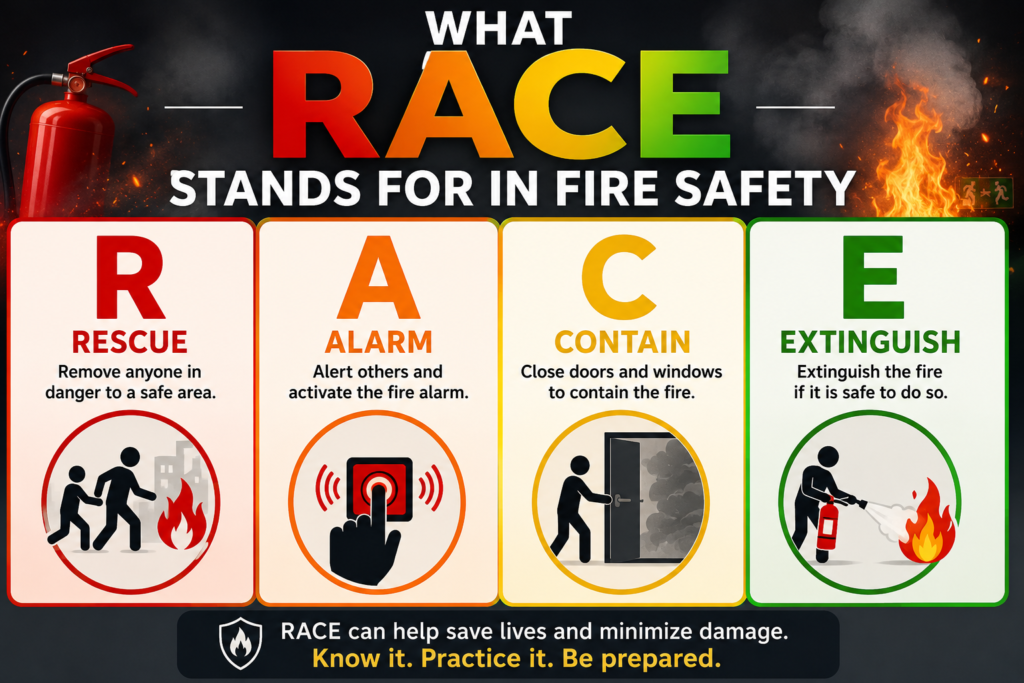
RACE stands for:
- Rescue
- Alarm
- Contain
- Extinguish or Evacuate
These are the four steps you can take to respond to a fire emergency in a structured manner and to minimize panic and confusion.
Every step is crucial to the safety of people and to minimising fire damage.
Fact 1: R Means Rescue
Rescue is the first step in the RACE procedure.
Remove person(s) from danger from fire/smoke/affected area, if safe to do so.
During rescue efforts:
- Prioritize human life
- Assist vulnerable individuals
- Help people to get to a safe place.
- Never put yourself at unneeded risk
Rescue work must always be carried out in a manner that puts personal safety first.
Fact 2: A Means Alarm
The next is Alarm.
When people are safe or rescue attempts have started, sound the fire alarm system right away.
This action helps:
- Alert building occupants
- Notify emergency responders
- Trigger evacuation procedures
- Raise awareness of the emergency situation.
Emergency contact also needs to be made to as quickly as possible in many facilities.
Fact 3: C Means Contain
Contain is the third step.
Controlled fire can help slow down the spread of fire and limit property damage.
These are typical containment measures:
- Closing doors
- Closing windows
- Isolating affected areas
- It is important to follow the facility fire procedures.
Controlling the spread of a fire helps maintain evacuation routes and gives extra time for firefighters to arrive.
Fact 4: E Means Extinguish or Evacuate
The last phase is to Extinguish or Evacuate.
If a fire is small, contained, and the person is trained, he or she can try to extinguish the fire with a fire extinguisher.
But evacuation always trumps if:
- The fire is moving outwards.
- The number of smoke particles is on the rise.
- The fire is too difficult to control safely
- Routes of escape can be blocked.Routes of escape can be obstructed.
Do not try to extinguish a fire when there is danger to life.
Fact 5: RACE Helps Reduce Panic
The wide-spread use of the RACE response procedure is partly due to its simplicity and easy to remember plan of action.
In an emergency, stress can impact on judgments and choices. The RACE acronym assists people to know the proper sequence of actions.
A clear plan can help to quicken response time, and facilitate a safe response.
FACT 6: RACE is EVERYWHERE in Healthcare Facilities!
In hospitals and medical settings, the RACE procedure is often used due to the possibility of emergencies occurring when patients need help.
Healthcare workers typically are trained in:
- Patient evacuation
- Fire containment
- Alarm activation
- Fire extinguisher use
RACE is a method that assists in the effective response of healthcare teams in safeguarding vulnerable patients.
Fact 7: RACE Works Best with Fire Safety Training
The RACE acronym is simple but training is still a necessity.
By providing fire safety training, people can be helped to:
- Understand emergency procedures
- Practice evacuation plans
- Learn extinguisher operation
- Improve emergency preparedness
Regular fire drills can result in quicker and more coordinated action during an emergency.
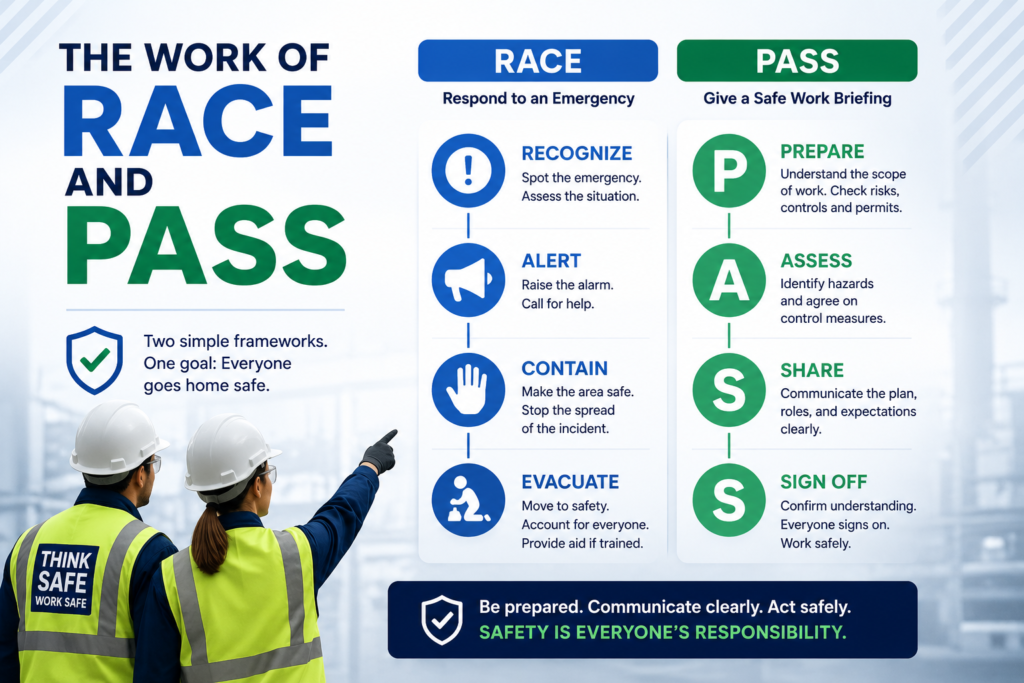
The work of RACE and PASS
Most fire safety courses cover RACE along with PASS.
PASS stands for:
- Pull
- Aim
- Squeeze
- Sweep
PASS is used to demonstrate how to make use of an extinguisher, and RACE is used to describe the emergency response process.
They are complementary and work well together to form a more comprehensive fire plan.
Why Fire Safety Procedures Matter?
Fire safety procedures assist organisations:
- Protect lives
- Reduce injuries
- Limit property damage
- Improve emergency preparedness
- Support regulatory compliance
Sometimes, a well-trained personnel is one of the best shield against fire emergency.
Must read this BLog: 7 Essential Steps: What Should You Do If Someone Is on Fire?
Conclusion
Knowing the meaning of RACE in fire safety is a key component of emergency preparedness. The acronym represents Rescue, Alarm, Contain and Extinguish/ Evacuate. These four steps offer an easy-to-follow plan for how to safely and effectively handle fire emergencies.
The RACE procedure is utilized to guide critical decisions during emergencies, whether it is in a hospital, office, school or industrial facility. In addition to regular training, fire planning can be part of a plan to achieve safer workplaces and better emergency response results.
In the context of Fire Safety, what does RACE mean?
RACE is the acronym for Rescue, Alarm, Contain and Extinguish/evacuate.
Why is the RACE procedure important?
It offers a plan that is easy to follow and straightforward for dealing with fire emergencies.
Does RACE get used in hospitals?
Yes. The RACE procedure is widely adopted in hospitals as they may require assistance during emergency situations.
What is the E in RACE the initial for?
The E represents Extinguish, or, Evacuate in case of risk and/or situation.
What is the difference between RACE and PASS?
RACE: Describes the process of responding to a fire; PASS: Provides instructions on using a fire extinguisher.