
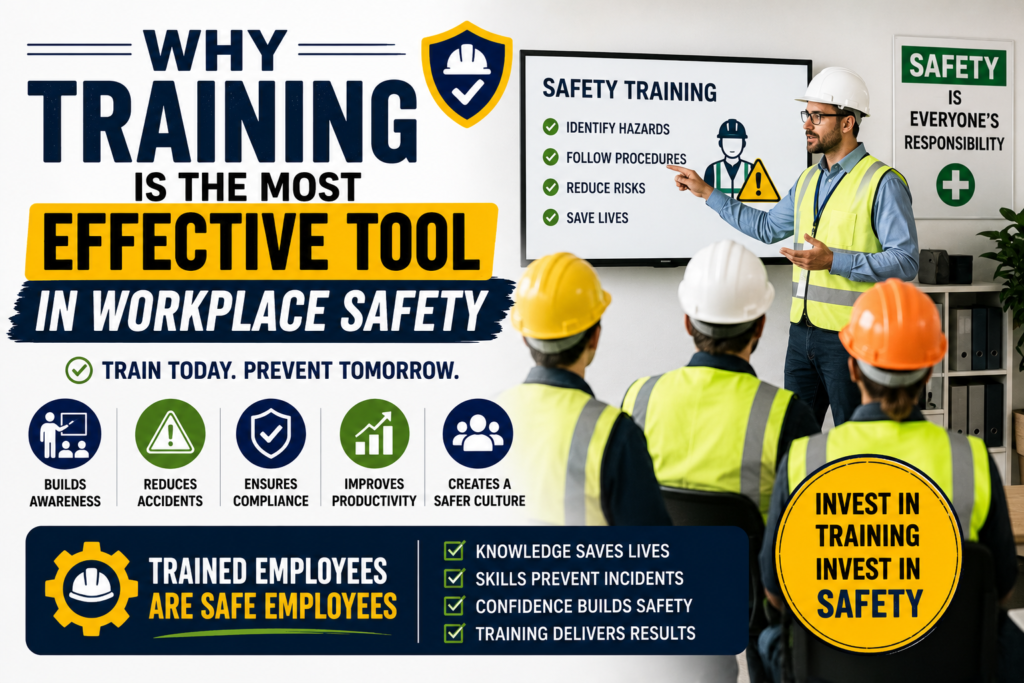
In the context of workplace safety, many will respond with hard hats, fire extinguishers, safety signs or personal protective equipment (PPE). Although these can be important tools they are not the best tool for workplace safety, per se.
Therefore, What’s the Most Effective Tool in Workplace Safety?
The answer is you might be stunned by it: good safety training and employee awareness.
The best safety equipment can’t stop the accident from happening if workers don’t know how to look for hazards, how to follow them, and how to react during an emergency. Employees gain knowledge and confidence as a result of training, thus allowing them to make safe decisions on a daily basis.
We will examine why safety training is still very much the backbone of workplace safety and how organisations can use it to minimise accidents, injuries and expensive incidents.
The Common Misconception About Workplace Safety
While many companies are spending large amounts of money on safety programs and equipment, they have forgotten one important factor—human behavior.
Consider these examples:
- An incorrect hard hat is worn by a worker.
- There is a fire extinguisher but staff are not trained in its use.
- Safety signs are displayed but ignored by the workers.
- Employees are unaware of the evacuation procedures, and there are emergency exits.
In each scenario the safety tool exists, but there is a risk as it is not trained.
Why Training Is the Most Effective Tool in Workplace Safety
Safety training can impact all facets of work safety.
Training is a tool that can be used to help workers:
- Recognize hazards
- Follow procedures correctly
- Respond to emergencies
- Use equipment safely
- Keep themselves and their work colleagues safe.
Training makes safety rules become a habit.
Reason 1: Train to prevent accidents before they occur
The ideal accident is the one that doesn’t happen.
Employees who are aware of hazards in the workplace are more likely to be able to recognise hazards and act to prevent an incident from happening.
It’s always better to prevent an injury than to respond to it after it occurs.
Hazard Recognition is a component of the training.
Reason 2: Hazard Recognition is part of employee training
Workers often fail to see hazards in the workplace, which leads to many workplace accidents.
By training, employees are able to recognize:
- Slips and trips
- Electrical dangers
- Fire risks
- Chemical exposure
- Equipment malfunctions
The sooner the hazard is identified, the better it can be managed.
Reason 3: Use of equipment improves safety
Safety equipment can only be effective if it is used appropriately.
Workers will be trained and will know:
- If equipment is needed
- How to wear PPE properly
- Equipment limitations
- Inspection procedures
- Maintenance requirements
Building knowledge is a huge enabler of safety tools.
Reason 4: Emergency Preparedness Saves Lives
People tend to come up with a plan B only when they need it most.
Well trained staff can respond during:
- Fires
- Medical emergencies
- Chemical spills
- Equipment failures
- Natural disasters
Prompt and sound actions can minimise injuries and damage.
Reason 5: Training establishes a Safety Culture
When employees regularly focus on safe behaviors, a strong safety culture is created.
Training encourages:
- Personal responsibility
- Team accountability
- Hazard reporting
- Safe decision-making
- Continuous improvement
Organisations that have a good safety culture, tend to have fewer incidents.
Reason 6: Reduces Human Error
One of the biggest causes of work accidents is “human error.
Effective training can minimize errors by educating employees on:
- Correct procedures
- Safe work practices
- Risk assessment techniques
- Problem-solving skills
As the employees get more information, the fewer mistakes that cost money are made.
Reason 7: Improves Compliance With Regulations
There are regulations governing workplace safety which must be adhered to in many industries.
Safety training helps organizations stay compliant to the legal requirements and also keeps the employees safe from harm.
Compliance benefits include:
- Reduced fines
- Fewer violations
- Better inspections
- Improved documentation
Meeting compliance also enhances a company’s reputation.
Reason 8 – Builds employee confidence
Employees are more productive when they are confident and ready.
During training, employees will learn:
- Their responsibilities
- Safety procedures
- Emergency protocols
- Equipment operation
Self-confidence can mean higher work productivity and safer work environments.
Reason 9: Makes long-term safety improvements
Knowledge is something which can keep benefiting employees throughout their careers, as equipment might wear out over time.
Continuous training works to achieve sustainable improvements through:
- Safe habits
- Awareness
- Communication
- Accountability
Long-term safety will be achieved by ongoing learning.
Myth vs Reality
The myth: PPE is the best safety tool
PPE is essential but employees need to be trained in use.
Myth: If there is a safety sign then an accident will not happen
Staff need training to interpret and act upon information in the form of signs.
Myth: Workplace Safety is the responsibility of management only
Safety is a shared responsibility of managers, supervisors and employees.
Myth: One Training Session Is Enough
Safety training should be continuous and continually updated, to take into account new risks and procedures.
Other Important Workplace Safety Tools
While training can be viewed as the best tool, training combined with other safety measures is most effective.
Use the following resources to help keep your workplace safe:
Personal Protective Equipment (PPE)
is the equipment that individuals wear to protect their bodies.
Helmets, gloves, safety glasses, protective clothing.
Fire Protection Equipment
Fire extinguishers, fire alarms and sprinkler systems.
Safety Signage
Warning signs, hazard labels and emergency instructions.
Safety Inspections
Inspection is regular and hazard identification and rectification achieved.
Reporting Systems
Any unsafe conditions should be easily reported by employees.
All these tools work well together to create a total safety program.
What are ways that employers can improve work safety?
To improve safety performance, organisations can:
- Providing regular training
- Encouraging hazard reporting
- Conducting safety meetings
- Reviewing incidents
- Performing workplace inspections
- Updating emergency plans
Strive to keep everyone at work safe.
Final Thoughts
When it comes to the best tool in workplace safety, it’s safety training and employee awareness. Equipment, policies, and procedures are a must, but they only work when employees know how to use them effectively.
An informed workforce can detect hazards, prevent incidents, act during emergencies, and help to foster a positive safety culture. Continuing education and awareness can be a major investment that will greatly alleviate workplace risks and help protect the most valuable asset – an organization’s people.
In a workplace, what is the best tool to use for safety?
Training and employee awareness are regarded by most safety professionals as the most effective workplace safety tools available because they impact employee behavior and decision making in the everyday workplace.
Why is it important to train people for safety?
Safety training enables the staff to identify hazards, operate equipment properly, and take appropriate action in emergency situations.
Will wearing PPE protect workers from workplace injuries?
No PPE means reducing risk but employees need to be trained to use it properly.
When does work related training on safety need to be repeated?
Training should be conducted regularly particularly when introducing any new hazards, equipment, or procedure.
What is the factor that makes a strong workplace safety culture?
A good safety culture can be fostered through consistent training, leadership commitment, employee involvement and communication.