
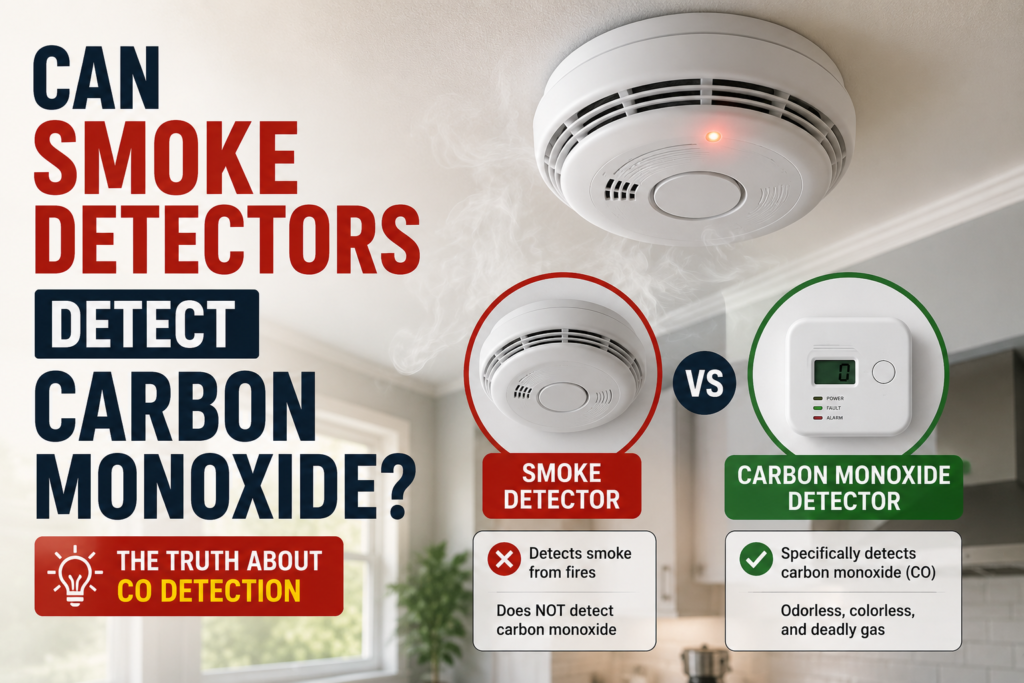
Can smoke detectors detect carbon monoxide? Most homeowners think if they have smoke alarms installed in all rooms in their home they are safe from all fire hazards. But smoke and carbon monoxide are quite separate hazards and an understanding of how these detectors operate might save lives.
The answer is: Most of the traditional smoke detectors are not designed to detect carbon monoxide. They are intended to detect smoke generated by fires, but carbon monoxide is invisible, odourless and can only be detected with special technology.
Let’s discuss the differences and learn ways to keep your family and home safe.
Why is this question important?
Each year thousands of people are exposed to Carbon monoxide and are unaware of it.
Carbon monoxide is different from smoke in that:
- Has no smell
- Has no color
- Has no taste
- Cannot be seen
- May rapidly turn lethal!
Since people do not detect it with their senses, they need a reliable detection equipment.
Myth vs Fact
Fact: All smoke alarms do not detect CO
Many people think all types of alarms are the same.
Fact
Most typical smoke detectors only sense smoke and fire particles. They do not monitor the CO concentration.
For carbon monoxide protection, a carbon monoxide-specific alarm or a combination alarm (which includes CO detection) is necessary.
Understanding Smoke Detectors
Smoke detectors are intended to alert us early to a fire.
They generally work by detecting:
- Smoke particles
- Combustion products
- Changes in air conditions caused by fire
Smoke alarms are primarily to warn people of the presence of a fire before it can spread.
This early warning may give sufficient time to evacuate safely.
Understanding Carbon Monoxide Detectors
Carbon Monoxide detectors are used to detect carbon monoxide gas levels.
These devices are used to continuously monitor the air and alert to unsafe levels.
Here are some of the most common sources of CO:
- Gas furnaces
- Water heaters
- Fireplaces
- Portable generators
- Gas stoves
- Vehicle exhaust
A carbon monoxide detector’s absence can mean that dangerous levels can go undetected.
Why Smoke Detectors Cannot Usually Detect Carbon Monoxide?
The technologies that smoke detectors and carbon monoxide detectors have differ.
Smoke alarms detect particles in the air that are produced by a burning fire.
Carbon monoxide detectors contain sensors that are sensitive to the presence of carbon monoxide gas.
Carbon monoxide is not a smoke with a visible particle and traditional smoke detectors cannot detect it.
This is why it is sometimes required to have separable protection.
What are Combination Smoke and Carbon Monoxide Alarms?
Things have changed in the world of safety devices.
Combination alarms combine:
- Smoke detection
- Carbon monoxide detection
into a single unit.
Benefits include:
- Simplified installation
- Reduced maintenance
- Comprehensive protection
- Less wall and ceiling devices
Many people select combination units in order to boost overall safety.
Recognizing signs of Carbon Monoxide Exposure
The symptoms are often the first sign of carbon monoxide exposure since carbon monoxide is a colorless, odorless, and tasteless gas.
Common symptoms include:
Headaches
Increased levels of carbon monoxide can cause persistent headaches.
Dizziness
Exposure may cause loss of balance and coordination.
Nausea
The symptoms are often confused as sickness by many victims.
Fatigue
Feeling unusually tired after getting a good night’s sleep.
Confusion
Excessive levels may impair mental processes and judgment.
If several people are experiencing symptoms at the same time, then CO is a potential cause.
Where to Place Carbon Monoxide Detectors?
Effectiveness is enhanced by proper placement.
Whereas the following are suggested locations:
- Near bedrooms
- In each home on every floor
- Closeness to fuel burning appliances
- Near attached garages
Manufacturers’ instructions are followed for best performance.
Where to Place Smoke Detectors?
For maximum fire protection, smoke alarms are commonly installed:
- Inside bedrooms
- Outside sleeping areas
- On every floor
- Near living spaces
The strategic placement makes it possible to provide early warnings during emergency situations.
Common Home Safety Mistakes
Many homeowners don’t realize they are lowering their level of protection.
Assume that the smoke alarms work
There are differences between smoke alarms and carbon monoxide detectors.
Ignoring Battery Replacement
In case of an emergency, dead batteries can render alarms ineffective.
Failing to Test Devices
The regular testing helps to ensure proper operation.
Installing too few alarms
The coverage should be throughout the home.
Ignoring Expiration Dates
There are lots of alarms that have a restricted life span and will need to be replaced at some time.
How frequently should Detectors be tested?
Testing is a crucial component of home safety.
Most manufacturers recommend:
- Monthly testing
- Replace Battery When Necessary
- Following maintenance instructions
- Scheduling replacing of units at recommended time intervals
Regular servicing makes sure that alarms perform as expected when they are required.
Difference between a Smoke Detector and Carbon Monoxide Detector
Both devices can save lives, but for different hazards.
Smoke detectors safely help prevent:
- House fires
- Electrical fires
- Cooking fires
- Smoke inhalation risks
Carbon monoxide detectors will help to prevent exposure to:
- Gas leaks
- Faulty appliances
- Exhaust exposure
- Carbon monoxide poisoning
Protection against both threats is available in the safest homes.
Why Every Home Should Have Both?
Fire and CO incidents can happen separately.
During a carbon monoxide leak, a smoke detector could give no alarm.
Likewise, an alert from a carbon monoxide detector might not be triggered by a fire that is beginning.
The combined use of both devices provides a better safety system and family protection.
Final Thoughts
So, do smoke alarms work in the event of a CO leak? Most of the time, the answer is no–traditional smoke detectors are made to detect smoke from a fire, and CO detectors detect the invisible CO gas. These hazards need to be detected using different technologies, so homeowners shouldn’t think there’s one device that can do everything.
To get the most protection, think about installing smoke alarms and carbon monoxide detectors, or combination units that offer protection for both. A little investment in right detection equipment can save your family from two of the worst household hazards.
FAQs
Does a normal smoke alarm work against carbon monoxide?
No. Typical smoke alarms only detect smoke, not CO gas.
Should I have an individual carbon monoxide detector?
If you don’t have combination alarms in your home, a carbon monoxide detector is recommended.
What is a ‘combination alarm’?
CO and smoke alarm is a combination alarm.
When should smoke/carbon monoxide detectors be tested?
Most manufacturers recommend that alarms be tested at least once a month.
Is CO really dangerous?
Yes. CO is a poisonous gas which can cause serious illness or death if not detected in time.