
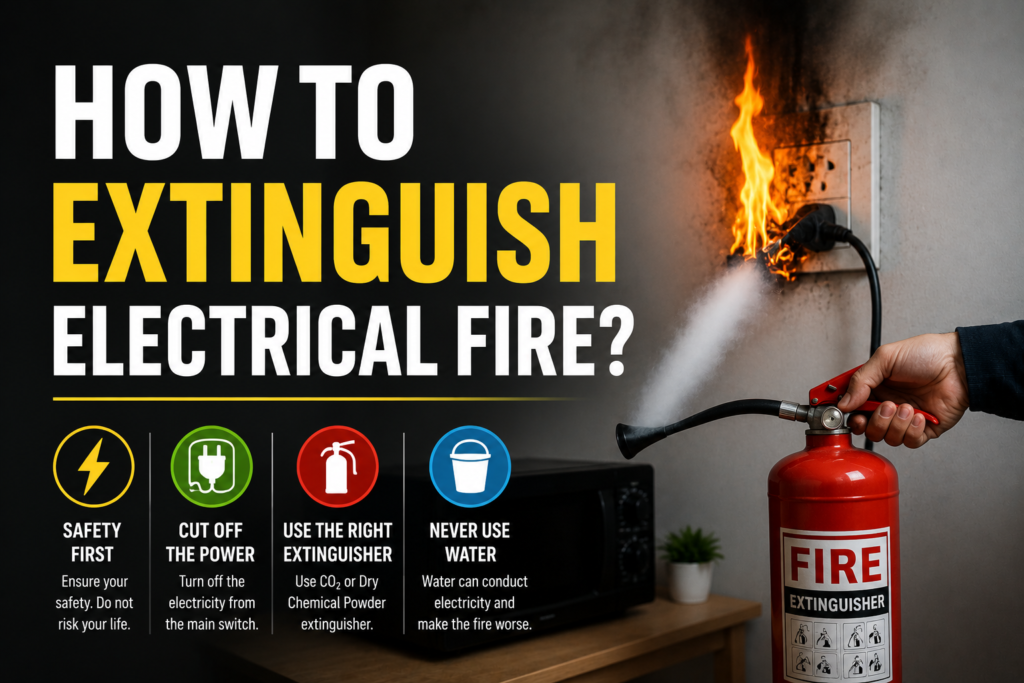
There are many reasons why everyone should know how to extinguish electrical fire, as it can start out of nowhere and grow in minutes. Responding properly to the fire, whether it starts in a power outlet, appliance, extension cord or electrical panel, can help save lives and limit property damage. But if you use the wrong method (specifically water) the situation can become far worse. Being prepared for an emergency is one of the most important fire safety skills you can have.
Imagine the Situation
While you’re sitting at home, you see sparks emanating from a power strip behind your TV. Seconds later, smoke begins rising, followed by small flames. The first thing you’d think of doing is taking the nearest bucket of water.
That instinct could pose a threat.
Power and water don’t mix. The best course of action for dealing with an electrical fire is to remain calm and take the proper steps.
Action 1: Keep Cool and evaluate the Fire
The first few moments are crucial.
In the case of a small fire, if it is contained, it might be possible to put it out safely. If the fire is moving quickly, there is a lot of smoke in the room, or you don’t feel safe, get out and dial your local emergency numbers.
Your safety is always your first priority.
Action 2: Disconnect the Power If It Is Safe
Electric fires will persist as long as electricity is flowing in the damaged equipment.
If power can be safely reached to the affected circuit or main circuit, turn off the electricity to the circuit or to the main circuit.
Never risk to unplug the power.
If you can not turn off the power safely, proceed to step 2.
Action 3: Use the Correct Fire Extinguisher
All fire extinguishers are not recommendable for electrical fires.
The safest are:
- Carbon dioxide (CO₂) fire extinguishers are not available.
- Dry chemical fire extinguishers that are rated for electrical fires.
These extinguishers act as an insulant in the fight against fire.
Read the label on your extinguisher to find out which type of fires it can extinguish.
Action 4: Never Throw Water on an Electrical Fire
One of the biggest errors made by people is drinking water.
Water conducts electricity, and can cause severe electric shock if still energised.
It also can spread a fire and cause damage to nearby electrical equipment.
Never use water for an electrical fire, unless the power has been turned off and you are sure that there is no electrical hazard left.
Action 5: Aim at the Base of the Flames
When using a fire Extinguisher, aim at the fire, not at the fire flame.
PASS is a technique to remember:
- Remove the safety pin.
- Target for the fire’s base.
- Squeeze the handle.
- Sweep left to right until flames are extinguished.
This technique assists in getting extinguishing agents to the fuel.
Action 6: Watch for Re-Ignition
The danger can be far from over even after the flames have been extinguished.
Electrical equipment can still be very hot and damage in the interior of the appliance or the wiring could reignite.
Do not get too close and wait until the area is safe, as determined by emergency responders or a licensed electrician.
Action 7: Evacuate If the Fire Grows
If the fire is too large to control, evacuate!
If possible, close doors behind you, which will help stop the spread of smoke and fire.
Don’t put off evacuating to salvage personal items.
If outside, remain outside until told otherwise by emergency personnel.
Action 8: Electrical equipment inspected
Do not re-use damaged electrical equipment.
If there is an electrical fire:
- Replace damaged wiring.
- Check outlets and switches.
- Repair affected circuits.
- Have appliances checked by a qualified electrician.
Acknowledging the damage may could make it more likely that there will be another fire.
Action 9: Understand how to avoid electrical fires
The safest electrical fire is one that doesn’t ignite.
Examples of simple prevention practices are:
- Avoid overloading outlets.
- Replace damaged extension cords.
- Do not leave appliances plugged in when they are not being used.
- Maintain access to electrical panel.
- Have regular electrical checks.
- Use approved electrical appliances.
- Replace old and damaged wiring as soon as possible.
Simple maintenance measures can avert disaster.
Common Errors That Can aggravate Electrical Fires
Electrical fires are made worse by the lack of knowledge of their potential dangers by people.
Using Water Immediately
The first choice of a live electrical fire should never be water.
Using the Wrong Fire Extinguisher
Always be sure that your extinguisher is appropriate for an electrical fire.
Ignoring Burning Smells
Overheating wires can sometimes give off a burning smell.
Operating damaged equipment
Any electrical equipment that has ignited or overheated should be checked prior to its next use.
Blocking Electrical Panels
The circuit breaker must be easy to access in case of an emergency.
What Causes Electrical Fires?
What Causes Electrical Fires?
The most common causes of electrical fires are:
- Faulty wiring
- Overloaded circuits
- Damaged extension cords
- Defective appliances
- Loose electrical connections
- Aging electrical systems
- Improper electrical installations
Ongoing maintenance can help detect many of these hazards that pose a risk before they cause serious problems.
Why Every Home Should Have the Right Fire Extinguisher?
A smoke detector alerts you to danger, but can’t extinguish a fire.
It can be helpful to have the right fire extinguisher in the area as an additional safeguard.
Place fire extinguishers in locations where electrical equipment is commonly used, such as:
- Kitchens
- Garages
- Workshops
- Utility rooms
- Home offices
It is important that everyone in the household knows how to use one safely also.
Final Thoughts
A proper knowledge of how to extinguish electrical fire properly can make a big difference during emergency. The most critical precautions are: remain calm, extinguish the fire if it is safe to do so, use the proper fire extinguisher, and never use a water extinguisher on a propane or electrical fire. If the fire is out of control, evacuate, and call for the police or fire department.
The preparation is as crucial as your response. There are ways to lessen the risk of electrical fires and to better protect your home and family by taking proper measures to maintain an electrical system and use appliances responsibly and ensuring you have the proper fire extinguisher within easy reach.
May water be used to extinguish an electrical fire?
No, water is an electrical conductor and can cause electric shock if the electrical source is still live.
Which fire extinguisher is best for an electrical fire?
CO₂ and dry chemical fire extinguishers are the most popular fire extinguishers to use on electrical fires because they are not conductors of electricity.
Is it safe to turn off the power before trying to extinguish a fire caused by electricity?
Yes, as long as it’s safe to do so! Unplugging the power will take away the electrical source that could be fueling the fire.
What is the number one cause of electrical fires?
Common causes are faulty wiring, overloaded circuits, damaged electrical cords, defective appliances and poor electrical installation.
When should I call the fire department?
If the fire is advancing, heavy smoke, or cannot be controlled with the correct fire extinguisher, then call for emergency services immediately.