
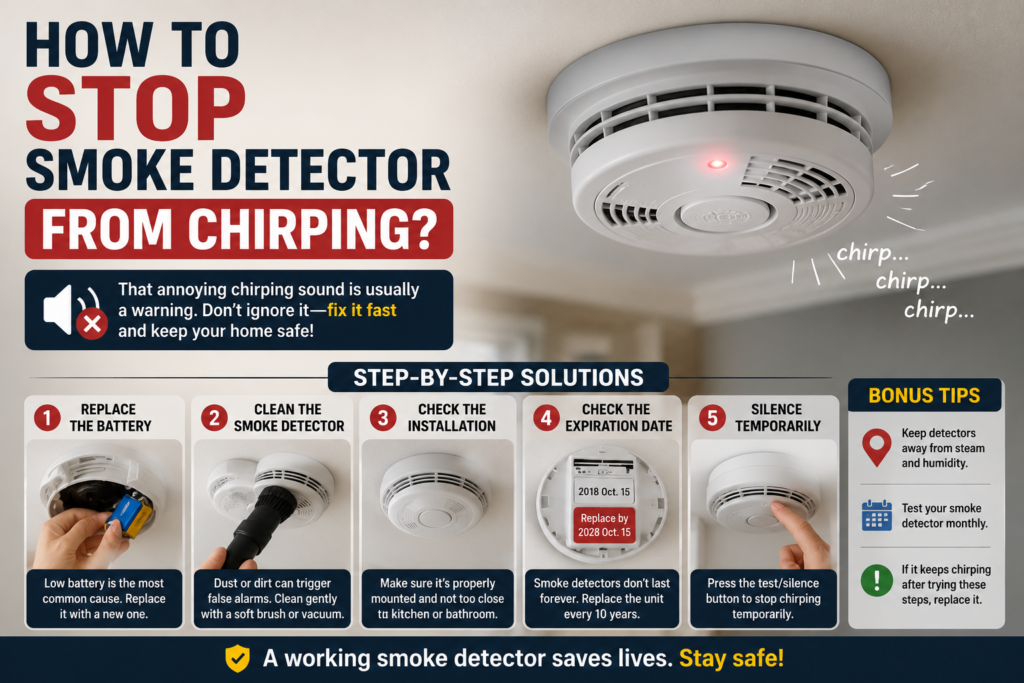
When the constant chirping begins in the middle of the night, one of the most frequently asked home safety questions is, “how to stop smoke detector from chirping.” You can’t always help but get aggravated at the chirping, but it is your smoke alarm’s way of saying “hey, take action.Sometimes you just can’t help but get aggravated about the chirping, but it’s your smoke detector’s way of saying “hey, take action. Fortunately, many chirping issues can be resolved within minutes after determining the cause of the chirping.
Rather than dismiss the sound, or even take the detector out of the room altogether, it’s essential to diagnose the problem correctly so your home can still be safe from fire.
Consider the Chirp as a Warning, NOT an Annoyance
A smoke detector is built to be able to talk to you.
If the alarm sounds, it is most likely a smoke or fire alarm, and a short chirp that repeats every 30 to 60 seconds is a maintenance alarm, not a fire alarm.
That little noise is calling for assistance, before the detector can no longer defend your home.
Fix 1: Replace the Battery
A weak battery is the most typical cause of a chirping smoke detector.
A low battery can be the cause of regular chirps to let you know that the battery is low even if the alarm works.
Replace with a high quality battery following manufacturer’s specifications.
Replace it after few minutes to determine whether chirping stops.
Fix 2: Reset the Smoke Detector
There are some detectors that will keep chirping even after the battery has been changed.
This is because the unit contains some electrical energy that it retains.
Most detectors can be reset by following these instructions:
- Remove the battery.
- If detector is hardwired, disconnect power.
- Hold the test button down for 15 to 30 seconds.
- Install the battery and reconnect power.
The warning signal usually will clear up if the reset is performed properly.
Fix 3: Check the Battery Installation
The issue may not always be the battery.
Make sure:
- The battery has been installed in the proper direction.
- Battery compartment is properly closed.
- Contacts on battery are free of gasket residue.
- A new battery is without the protective plastic tab.
Some loose connections can lead to persistent chirping.
Fix 4: Clean the Smoke Detector
The sensors in the detector can be disturbed by dust, cobwebs and small insects.
Use:
- An upright vacuum cleaner with soft brush attachment.
- Compressed air.
- A dry Microfiber cloth.
Cleaning will ensure consistent operation and can stop extra chipping.
Fix 5: Look for End-of-Life Warnings
Today’s smoke detectors have a finite lifespan.
The average lifespan of a unit is approximately 10 years, at which point parts within the unit start to become obsolete.
Some detectors emit a characteristic chirp upon the end of the useful life.
When the detector is over 10 years old, it can be best to replace it.
Fix 6: Check for Power Problems
Hardwired smoke alarms are connected to household electrical power and have a battery backup in case of a power failure.
Some models chirp when there is a power outage.
Inspect:
- Circuit breakers
- Power connections
- Backup battery condition
The power will typically be restored and this will solve the problem.
Fix 7: Reduce Environmental Interference
Smoke detectors can be impacted by extreme environmental factors.
Possible causes include:
- High humidity
- Excessive heat
- Cold temperatures
- Dust accumulation
- Steam from bathrooms
Reconsider placement if near a bathroom or kitchen; follow manufacturer’s installation instructions.
Fix 8: Test the Detector
After making any repairs, test the smoke detector.
Test the alarm by pressing the test button until the alarm is heard.
If it is successful, the detector is receiving power and is operating.
Testing should be a part of your home maintenance routine.
FIX 9: Check for Physical Damage
Smoke detectors may be damaged with aging.
Look for:
- Cracked housing
- Loose components
- Water damage
- Burn marks
- Corrosion
Any visible damage likely will impact the performance and will generally need replacement.
Fix 10: Replace the Smoke Detector
When all of the above troubleshooting steps have been performed and the detector is still chirping, it may be time to replace it.
When a new smoke detector is installed:
- Improved reliability
- Updated safety technology
- Better sensor performance
- Feel more secure and relaxed.
Since smoke detectors are a life-saving device, it’s a good investment to replace an old detector.
Common Mistakes to Avoid
Many homeowners make matters worse than the chirping when they try to do something about it.
Removing the Battery Permanently
This means that your house is without any protection from fire.
Ignoring End-of-Life Warnings
Old detectors might not function correctly in case of fire.
Installing the wrong type of battery
Do not use any other type battery than that recommended by the manufacturer.
Forgetting Routine Maintenance
Frequent testing and cleaning can prevent unforeseen problems.
How to Prevent Future Chirping?
Regular smoke detector maintenance ensures proper functioning.
Good habits include:
- Testing alarms monthly.
- Change batteries every 12 months (or as often as every year, for sealed long-life batteries).
- Cleaning the detectors multiple times a year.
- Replacement of smoke alarm batteries at the suggested service life.
- Having a maintenance program for each detector in the house.
Take these simple steps to minimize the risk of surprise chirping without compromising fire protection.
Why You Should Never Ignore a Chirping Smoke Detector?
A chirping detector is not just a noisemaker.
It’s a kind of cautionary sign.
Failure to take the warning seriously could lead to:
- Reduced fire protection
- Dead batteries
- Sensor failure
- Delayed emergency alerts
If you have a fire in your office, your detector will be ready, and you will be able to rectify the situation quickly.
Final Thoughts
If you know how to silence the chirping of smoke detectors you’ll avoid the frustration and keep your home protected. A low battery, out-of-date detector, dust and a simple reset are usually the causes of the problem. Once you know the cause, and the proper troubleshooting procedure, you can prevent the chirping without sacrificing fire safety in your home.
Keep in mind, your smoke detector is one of the most crucial safety devices in your house. Regular maintenance and timely replacement ensures it is going to serve you when you need it.
What is the cause of my smoke alarm chirping every half minute?
If you hear a chirp every 30-60 seconds it’s typically a battery condition, a Maintenance Alert or battery failure.
Can the battery be taken out to stop the chipping?
Temporarily, yes. However, the smoke detector will be disabled when the battery is removed, and your home won’t be protected.
What can I do if my smoke detector continues to chirp after the battery replacement?
If the detector has reached its service life, it should be reset, cleaned or replaced.
How long does a smoke detector last?
The life of most smoke alarms is about 10 years, but always check the manufacturer’s recommendations.
What to do when a smoke alarm chirps?
If the battery is new and the unit has been reset and it still chirps, it’s usually best to just replace the detector.