
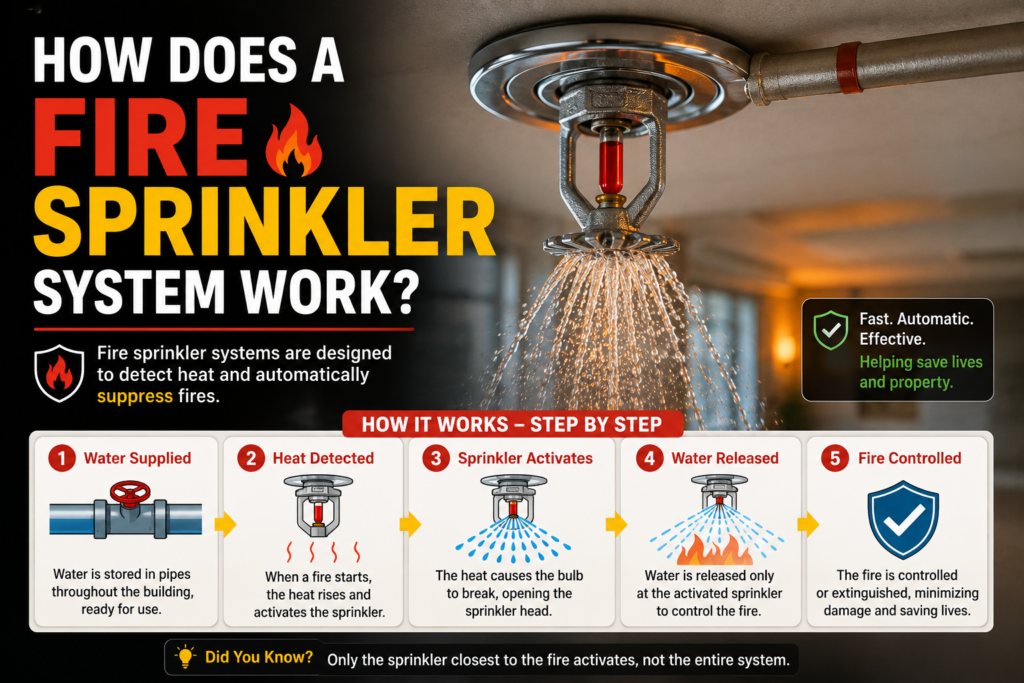
What is the operation of a fire sprinkler system? Have you ever noticed small sprinklers on your building’s ceiling? If so, you may have asked yourself, “What do the sprinklers do when a fire occurs?” A lot of people think that all sprinkler heads go off simultaneously and water the entire building. In fact, fire sprinkler systems are a lot more intelligent than that.
Suppose there is one drop of water in a pipe network above your ceiling. It can stay completely un-moving until it is heated by a fire’s warmth near a sprinkler head. That water can only help extinguish that fire once it has started to make its way to it.
Let’s take a trip down that road and learn about how a fire sprinkler system keeps people and property safe.
The Journey Begins: Water Waits Inside the Pipes
There is always a fire sprinkler system in place.
The pipes in the building can be filled with pressurized water or be dry until turned on. Whatever type of system, everything will immediately respond automatically if dangerous heat is detected.
Sprinklers are not smoke reactive. They are activated by heat.
This design can reduce the amount of water being discharged because of minor occurrences such as a burned toast or steam that comes from a hot shower.
The First Sign of Danger
The more a fire grows, the more heat that it releases.
Hot air rises, toward the ceiling where sprinkler heads are located.
It is equipped with a heat-sensitive element that is typically a small fragile glass bulb containing the liquid or a metal fusible link in each sprinkler head.
The heat-sensitive component breaks or melts when the surrounding temperature is at a certain level, generally 135°F to 165°F (57°C to 74°C).
This one action begins the whole process.
Only the Sprinkler Closest to the Fire Opens
Among the most popular sprinkler system misconceptions is the belief that all sprinkler heads turn on simultaneously.
This is a very rare occurrence.
Rather, only the sprinkler head that is exposed to sufficient heat will open.
There are a number of advantages to this targeted response:
- Uses less water
- Limits water damage
- Directs attention towards the fire
- Improves fire control
If a fire grows to the point that it reaches the temperature necessary to cause the activation of the sprinkler head, then that sprinkler head will also be triggered.If a fire grows large enough to cause activation of the sprinkler head, it will be activated as well.
Water rushes towards fire
Once the sprinkler head opens, water immediately flows through the opening.
The sprinkler’s deflector plate disperses the water into a specific spray pattern.
The sprinkler doesn’t create a single strong stream of water, and makes sure to spray the water over the entire area that it’s designed to cover.
This enables the water to:
- Cool burning materials
- Reduce surrounding temperatures
- Slow fire growth
- Do not allow fire to spread.
The intent is to extinguish the fire before firefighters can arrive.
Why is it that sprinklers go off when it’s hot rather than when it’s smoky?
Many people ask this question: “Why doesn’t smoke activate sprinklers by itself?
The answer is simple.
Smoke can be generated as a result of normal household activities, such as cooking.
Sprinklers would go on every time there was smoke, thus creating a problem of water damage where it is not needed.
Heat is a much better indicator of a dangerous fire.
This will result in effective and reliable sprinkler systems.
Each building has a different sprinkler system
Not all buildings have the same type of sprinkler system.
Wet Pipe Systems
The most common ones are these.
Water is always in the pipes, so that if a sprinkler turns on water can be turned off immediately.
Dry Pipe Systems
Pipes are filled with air and not water.
Water enters the system when a sprinkler opens, the air escapes.
These are frequently planted where there is a chance of freezing temperatures.
Pre-Action Systems
The systems need extra detection before the water can get into the pipes.
They can be seen in museums, data centers, and libraries where water can cause damage to valuable artifacts.
Deluge Systems
All sprinkler heads are open.
When this is on, all the sprinklers activate at the same time.
These are generally applied in high hazard industrial systems.
What Happens After Fire is Under Control?
After the fire is extinguished, the sprinkler system keeps pumping water until it is turned off by the fire department or trained personnel.
Afterward, professionals inspect:
- Sprinkler heads
- Pipes
- Water supply
- Valves
- Damaged components
If any sprinkler heads are activated, they are replaced prior to service.
The system is maintained on a routine basis to ensure it will be prepared for future emergencies.
Common Myths About Fire Sprinkler Systems
There are numerous misconceptions that render people unaware of the functioning of these systems.
Myth: All sprinklers turn on at the same time
Sprinkler heads exposed to enough heat will normally turn on.
Myth: Smoke activates sprinklers
Most sprinkler systems are not smoke activated.
Myth: Sprinklers Cause More Damage Than Fire
A controlled water discharge will usually cause less damage than a wild fire.
Myth: Sprinklers are a substitute for the Fire Department
While sprinklers can help to contain or slow fires, firefighters are still crucial to fully extinguish the blaze and make the building safe.
Why Fire Sprinkler Systems Save Lives?
In an emergency, fire sprinkler systems give precious time.
They help by:
- Slowing fire growth
- Reducing temperatures
- Improving evacuation conditions
- Limiting property damage
- Supporting firefighter operations
If fire is detected early, it can often be managed and mitigate the injuries and financial damages.
How to Keep a Fire Sprinkler System Working Properly?
As with all safety equipment, sprinkler systems need to be maintained on regular basis.
Property owners should:
- Schedule routine inspections
- Test system components
- Don’t cover sprinkler heads
- Avoid painting sprinkler heads
- If any parts of the vehicle are broken, replace them right away.
By maintaining the system properly, you can ensure that it operates when it’s most needed.
Final Thoughts
If you understand how a fire sprinkler system works, then you will be able to understand why these systems are one of the best methods for fire protection. Fire sprinklers respond to the heat, only open when necessary, and drench the fire directly, instead of pouring water over a whole building. This rapid, automatic response assists fire control, safety of life and property damage prevention before reaching the fire scene.
A properly designed and maintained fire sprinkler system is one of the best investments for safety, whether installed in schools, industrial facilities, hospitals, homes or offices.
How does the fire sprinkler system know when to go on?
There is a heat sensitive element in each sprinkler head, which turns on when the temperature within a certain range.
Do all fire sprinklers go off at once?
No. In most systems, only sprinkler heads that are exposed to sufficient heat from the fire are activated.
Will smoke set off a fire sprinkler?
No, standard fire sprinkler systems detect heat and not smoke.
What do you think will happen once a sprinkler turns on?
Water will continue to flow until the water supply is turned off by firefighters or authorized personnel.
Are fire sprinkler systems effective?
Yes. They are useful in helping control fires in the early stages of the fire, giving enough time to evacuate and minimise damage to property.