
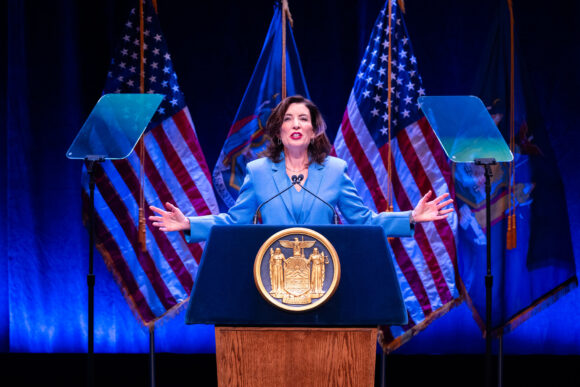
New York State has a 2026-2027 budget agreement, at least according to Gov. Kathy Hochul.
Hochul announced today that the budget totals about $268 billion and includes some but not all of her proposals for auto insurance reform to lower premiums along with some lawmakers’ proposals for consumer protections.
The budget was supposed to be ready by April 1. But state lawmakers passed nine deadline extensions to keep the government functioning until they and the governor could come to an agreement.
Contrary to Hochul’s announcement, Assembly Speaker Carl Heastie (D – 83rd District) told reporters that they still have not agreed and there’s no deal. He said the specifics of a deal have not been finalized and Hochul’s announcement is “premature.“
Heastie said lawmakers may be sent home for the weekend without a budget vote.
According to Hochul’s summary, the budget does not raise income or statewide business taxes and it maintains the governor’s powers to make future adjustments if actions by the federal government require.
It does, however, include a surcharge on high value second homes and investor-owned apartments worth $5 million and up in New York City, which lawmakers estimate will generate at least $500 million in tax revenue annually.
“I promised a budget that works for working people and expands opportunities for all New Yorkers and I was not going to back down from that fight,” Hochul declared in announcing the agreement.
One group that supported Hochul’s insurance reforms, Citizens for Affordable Rates (CAR), called the apparent agreement “a big win for New Yorkers struggling to get by in the midst of an affordability crisis.”
The insurance industry supported Hochul’s reform efforts but the final agreement includes some provisions including prior approval of rate hikes and limits on certain rating criteria that the industry may not welcome.
The legislative houses are tasked with passing bills to enact the priorities set forth in the budget.
NY Lawmakers Urged to Have Faith in Auto Insurance Reform Numbers. But Do They?
In addition to auto insurance, according to Hochul, the budget seeks to lower costs for childcare, utilities, and tuition for community and some four-year college programs. It provides $30 million in direct “tariff relief” for New York farmers and eliminates the state’s income tax on tipped wages up to $25,000 per year. It outlines investments in affordable housing, infrastructure, public safety, child nutrition, water quality and the environment, and it calls for online platform protections for children and countermeasures to aggressive federal immigration enforcement.
Auto Changes
Regarding auto insurance, the budget adopts reform provisions largely as proposed by Hochul that address:
- Fraud Fighting: Crack down on staged accidents, including increased legal liability for the ringleaders and giving insurers more time to investigate claims.
- Limiting Damages for At-Fault Drivers: Limit payouts to those found to be more than 50% responsible for an accident.
- Tightening Threshold: Narrows the definition of “serious injury” allowed for non-economic damages (pain and suffering), reducing the ability to sue for minor injuries.
- Mandating Tech Discounts: Require insurers to offer discounts to drivers opting into programs like telematics or other apps that monitor driving behavior.
The budget also reflects other Hochul recommendations that were amended by lawmakers and other proposals initiated by lawmakers:
- Prior Approval for Rates: Lawmakers insisted that insurers be required to get prior state approval before implementing rate hikes.
- Tighter Profit Limits: Rules to prevent insurance companies from taking excess profits.
- Rating Criteria Prohibitions: Insurers will be prevented from using zip codes and credit scores to rate policies.
- Eliminating 90-Day Rule: Eliminates the category of “serious injury” that allowed lawsuits based solely on being unable to perform daily activities for 90 days.
A related proposal that was not part of Hochul’s recommendations will require dangerous drivers in New York City who receive 16 or more speed camera violations in a year to install intelligent speed limiter devices on their vehicles.
Trial Lawyers
Opposition to the auto insurance reforms by the state’s trial lawyers was a major obstacle to a budget agreement, with some lawmakers arguing they did not belong in a budget but should be fairly handled separately.
Trial lawyers questioned the promise of lower costs for drivers. They argued that the overall changes disadvantage crash victims to benefit insurance companies and firms like Uber. They maintained that capping damages and limiting liability will not really lower rates but will mean injured people receive less compensation.
“Insurance profits must not come at the expense of justice, accountability, or the rights of injured New Yorkers,” Andrew Finkelstein, president of the New York State Trial Lawyers Association, told lawmakers.
In the end, the lawmakers went along with most of Hochul’s auto insurance measures while adding their own, according to Hochul’s account.
“By strengthening enforcement and modernizing outdated rules, they are helping put money back in people’s pockets. These reforms will bring real relief for working families, and mark a meaningful step toward making New York more affordable,” commented James Freedland, spokesperson for the Uber-backed CAR.
Hochul’s Campaign
Hochul campaigned relentlessly for her reforms. For her the key question was: why do New Yorkers pay so much?
“Not because New Yorkers are doing anything wrong, but because rampant fraud and runaway litigation costs are jacking up prices,” was Hochul’s answer.
The Democratic governor insisted New Yorkers “should not pay more for the same coverage” and vowed this is the year, the state does “something about it.”
Do New Yorkers Pay Too Much for Auto Insurance?
New York households paid an estimated $1,935 on average for personal auto insurance in 2024, according to a report by the industry’s Insurance Information Institute (Triple I). This was an increase from $1,753 in 2023.
Triple I further estimates that New Yorkers spent 2.23% of the state’s median household income on personal auto insurance in 2024, up from 2.15% in 2023. Nationwide, households spent an average of 1.59%. New York ranked fourth highest in 2023, after Louisiana, Florida and Mississippi.
Hochul and others argued that New York’s car insurance rates are being driven up by fraud, litigation, legal loopholes, and enforcement gaps, with staged crashes and associated insurance fraud inflating everyone’s premiums.
Small businesses, big businesses, rideshare companies, police and fire unions, insurers, insurance agents, truckers, bus companies, auto repair shops, university professors, district attorneys, mayors, immigrant and minority groups and others came out in support of her efforts to lower costs for drivers by fighting fraud and discouraging excess litigation and excess insurer profits.
According to a statewide survey of voters commissioned by the Uber-backed group CAR, three-quarters (75%) of New Yorkers contended that auto insurance costs are a financial burden on their household and even more (86%) supported Hochul’s legislation.
During the legislative debates, Assembly Member Landon C. Dais suggested the stakes for getting the reforms right were high and the issues deserved a full airing.
“I would argue that we as a legislature are probably on trial right now along with the insurance industry and the trial lawyers. The people of New York are the jury and they’re looking for us to for a verdict of affordability while the parties point fingers,” offered Dais.
He suggested that insurers, lawyers and lawmakers share responsibility for high costs and “no party is entitled to summary judgment in the court of public opinion.”
Topics
Auto
New York

