
The U.S. Supreme Court gave Bayer AG a mixed reception on its bid to stop tens of thousands of lawsuits claiming its Roundup herbicide should have been labeled as a cancer risk.
Hearing arguments in Washington Monday, the justices weighed a $1.25 million jury verdict won by a Missouri man who blamed Roundup for his non-Hodgkin lymphoma. The company contends that since U.S. regulators didn’t require a cancer warning, federal law bars the Missouri suit and others like it.
The company drew supportive comments from Justice Brett Kavanaugh, who questioned whether lawsuits alleging a failure to warn could be squared with a provision in federal law requiring “uniformity” in herbicide labels. But Chief Justice John Roberts suggested that states considering new evidence that a product is risky should be allowed to “call this danger to the attention of the people.”
Bayer is looking to the Supreme Court to help put an end to litigation that has cost the company more than $10 billion and cast a pall over its stock price. A ruling favoring Bayer could also help the medical-device, cosmetic and food industries, which are governed by laws similar to the one at the center of the Bayer case. The court will rule by early July.
Bayer contends that federal law supersedes, or “preempts,” traditional state-law claims for failure to warn. The case centers on the Federal Insecticide, Fungicide, and Rodenticide Act, which sets out rules for pesticides including the requirement of an adequate label. FIFRA, as the law is known, also says that states can’t impose additional mandates.
Bayer says the latter provision means that once the Environmental Protection Agency approved Roundup’s mandatory label without requiring a cancer warning, the company can’t be sued for not having one. The company, which has the Trump administration’s backing in the case, has steadfastly maintained Roundup is safe and doesn’t cause cancer.
Lawyers for the plaintiff, John Durnell, say EPA’s determinations don’t preclude state courts from making their own judgments about the need for a warning.
Cutting Across
The questioning Monday cut across the usual ideological lines. The Republican-appointed Roberts questioned the notion that states worried about cancer risks should have to wait for the EPA to decide whether to require a label change.
“If it turns out that they were right, it might have been good if they had an opportunity to do something to call this danger to the attention of the people while the federal government was going through its process,” Roberts said.
But liberal Justice Elena Kagan suggested that EPA’s judgment shouldn’t be overridden lightly. She said Congress entrusted EPA with the duty of evaluating the costs and benefits of warning labels and reassessing its decisions in light of new information.
“There just seems like a lot of stuff that the EPA does and is told by Congress to do to ensure the appropriateness of a particular pesticide,” Kagan said.
Kagan also said the preemption provision was “clearly designed to achieve uniformity in labeling.” When Durnell’s lawyer, Ashley Keller, said lawsuits wouldn’t undercut that uniformity, he drew pushback from Kavanaugh.
“The label’s illegal in one state and legal in another state,” Kavanaugh said. “That’s uniformity?”
Keller told the justices that lawsuits were an important supplement to EPA requirements because “things slip through the cracks with that agency.”
Bayer’s lawyer, Paul Clement, argued that allowing lawsuits “would open the door for crippling liability and undermine the interest of farmers who depend on federally registered pesticides for their livelihood.”
Bayer said in a statement Tuesday that a favorable ruling “would provide essential regulatory clarity for companies who seek to bring currently approved and new products to market, addressing their ability to serve US farmers and consumers.”
MAHA Demonstrators
President Donald Trump has embraced glyphosate, the active ingredient in Roundup, moving in February to ramp up domestic production. The administration’s stance has angered many members of the Make America Healthy Again movement, who have pushed to get glyphosate out of the food system.
About 200 demonstrators gathered near the front steps of the Supreme Court Monday morning to voice their opposition to glyphosate and the prospect of legal protections for Bayer.
“You cannot tell Americans to eat real food while protecting the cancer-causing chemicals sprayed on it,” said Vani Hari, known as the Food Babe, referring to Health Secretary Robert F. Kennedy Jr.’s “Eat Real Food” push, which accompanied an overhauled dietary guidelines this year. She added that “we wouldn’t be here right now if President Trump didn’t sign that executive order.”
Other protesters held signs proclaiming “No Immunity for Poison” and “Farmers and Families Deserve Better than Poison” at the rally.
Various farm, business and nonprofit groups filed briefs in support of Bayer, arguing that a uniform standard is better than a patchwork of state rules.
Durnell’s supporters include consumer and food-safety advocates who say the EPA review process is inadequate because of loopholes, data gaps and corporate influence over the agency.
Bayer recently reserved $11.25 billion (€9.6 billion) to deal with as many as 65,000 outstanding suits, according to the company’s securities filings.
Bloomberg Intelligence analyst Holly Froum estimated in a note that about $787 million in existing Roundup verdicts could be affected by the Supreme Court case and, if the justices rule for Bayer, “it would eliminate plaintiffs’ strongest claim.”
The case is Monsanto v. Durnell, 24-1068.
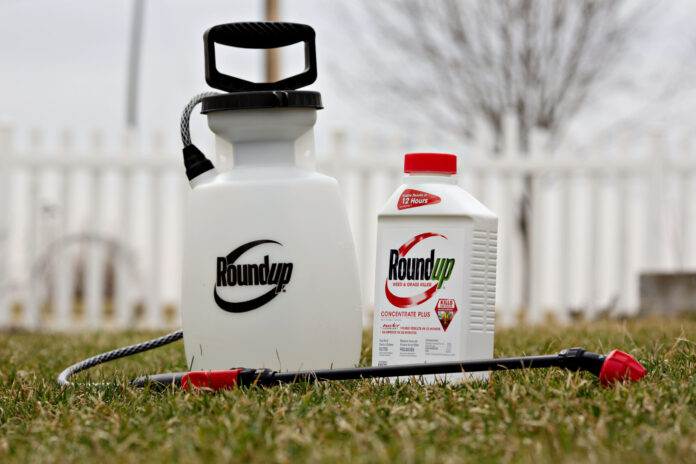
Top photo: Bayer AG Roundup brand weedkiller concentrate in Princeton, Illinois. Photographer: Daniel Acker/Bloomberg.
Copyright 2026 Bloomberg.

