
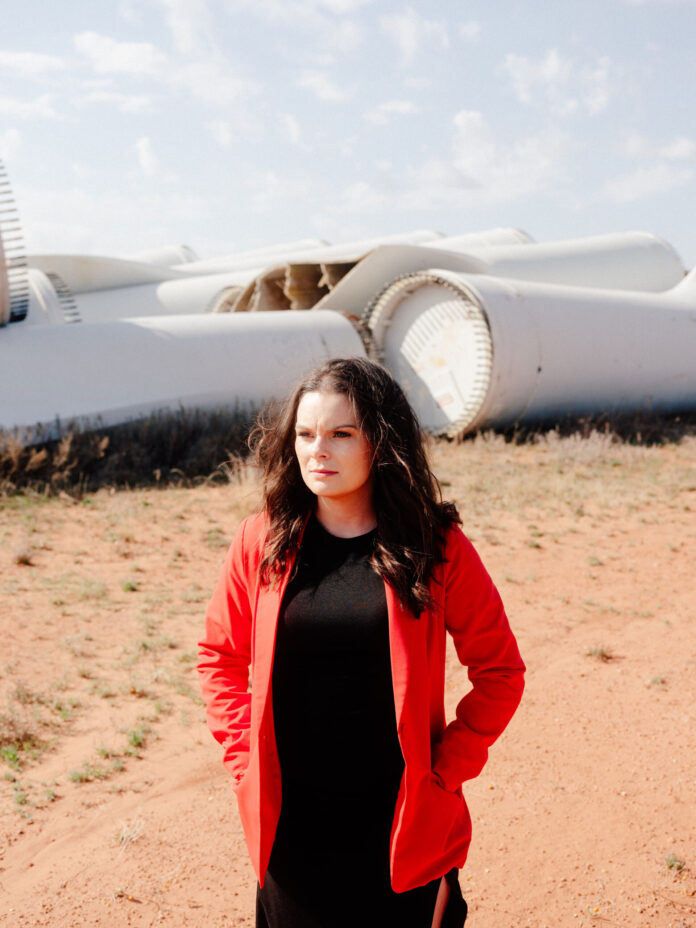
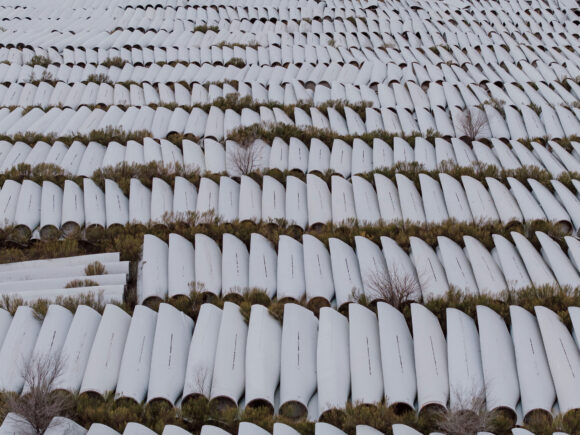
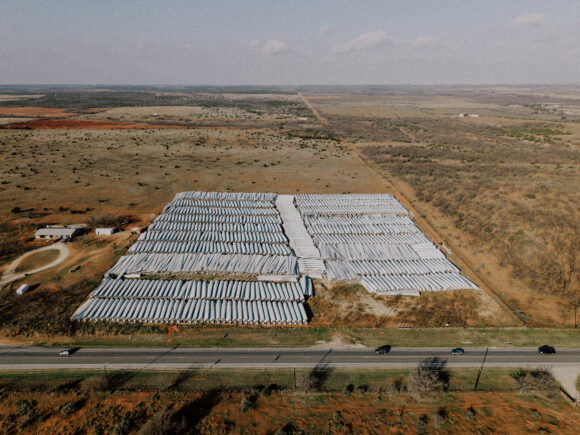
For nearly a decade, residents of Sweetwater have been confronted by a jarring sight as they leave and enter this small West Texas town: thousands of used wind-turbine blades.
The blades take up nearly 1 million square feet in a field off Interstate 20. Hundreds more occupy a second site nearby. Originally up to 200 feet long — nearly the wingspan of a Boeing 747 — the blades have been cut into thirds, exposing gaping openings. Locals complain they’re a haven for rattlesnakes, collect water that attracts mosquitoes and pose a threat to children living nearby.
The town has repeatedly asked the company that left the blades there to remove them, with no success.
“It’s really ugly,” says Samantha Morrow, the city attorney. She’s received quotes to remove the blades, but they range from $13 million to $54 million, beyond the city’s budget.
Thousands of visitors come to Sweetwater each year for its rattlesnake roundup, and the town also draws traffic tied to nearby wind energy projects. Miesha Adames, Sweetwater’s executive director of economic development, says the blades have damaged the town’s reputation.
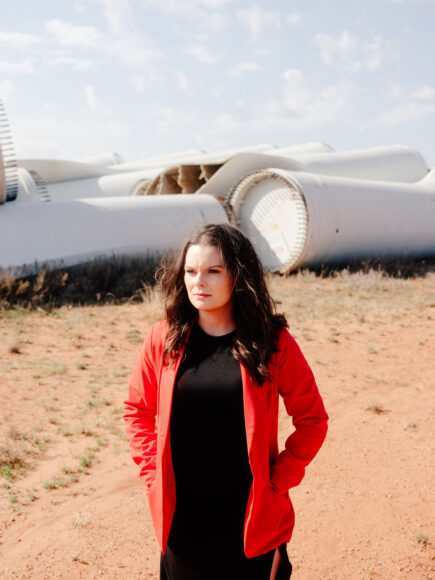
Texan officials have had enough. Attorney General Ken Paxton last month filed a civil lawsuit against Global Fiberglass Solutions, the recycling company that left the blades in Sweetwater.
Four people have been indicted for illegal dumping and theft of property. The Nolan County District Attorney is seeking significant jail time and says more charges are likely.
“They chose Sweetwater, Texas, Nolan County, and just decided, ‘I’m going to take some money and I’m going to leave this here and it’s their problem,” District Attorney Ricky Thompson told reporters at a recent press conference held in front of the blades. “That’s not okay.”
It isn’t just Texas that’s angry. Global Fiberglass is facing another lawsuit from the state of Iowa, as well as several claims for unpaid wages and fees to suppliers.
This is a story about an entrepreneur who believed he could make millions from old wind-turbine blades but, by many accounts, got in over his head. The upshot: angry citizens, mounting debt and an array of legal troubles.
The entrepreneur, Don Lilly — chief executive officer of Global Fiberglass — said he hasn’t dumped anything and remains interested in recycling the blades. In an interview for this story late last year, he described a vicious circle of acquiring old blades but being unable to find buyers for recycled material, leading to a growing stockpile.
In a statement emailed to Bloomberg News in March, Lilly said Global Fiberglass would not comment on allegations against it due to ongoing litigation. The company’s head of business development, Ronald Albrecht, and lawyers representing him did not respond to requests for comment.
Officials haven’t announced the names of the people under indictment, but Lilly and Albrecht are among them, according to two people familiar with the matter, speaking on condition of anonymity. Lilly and lawyers for him and Albrecht didn’t respond to requests for comment about the indictments.
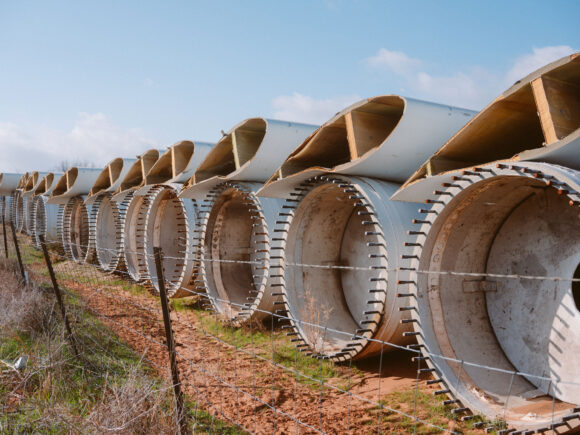
While the case is extraordinary, it offers a window into the larger challenge of disposing of turbine blades, and other complex plastic-infused materials, after their useful life. Blade waste has been increasing as older turbines are replaced or refurbished, and the world could see some 43 million tons of it by 2050, according to one estimate.
Blades can be broken down for further use in cement kilns or to make new materials, but the methods are expensive and come with their own environmental impacts. There are few buyers for recycled content from blades. Some companies are turning old ones into bus shelters or pedestrian bridges, but this is a niche solution.
Low-carbon wind power is a vital tool to keep global temperatures in check, and waste from wind projects makes up only a tiny fraction of what flows to landfills every year. The local environmental impacts of renewable energy are also far eclipsed by those of fossil fuel production.
But the waste is bad public relations for an industry reliant on appearing clean and green. It’s also a ripe target for political opponents of wind farms, which President Donald Trump has decried as dangerous, inefficient and ugly.
Texas generates more wind power than any other US state, and the industry supports tens of thousands of jobs there. But Paxton, a Republican running for the US Senate, announced the lawsuit against Global Fiberglass with a political jab at the sector: “Just because the radical left calls something a ‘green industry’ does not give any company a free pass,” he said.
Back in 2009, Don Lilly and Ken Weyant founded Global Fiberglass Solutions in Bothell, Washington, after being introduced by a mutual friend. Lilly until that point had worked in software sales and knew nothing about recycling. Weyant — who died in 2015 — was an accountant who had developed an interest in hard-to-reuse materials. He wanted a partner who “thought outside the box,” according to Lilly.
The pair saw an opportunity in the mounting waste from composite materials, like those used in boats and airplane wings. A few years later, they widened their focus to include wind blades after Lilly read an article about a turbine-maker looking to dispose of its used ones.
The timing was opportune. In 2015, the US government extended the federal production tax credit for wind energy. That encouraged many wind-farm owners to “repower” — to replace existing turbines, or just their blades, with newer, larger components, which can produce more energy. It meant thousands of blades would soon be headed for landfills across the country.
Up to 90% of a wind turbine’s mass can be easily recycled, but not the blades. They contain layers of fiberglass or carbon fiber wrapped around a core of balsa wood or plastic foam. Liquid resin is drawn through the fibers and cured, hardening the structure. Separating these materials for recycling is complex and costly. Transportation adds to the expense, since moving the blades often requires specialist trucks and permits.
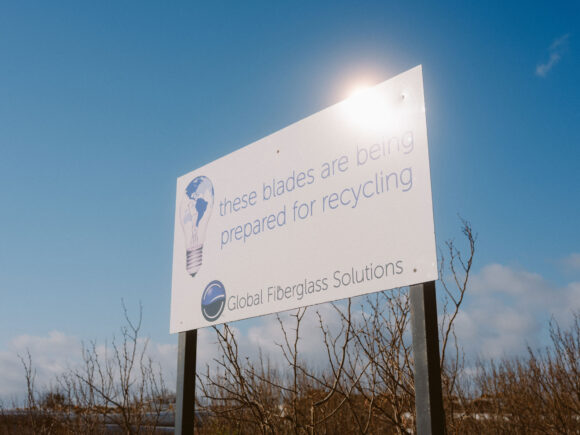
Global Fiberglass pitched turbine-makers including General Electric, explaining that it could chop up their blades on wind farms, take them away for recycling and issue certificates of decommissioning. Lilly touted his partnership with Karl Englund, a Washington State University researcher who’d go on to become Global Fiberglass’s chief technology officer. Englund had found a way to grind old blades down into filler materials he claimed could strengthen everything from furniture to concrete.
In 2016, Global Fiberglass sent GE executives a presentation with photos of manhole covers, pallets and panels that it said it could make from old blades. The presentation offered GE the option to buy these at discounted prices as well as “joint PR activity on recycling efforts,” according to court filings.
The following year, 2017, the company moved into a former aluminum recycling plant in Sweetwater. Soon after, GE struck two deals for Global Fiberglass to remove and recycle nearly 5,000 old blades, at a per-blade price of more than $3,500.
The company started to amass blades. But there was a problem: It hadn’t lined up customers for what it planned to recycle.
In late 2018, Lilly got a “scramble call” from GE, he said. It was hearing complaints that its blades were piling up. “They said, ‘We want you to take blades and start breaking them down,’” Lilly recalled. GE executives told Lilly they’d be coming by the facility for a visit.
Heath Ince, a former Global Fiberglass field manager, said Lilly instructed him and other employees to “look busy.” When the visitors arrived, Ince demonstrated how blades could be ground up and turned into pellets.
But it was clear that production wasn’t up and running. Only prototyping was. “When we showed them what we had, they got mad,” recalled Ince.
With no ready buyers for recycled material, it didn’t make sense to break down the blades, Lilly said: “Grinding without knowing who the customer is and what they want is just waste.”
According to Englund, filler just didn’t appeal to potential customers. “People want sexy. They want their recycling operation to have some whiz-bang,” he said in an interview. Plus, producing filler — even if there had been demand for it — used up only a small amount of the material from the blades.
Englund had found a way to make panels that used more of the blades, but equipment was expensive and grinding caused major wear and tear on machinery.
Still, a Global Fiberglass press release issued in early 2019 described “commercial production” being underway in Sweetwater.
Former employee Tatiana Golik said she was pressured by executives to describe Global Fiberglass as “fully operational” in a 2019 presentation to a turbine maker, and that she was instructed to write a newsletter for clients declaring that “manufacturing is on.” The newsletter, seen by Bloomberg, said Global Fiberglass was producing 300 to 500 pounds of pellets daily.
“That was a complete lie,” Golik said in an interview. “We weren’t producing anything daily.”
In an email to Bloomberg, Lilly said that statements made by former employees were “disputed.” He also said the status of the plant shifted over time, and during this period it “had not yet received all permits required to conduct full manufacturing operations.”
After its 2018 visit to Sweetwater, GE didn’t sign more contracts with Global Fiberglass. But it had already given Global Fiberglass 5,000 blades to recycle, which the company had stashed across Iowa and Texas. And GE wasn’t Global Fiberglass’ only client.
In 2022, the Texas Commission on Environmental Quality issued an enforcement order requiring Global Fiberglass to obtain permits for existing blades and stop accepting new material until it did. It didn’t comply, the commission said, so it referred the matter to the attorney general. According to Paxton’s office, Global Fiberglass has since accepted numerous deliveries of turbine parts to its main Sweetwater site.
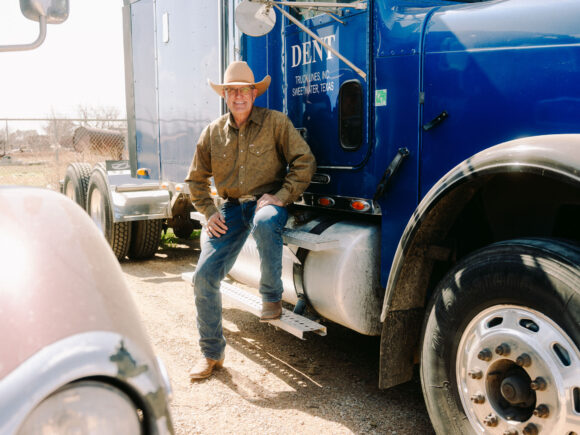
Some blades were brought in by Dent Trucking, a Sweetwater firm that started hauling for Global Fiberglass in 2017. Owner Cliff Dent said he bought seven extra-long trailers, at a cost of $35,000 each, especially to transfer blades, but after a while he stopped getting paid. He said he is owed $590,000 and has had to use his retirement savings to keep Dent Trucking afloat.
“It’s been a wreck for our company,” Dent said. Lilly didn’t comment on Dent’s allegations.
Global Fiberglass also piled up hundreds of GE’s blades at three sites in Iowa. It told GE it would be expanding into a plant in Newton, and in a press release described the plant as a “major development.” But Lilly, when interviewed for this story, said his team never got access to that facility after asbestos was discovered inside.
In 2022, Iowa’s attorney general’s office told GE it would pursue a civil environmental enforcement action against both GE and Global Fiberglass for the blade waste. To fend this off, GE arranged for the blades to be removed, paying $5.5 million.
GE then sued Global Fiberglass in September 2023, accusing the company of “fraud and deception” and a “bait and switch scheme.” In response, Global Fiberglass argued that it had no obligation under its agreements with GE to recycle the blades and that its only continuing obligation was not to send these to a landfill, according to court filings.
In 2024, a judge ruled for GE — which by then had split into three companies, with its wind-energy operations becoming part of GE Vernova Inc.— ordering Global Fiberglass to pay about $15.5 million, plus interest and legal fees.
“We are pleased that the court ruled in our favor,” a GE Vernova spokesperson said in a statement to Bloomberg. “We will continue to work with other reputable suppliers and support industry partnerships designed to address the industry-wide issue of wind-turbine-blade recycling.” GE Vernova didn’t address specific questions about its dealings with Global Fiberglass.
From there, Global Fiberglass’ troubles kept mounting. Iowa’s attorney general sued the company, Lilly and Albrecht in September 2024, saying they illegally disposed of solid waste by accumulating blades while making “no effort to recycle” them. Lilly and Albrecht sought to have the claims against them thrown out, arguing that Iowa courts lacked jurisdiction and that they should not be personally liable for the conduct alleged. A district court judge denied that request. The pair then asked the Iowa Supreme Court to overturn the ruling. That appeal is still pending.
Golik, Ince and Englund said they believe that Lilly set out to recycle the blades but mismanaged the business.
Golik left the company in 2022 after months of not being paid, she said, and is still owed $86,000. Ince said Lilly owes him over $14,000. He said he urged Lilly to fence off the blades to make sure children couldn’t play on them, but was ignored.
“Towards the end, he was desperate for money and started trying to save himself, regardless of who else got hurt,” said Ince.
Lilly didn’t comment on Ince or Golik’s specific allegations. In late 2025 he said that he was still involved in blade recycling through a new company he’d set up, which had recently signed contracts. He declined to name his clients.
“This is not Global Fiberglass. It has nothing to do with Global Fiberglass,” he said.
It remains unclear what will happen to the blades in Sweetwater.
Most old wind-turbine blades end up in landfills. The main alternative in the US is to shred them and send them to cement kilns. But many see that as a stopgap. Cement kilns are a major source of hazardous air pollutants and carbon emissions, and blades arrive in irregular volumes while kilns need a consistent mineral mix. The process is more expensive than landfilling. Only a handful of US kilns accept blades, and the grinding equipment also wears out quickly.
“Silica will grind down every component you use,” said Bob Cappadona, president and CEO for hazardous waste at Veolia North America. Veolia began working with GE, after it stepped away from Global Fiberglass, to shred its blades so they could go to cement kilns. “The grinder we were using was nearly half a million dollars and we were going through them like candy.”
Other companies have taken different approaches. Some are designing blades with materials that are easier to separate for recycling. Others like Vestas Wind Systems AS and Gjenkraft are trying to use heat or chemicals to break them down, although such processes can be energy-intensive and costly. An Iowa company called Renewablade is incorporating blades into non-structural concrete but says its process is limited to local manufacturing.
Some older turbines and components are refurbished and sold secondhand in countries like Italy and Poland, where height restrictions can make newer, larger turbines harder to install.
To spur further innovation, members of WindEurope — a trade group — agreed to a voluntary ban on landfilling blades that took effect in January. In Texas, a new law stipulates that the costs of component disposal and recycling be included in the financial assurances required under wind-power facility agreements.
Meanwhile, in Sweetwater, the blade dump remains a daily annoyance, with no timeline for when it might be cleared.
Dent, the trucking-firm owner, last hauled blades for Global Fiberglass in 2023 but still worries about children from the neighboring housing complex getting hurt by the blades.
“They’re like handmade forts to go play in. They’re stacked and they’re dangerous,” he said. “For us, this started out as a blessing but it’s turned into a nightmare.”
Copyright 2026 Bloomberg.
Topics
Texas

