
The Federal Emergency Management Agency said Wednesday it will fund up to $1 billion in disaster-resilient infrastructure under a grant program it had previously canceled and criticized as being wasteful.
The move was prompted by an order from a U.S. district court earlier this month, which had mandated in December that the Trump administration restore the Building Resilient Infrastructure and Communities (BRIC) program.
FEMA launched the multibillion-dollar grant initiative during President Donald Trump’s first term in office in an effort to reduce the cost of future disasters. State, local and tribal governments can apply to fund an array of construction projects, and in prior years had been awarded money for everything from flood levees to tornado safe rooms. When the program was cancelled, progress on many of those projects stalled.
In April 2025, FEMA abruptly ended BRIC and tried to spend the appropriated money on other priorities, a decision the district court later determined was unlawful. When the agency failed to reopen the program the within several weeks, U.S. District Judge Richard G. Stearns gave officials an explicit timeline for issuing new grant opportunities and restarting communication on previously funded projects.

The Wednesday announcement is the biggest sign yet that the agency is complying with the court. It comes after Homeland Security Secretary Markwayne Mullin was confirmed by the Senate and sworn into his role. Mullin replaced Kristi Noem, who exercised tight control over FEMA’s spending and presided over the firing of hundreds of disaster workers.
Acting FEMA chief Karen S. Evans signed off on the announcement of BRIC’s return, which the agency said will help save lives. “For this new funding opportunity, FEMA has reduced bureaucratic hurdles, focused funding on major infrastructure projects and shifted responsibilities to the states, reducing federal overreach,” Evans said in a statement.
Disaster experts celebrated the news. “For the communities who have been waiting on this funding, the announcement means BRIC survived, and mitigation is back,” said Carrie Speranza, former chair of the FEMA National Advisory Council.
Over the life of the program, FEMA has received applications for more than $15.6 billion of work and agreed to fund more than $4.6 billion, or roughly 30%. BRIC has been funded at the behest of the president and by Congress.
Trump, who has at times advocated to eliminate FEMA, is still waiting for final recommendations from a panel of experts he convened to recommend reforms at the agency. On Tuesday, Trump issued a second extension to his FEMA Review Council, with its final report now due by May 29 — days before the Atlantic hurricane season begins.
FEMA has not been tested by a large-scale, multi-state catastrophe since Trump returned to the White House. The 2025 hurricane season passed without a landfall in the US.
The upcoming season that begins June 1 is expected to produce anywhere from 11 to 16 tropical storms, according to commercial forecaster AccuWeather Inc., which is near the long-term average. Four to seven of those storms are likely to become hurricanes.
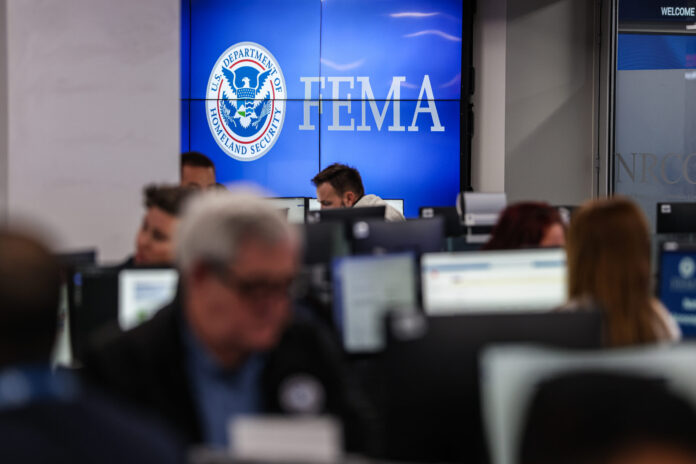
Top photo: The Federal Emergency Management Agency (FEMA) National Response Coordination Center in Washington, D.C., on Saturday, Jan. 24, 2026. Bloomberg.
Copyright 2026 Bloomberg.

Want to stay up to date?
Get the latest insurance news
sent straight to your inbox.

