
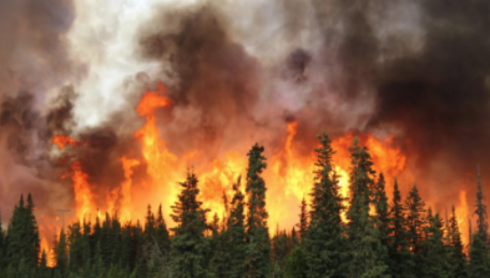

Wildfires on Alaska’s North Slope were more intense during the past century than at any point in the last 3,000 years, according to new research published in the journal Biogeosciences. The research took place in Arctic Alaska and involved an international group of scientists from Germany, Poland, the United Kingdom, Romania and the University of Alaska Fairbanks’ Toolik Field Station.
Angelica Feurdean, the study’s lead author and a senior researcher at Goethe University in Germany, said the team combined multiple scientific methods to rebuild a long-term record of wildfire activity. The results show that recent fire levels are the highest on record, driven by the spread of woody vegetation and increasingly dry soils. Both trends are linked to rising temperatures.
“The interlinked changes across millennia mean recent fires are indicators of a system undergoing rapid transformation,” Feurdean said. To uncover this history, researchers extracted peat cores reaching about half a meter deep from nine tundra locations north of the Brooks Range. The sites stretched along the Dalton Highway between Toolik Lake and the Franklin Bluffs.

