

Specialty insurance market rates declined in 2025 and during the January 1, 2026 renewals, with the pace of change exceeding expectations, according to WTW’s Specialty Insurance Marketplace Survey (SIMS).
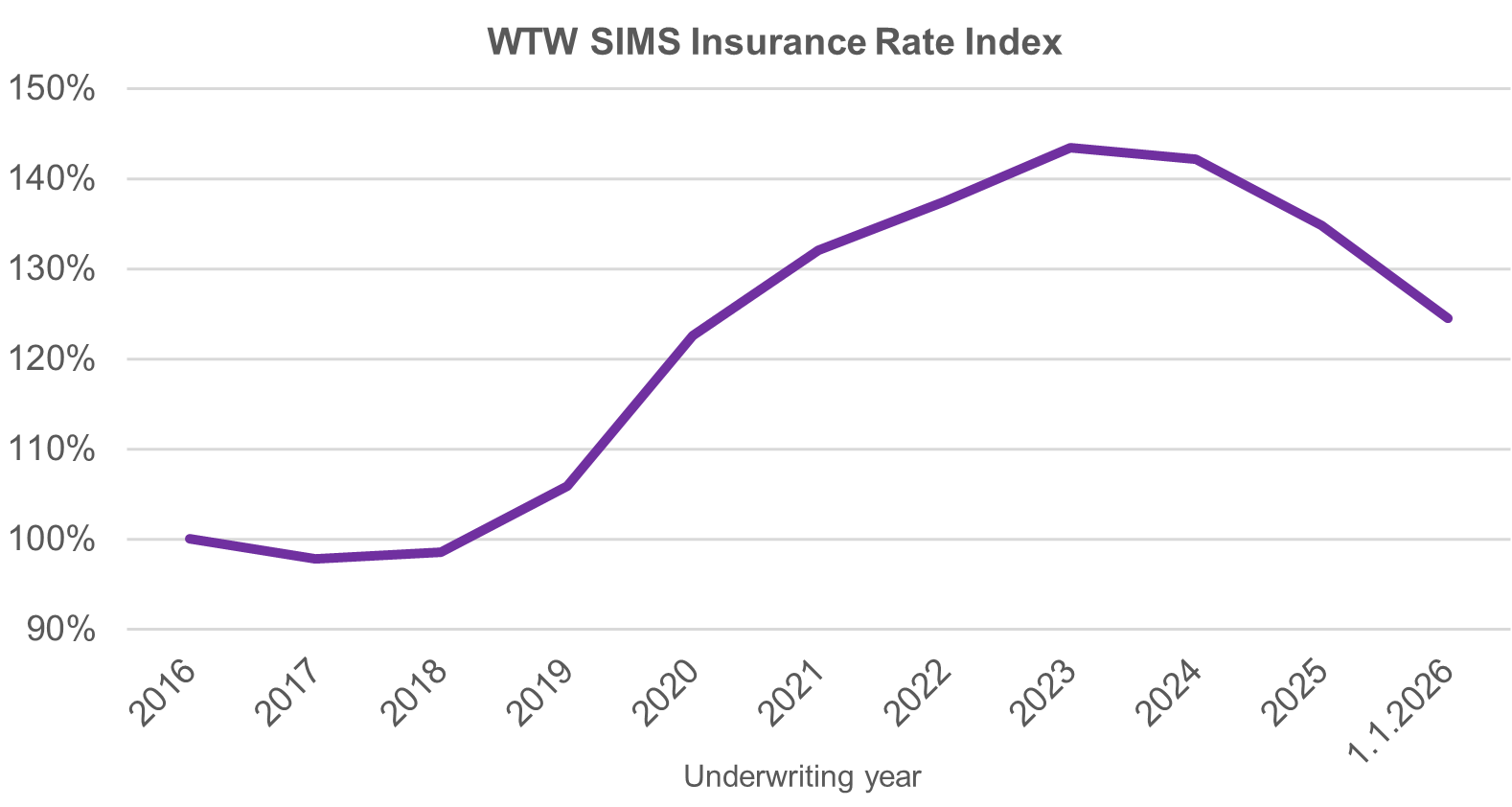
Data from the January 1 renewals and new business point to continued rate softening, with a 10-point decline in the insurance rate index, back to 2020 levels, WTW added.
The findings also highlight the speed of recent market movements. An approximate 45% cumulative rate increase was achieved between 2017 and the market peak in 2023, with around half of that increase eroded over the past two years.
“Substantial concerns relate to social inflation, nuclear jury verdicts and the expansion of litigation funding in this market. We do not believe this trend is sustainable, but how this might change in the short-term remains uncertain.”
Based on the SIMS insurance rate index, expected performance (which is net of exposure trends) in 2025 has unwound the rate strengthening gains of the last few years back to levels last seen in 2021, said WTW, noting that 2025 was the first year since 2018 for which rate adequacy for new business was lower than for renewal business.
The most pronounced rate decreases are in property and energy, followed by marine, financial institutions and professional liability, reflecting benign catastrophe experience and distorted frequency/severity trends, offset by higher geopolitical tensions, WTW continued.
The general liability and medical malpractice markets are behaving counter-cyclically to the overall insurance markets, the survey found. “Substantial concerns relate to social inflation, nuclear jury verdicts and the expansion of litigation funding in this market. We do not believe this trend is sustainable, but how this might change in the short-term remains uncertain.”
During the January renewals, 75% of the 42 material classes show rate decreases (on a gross-of-claims-trend basis), compared with 30% of classes in 2024.
WTW said that the inclusion of claims trend data within SIMS allows for a more complete picture of expected profitability movements. In particular, the survey shows that aggregated insurance rates decreased by 5% gross of claims trend and 8% net of claims trend (i.e., adjusted for actuarial-estimated inflation in claims costs over and above what is captured in rate change data).
Survey Details
The WTW survey reflects around $250 billion of gross written premium over a 10-year cycle, including $45 billion in 2025, and covers specialty insurers operating across the London, Bermuda and the U.S. excess and surplus (E&S) markets.
Rather than using broker-derived data, the survey is built exclusively on data contributed by clients of WTW’s Insurance Consulting and Technology business that participate directly in SIMS
“Our intention is to provide insights on specialty market dynamics that hasn’t been possible before – using market derived data to deliver a consistent view of risk adjusted rate change over a large number of classes and key geographies, aligned to how underwriting teams are organized,” commented Richard Clarkson, global market leader, Global Specialty, WTW, in a statement. “Our clients already use this to validate business plans, compare current year rating trends, assess impact of new and renewal rate adequacy and support reserving processes.”
WTW said SIMS aims to provide a consistent view of rate movements across specialty markets, allowing carriers to assess how conditions are evolving across both new business and renewals.
Source: WTW
Topics
Excess Surplus
Interested in Excess Surplus?
Get automatic alerts for this topic.

