
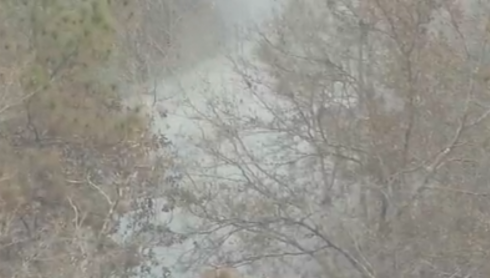
As brush fires continue burning across the region, health officials say the biggest danger may not be the flames themselves, but the smoke drifting into neighborhoods and lungs.
Dr. Sunil Joshi, the city of Jacksonville’s chief health officer and an allergist and immunologist, said wildfire smoke contains fine particulate matter that can irritate airways and trigger serious breathing problems, especially for people with asthma, chronic bronchitis and other underlying lung conditions.
“It’s the fine particulate matter — about 2.5 microns — very small amounts that can cause problems, especially for people with asthma or chronic bronchitis,” Joshi said. Joshi warned that large-scale wildfires near populated areas could quickly strain the health care system.
“If we had a wildfire in Jacksonville, with a million people, it could send people to the emergency room or the hospital, especially those with respiratory illnesses and anyone with allergies in general,” he said.
Unlike typical seasonal allergens, wildfire smoke adds ash and microscopic particles to the air, creating an additional irritant that can worsen symptoms even for people who don’t normally struggle with breathing issues. According to health officials, if smoke is visible or can be smelled, the air quality is already compromised.
Joshi said people who must go outside, particularly those in high-risk categories, should consider wearing a KN95 mask to reduce exposure. “Especially if you can smell the smoke or see the smoke and you’re in a high-risk category, it makes sense to wear the same mask we wore during COVID — a KN95 mask,” Joshi said. “Those keep out about 95 percent of small particles from getting into your airway.”

