

Let’s talk about what bi-directional amplification systems are, and why they’re so important for fire safety.
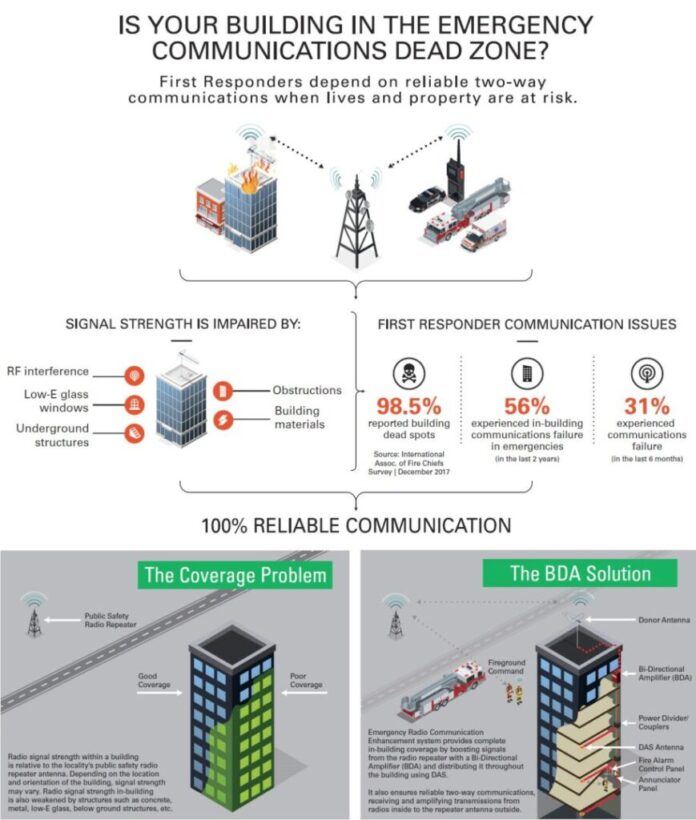
In large commercial buildings, hospitals, warehouses, campuses, and high-rise properties, clear and reliable radio communication is essential for emergency responders. Thick concrete walls, low-emissivity glass, underground structures, and sprawling layouts can weaken or block radio signals, which can put lives and property at risk during an emergency. That’s why these buildings need bi-directional amplification systems.
What Are Bi-Directional Amplification Systems For?
Bi-directional amplification systems (often called BDA systems) are life-safety communication solutions designed to improve in-building two-way radio coverage for first responders. These systems capture weak radio signals from the outside, amplify them, and rebroadcast them throughout the interior of the building. They also take internal radio signals and transmit them back to public safety networks, ensuring communication flows clearly in both directions.
Because of their critical role in emergency operations, many jurisdictions now require BDA systems as part of fire and life-safety code compliance for certain buildings.
How Bi-Directional Amplification Systems Work
Bi-directional amplification systems are made up of several working components that form a signal-boosting pathway. While every installation is tailored to the building, most systems include:
- Donor antenna: Located on the exterior or rooftop, where it can capture the strongest public safety radio signal available.
- Bi-directional amplifier (BDA): Receives the weak incoming signal and boosts it to a usable strength.
- Distributed antenna system (DAS): A network of antennas installed throughout the interior to evenly transmit the amplified signal.
- Return signal pathway: Allows transmissions from radios inside the building to travel back to the public safety network.
Together, these elements ensure that radios used by firefighters, police officers, EMTs, and other emergency personnel work seamlessly across every part of the facility, including:
- Stairwells
- Basements and parking garages
- Mechanical rooms
- Elevators and shafts
- Interior corridors
- Concrete-heavy areas
Anywhere signal strength is historically weak becomes fully accessible with bi-directional amplification systems in place.
Why Buildings Need Bi-Directional Amplification Systems
Reliable in-building radio coverage is a life-safety necessity. During emergency events, responders must be able to communicate with one another and with command units without interruption.
Supports First-Responder Safety
BDA systems ensure responders can coordinate effectively even in difficult environments. Clear communication allows for faster decision-making, safer navigation, and more efficient rescue operations.
Improves Coverage in Challenging Building Conditions
Modern construction materials are great for energy efficiency and durability, but they also block radio frequency signals. Thick walls, steel structures, and underground levels are common signal-dead zones. A BDA system eliminates those gaps.
Code Compliance & Regulatory Requirements
Authorities Having Jurisdiction (AHJs), along with fire marshals and code enforcement departments, increasingly require bi-directional amplification systems in:
- High-rise buildings
- Healthcare facilities
- Schools and universities
- Large warehouses and distribution centers
- Stadiums and event venues
- Transportation hubs
- Tunnels and parking structures
Many requirements align with standards such as:
- NFPA 72 (National Fire Alarm and Signaling Code)
- NFPA 1225 (Emergency Services Communications)
- IFC (International Fire Code) in-building radio coverage provisions
Staying compliant helps avoid costly delays during occupancy permitting or inspections.
The Importance of Professional BDA System Design & Testing
No two facilities are alike, which is why bi-directional amplification systems must be customized for each property. Proper system design involves:
- RF signal surveys and coverage mapping
- Coordination with local fire and radio authorities
- Selection of appropriate antennas and amplifier equipment
- System zoning to prevent interference
- Battery backup and survivability provisions
- Acceptance testing and ongoing inspection
Once installed, most jurisdictions require:
Regular testing ensures the system works when responders need it most.
Why BDA Systems Matter
Bi-directional amplification systems ensure that emergency responders never lose communication inside a building, even in areas where radio signals are weak or blocked. By boosting and retransmitting signals in both directions, they create safer environments, support faster emergency response, and help buildings remain compliant with evolving life-safety codes.
Choose Fireline for Your Bi-Directional Amplification (BDA) Systems
When you are looking for bi-directional amplification systems to make your building a safer and more compliant place, Fireline has you covered. We have been protecting people and property from fire damage since 1947—and our experience shows in our excellent work! We are known for our superb customer service, our expertise, and our reliability. For more information on how we can help your residential or commercial property, visit us online or give us a call at (800) 553-3405. For more information and fire safety tips, be sure to follow Encore Fire Protection on Facebook, Instagram, LinkedIn, and YouTube.

