
U.S. Ambassador to the EU Andrew Puzder said Washington will implement 25% tariffs on cars and trucks from the European Union “relatively soon” if the bloc doesn’t swiftly ratify a long-delayed trade deal.
“Unless we see some substantial progress, I think you probably should expect those relatively soon,” Puzder told Bloomberg Television.
U.S. President Donald Trump made the vehicle tariff threat last week, accusing the bloc taking too long to ratify the agreement, which was initially reached last July. The EU, meanwhile, is frustrated over several Trump moves it argues undermine Washington’s commitments under the pact.
Puzder’s comments add pressure to EU negotiators this week as they try to finalize proposed amendments to the deal.
“What the president was saying was, ‘Look, this has gone on long enough,’” Puzder said. “You’ve done nothing for nine months.”
The potential car tariffs have brought long-standing transatlantic trade tensions to a head.
Under the original deal, the EU agreed to erase levies on US industrial goods in exchange for a 15% tariff ceiling on most European products, including vehicles. A 25% car tariff would therefore violate that ceiling.
The EU has warned it is ready to retaliate, but would prefer to deescalate and preserve the existing pact—which the U.S. has partially implemented, but the bloc has not. On Tuesday, EU trade chief Maros Sefcovic told US Trade Representative Jamieson Greer that the bloc wants the main parts of the agreement in place by July. Sefcovic also pushed Washington to respect previous trade commitments.
“I don’t know that July would be fast,” Puzder said. “I think the president’s saying he’s pushing for something more rapid, something quicker.”
Puzder’s colleague, U.S. Trade Representative Jamieson Greer, echoed the message later on Wednesday.
“I’m not setting a hard date on it,” he told Bloomberg Television. “My view is it’s already past due.”
Europe is also smarting over Washington’s decision to widen a 50% metals tariff to hundreds of products that include steel and aluminum, like motorcycles and tableware. The move didn’t explicitly violate any US commitments, but many Europeans felt it nonetheless hollowed out the tariff ceiling.
Recently, the US attempted to address Europe’s frustration, changing how the tariff was calculated and exempting some products. But it did little to help, with officials saying the tweak actually made the situation worse for roughly half of the affected products.
Puzder said the two sides would continue discussing the matter.
EU lawmakers are now negotiating with capitals over final amendments to the trade agreement, including a potential expiration date. Officials will meet Wednesday evening for talks, but a final agreement was not expected until June.
Puzder chided the European Parliament for trying to “renegotiate the deal,” arguing “we’re done debating.”
The US ambassador warned that Trump was willing to ditch the overall agreement if the EU imposes additional trade measures.
“If a deal isn’t a deal, then the United States, I think, would walk away from it,” he said.
Greer warned that the changes would hamper the deal’s benefits.
“That could limit relief, limit the benefit of the agreement, place limits on U.S. exports to Europe,” he said.
“That could limit relief, limit the benefit of the agreement, place limits on U.S. exports to Europe,” Greer said.
Heightened car tariffs would particularly bite for Germany, an auto manufacturing base and the EU’s largest economy.
“For us, the topic of auto manufacturing and exports, being an automotive location, is very central and I’m hopeful that we can also solve this challenge in a good way together,” German Economy Minister Katherina Reiche told reporters on Wednesday in Paris, where Group of Seven trade ministers are meeting.
The strained transatlantic relationship is emblematic of how Trump has rearranged the global economic system.
“We’re moving away from a balanced and stable international trade system,” French Trade Minister Nicolas Forissier said at the G-7 gathering. “Now we have a more difficult environment, unstable,” with “weaponization of mutual dependencies, and so we have to act accordingly.”
Trade is not the only area where transatlantic relations are souring. Trump has repeatedly threatened the NATO military alliance, trashed the EU’s tech rules and fumed at Europe’s refusal to provide military support for the U.S.-Israeli war against Iran.
Trump even said he would yank 5,000 U.S. troops from Germany after Chancellor Friedrich Merz said US negotiators were being “humiliated” in talks with Iran.
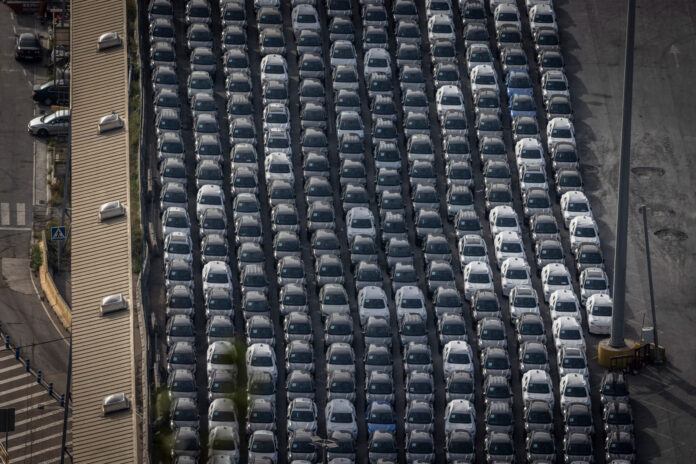
Top photo: Newly-manufactured automobiles on the dockside at the port of Barcelona. Photographer: Angel Garcia/Bloomberg.
Copyright 2026 Bloomberg.

