

British entrepreneurship appears to be on the rise, with tens of thousands of new businesses popping up. The problem, for workers, is that these startups are increasingly using artificial intelligence and freelancers instead of taking on permanent staff.
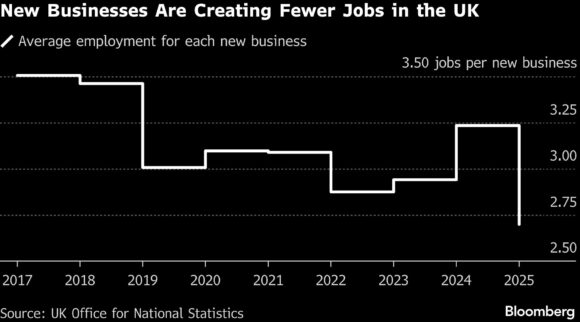
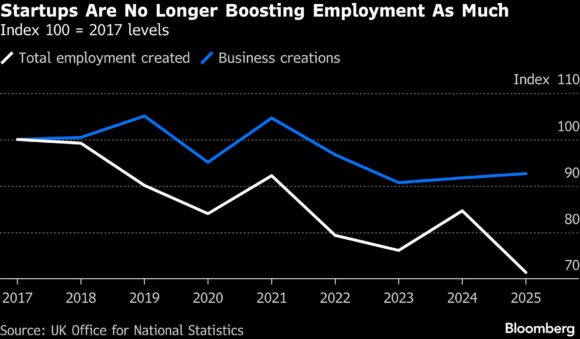
New firms launched in the UK last year generated an average of 2.7 jobs each, around one fewer than when records began in 2017, according to a Bloomberg analysis of official data. Total employment created by new enterprises fell 16% to the lowest level on record.
That’s despite Britons starting new firms at the fastest pace in two years, during the fourth quarter.
“It’s scary to hire people, the minimum wage is so high and there’s so many additional protections,” said Rachael Twumasi-Corson, an entrepreneur from London who’s set to launch a new company later this year. “I would much rather have a team, celebrate wins and figure out ways to solve problems together, but at the moment, my team is ChatGPT and Gemini.”
Business groups say the UK’s Labour government has made it more risky and expensive to hire permanent staff, despite the left-leaning party promising to prioritize economic growth. Chancellor of the Exchequer Rachel Reeves hiked national insurance, a key payroll tax, last year — and while small businesses are largely exempt, they face higher costs from rising salaries, including sharp increases in the minimum wage.
Entrepreneurs are also concerned about new employment laws, which allow workers to claim unfair dismissal after six months on the job, instead of the current two years, effectively making it harder to fire staff. The proposals will also give workers sick pay rights from day one.
AI technology means that some founders can avoid hiring in the first place. Twumasi-Corson initially wanted to employ a designer and a social media marketing specialist — she even wrote the job descriptions — but ended up relying on contractors and AI chatbots because of the costs. The London Living Wage, an optional rate the entrepreneur cited as a benchmark, has reached £14.80 ($20) per hour in 2025-2026, a 36% increase over the last five years.
That approach is common among new startups, according to Timothy Barnes, CEO at the Centre for Entrepreneurs. Founders are starting out with just a small team of specialists, while using AI to reduce the number of people needed to support each specialist, particularly in roles like business development, accounting or marketing. There’s also less appetite for human coders in new tech businesses as AI fills the gap.
“Before, the mindset might have been: we’ve got this idea and we’re going to quickly recruit as many people as possible to pursue it,” Eamonn Ives, research director at the Entrepreneurs Network, said. “Now startups are thinking twice about taking on new hires who they might not be able to keep on if things don’t pan out.”
One in four founders have made fewer administrative hires, and 19% recruited fewer juniors in response to AI technological advancements, according to a survey conducted by the Entrepreneurs Network in November. Only 2% said they increased headcount.
Labour’s Employment Rights Act includes stricter rules on unfair dismissal, the biggest worry for startups. A large company can deal with one bad hire in a way that a new company with five employees can’t.
“When I started my first company, as an 18-year-old in university halls, my first thought wasn’t, ‘well, how do I make sure I can provide maternity pay and sick pay’ — and I’m speaking as a mum of four,” said Twumasi-Corson, who launched her first venture with two employees. “You simply cannot treat a startup the same way that you treat a large corporation, and I think that’s the biggest mistake of the Employment Rights Bill.”
David Bharier, head of research at the British Chambers of Commerce, said “newer firms are starting out leaner, more automated, and less labor-intensive.”
It’s an early sign that the natural rate of unemployment, known as NAIRU — the point at which the labor market no longer bears on inflation — may be edging up. The Bank of England is keeping a close eye on structural changes in the labor market, with Chief Economist Huw Pill warning of a rise in NAIRU. Unemployment across the UK economy is close to a five-year high.
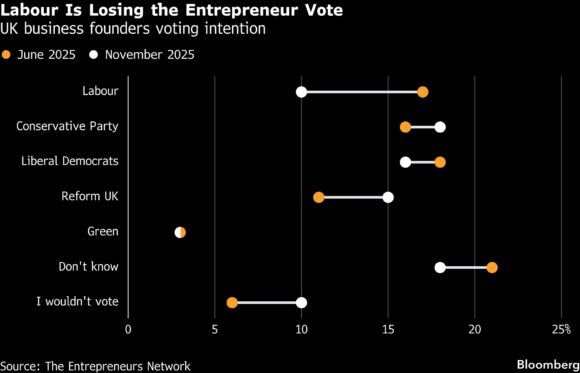
Labour’s tougher employment laws and tax hikes risk losing the votes of entrepreneurs. In June 2025, it was among the top parties backed by founders, within touching distance of the Liberal Democrats on about 17%. By November, support for Labour had fallen to 10%, placing it near the bottom of the list — above only the more left-wing Greens. Support for Nigel Farage’s populist Reform party increased the most, climbing four points to 15% over that period.
“I’ve been a Labour voter in the past and now I’m on the fence,” Twumasi-Corson said. “They seem out of touch with business.”
Photograph: Commuters cross London Bridge in the City of London, UK, on Monday, Feb. 16, 2026. Photo credit: Jose Sarmento Matos/Bloomberg
Copyright 2026 Bloomberg.
Topics
InsurTech
Data Driven
Artificial Intelligence

