
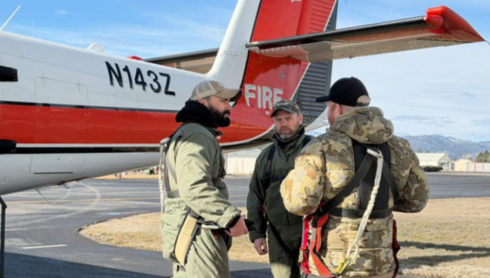
VIDEO/PHOTOS: Pick your favorite theme song and imagine it hits the loudspeakers. You suit up, load up and head out to the plane. After a 20-minute flight you are briefed about the jump spot and the fire behavior.
A tap on the back tells you to hone your focus and remember every day of training you’ve had as you free fall into the atmosphere. Five seconds, a tug and tranquility follows the rush of adrenaline when your parachute deploys.
This is smokejumping, a silhouetted parachutist against the smoke-hazed horizon. But one of the most important smokejumpers doesn’t even jump from the plane. This spring, smokejumpers from all nine Forest Service and Department of the Interior bases came together in Missoula to train new spotters.
A spotter is a highly experienced smokejumper responsible for coordination and picking the spot to make the jump. They may not be the first person you think of in wildland fire, but they are critical mission leaders in the aircraft.
“A spotter talks to dispatch, talks to air attack, coordinates with pilots, talks to ground resources, all those things, and then gets to the fire and selects a jump spot,” said Jake Besmer, training manager and smokejumper spotter at Missoula Smokejumper Base.
“They coordinate the whole mission, taking a low pass to make sure the ground is safe to land in, using streamers to indicate wind and determine a safe place to put the jumpers out.” Over 10 days, the Missoula Smokejumper Base hosted the National Smokejumper Spotter Academy.
Smokejumpers worked with counterparts from the Department of the Interior and spent an estimated 50 hours of flight time with multiple flights each day, plus additional classroom time and simulations, all to train for every possible scenario.

