
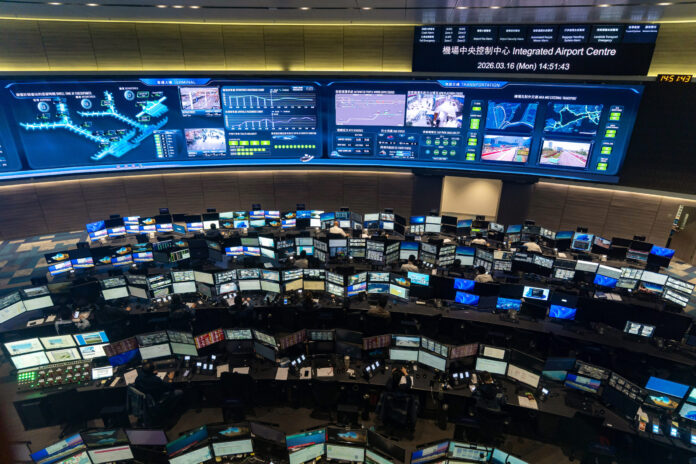
Inside a mock control tower next to Hong Kong International Airport, a virtual near-miss plays out on multi-panel screens.
A passenger jet descends in the computer-generated sky, seconds away from landing when suddenly, a barely visible object trundles along the edge of the runway and onto the aircraft’s path.
The simulation bears an uncanny and coincidental resemblance to a tragedy that unfolded at New York City’s LaGuardia Airport, where an Air Canada Express jet with 76 people on board smashed into a fire truck shortly after landing on March 22. The force of that crash obliterated the cockpit, killing the two pilots and demolishing the emergency services vehicle trying to cross the runway.
On the virtual runway in Hong Kong, well before the trajectories of the passenger jet and ground object intersect, artificial intelligence steps in.
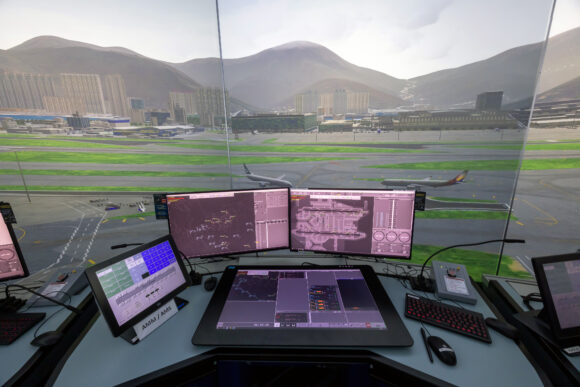
A computerized interface instantly identifies and tags the aircraft with its flight number and marks the unexpected object on the tarmac as an airport vehicle, flashing a warning to a human controller. The simulation is part of a training program for an AI-powered system actively deployed at Hong Kong’s airport. Combining advanced software with data from hardware inputs like high-resolution cameras, it’s designed to prevent incidents like the fatal collision in New York.
“Imagine how difficult it is for someone to spot a vehicle on the runway,” said Wesley Yung, chief air traffic control officer at Hong Kong’s Civil Aviation Department, as he points out the moving objects on the screen. “You may not be able to see it, but the system will tell you: Don’t land anyone there.”
The disaster at LaGuardia, the third major commercial aviation accident in the U.S. in 15 months, has exposed the shortcomings of an industry under tremendous strain.
The aviation business has lurched from one crisis to the next over the past few years, from the pandemic and mangled supply chains to a new war in the Persian Gulf that has upended air travel. At one end of the spectrum, plane makers can’t produce enough aircraft to replace aging fleets.
At the other, a shortage of air-traffic controllers, experienced airport staff and well-trained flight crews has stretched the air travel industry and the ecosystem supporting it to their limits. Meanwhile, passenger demand for flights globally is expected to more than double by 2050.
Implementing AI to help keep track of all that air traffic may become critical.
The neural network deployed in Hong Kong can’t completely eliminate the chance of an accident. The software isn’t omniscient, hardware can fail and humans are still in the loop. Air traffic controllers still must ultimately determine whether a plane is cleared to land or take off.
But airport officials say the system’s key strength is its ability to process enormous volumes of information — multiple flights and moving vehicles — that could easily overwhelm a human in a situation where there are multiple other variables such as fatigue and weather.
Nuanced Picture
While AI-related job losses have attracted much attention — such as fintech firm Block and software developer Atlassian Corp. — it’s a more nuanced picture in aviation, where AI is helping alleviate severe staffing shortages and reduce human error.
And just like in health care, where AI screening can increase levels of cancer detection while reducing the workload on radiologists, or at public swimming pools where AI lifeguards can spot drowning swimmers faster than the human eye misses, the technology has life-saving, and game-changing, potential.
At LaGuardia, air crews and controllers consistently faced a late-evening rush to clear planes from the busy New York City airport. On the night of the recent crash, the two air traffic controllers on duty were grappling with a higher-than-anticipated workload, complicated by foul weather.
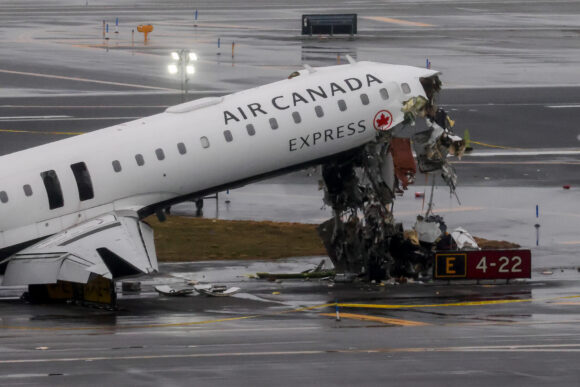
Initial investigations into the incident by the National Transportation Safety Board show a system designed to warn air-traffic controllers of a potential collision failed. One reason: The NTSB said the fire truck on the tarmac had no Automatic Dependent Surveillance–Broadcast, or ADS-B, transponder to broadcast its location. In the U.S., predictive safety technologies are used in control towers, but unlike in Hong Kong those aren’t AI-based, according to the Federal Aviation Administration.
“A digital solution that has cameras and AI to monitor runway incursions and provide information to ATC and augments situational awareness could have helped” prevent that type of accident, said Michael McCormick, an air traffic specialist at Embry-Riddle Aeronautical University in Florida and former FAA official. “If you had a digital solution that tracked the vehicle irrespective of ADS-B status, it may have given the controller more information.”
McCormick said that in the future, these systems may also provide pilots with greater awareness of potential runway obstructions as yet another way to avoid bad outcomes.
“AI monitoring systems are a key first step until there’s a solution that integrates the technology in the cockpits of aircraft,” he said.
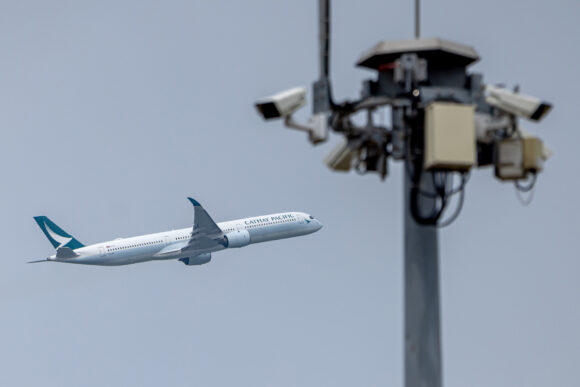
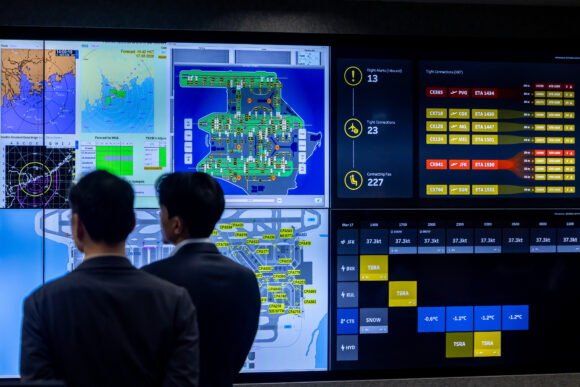
Hong Kong’s air traffic control system uses a multi-layered approach incorporating data from cameras, flight plans, radar and satellites plugged into algorithms to provide constant surveillance under all weather conditions. The territory’s Civil Aviation Department boasts it’s one of the world’s most sophisticated systems in operation that’s jointly used by HKIA’s operator Airport Authority Hong Kong. Searidge Technologies Inc., a unit of partly UK government-owned air traffic control service provider NATS, said it supplied the proprietary AI platform that sends alerts based on real-time analysis.
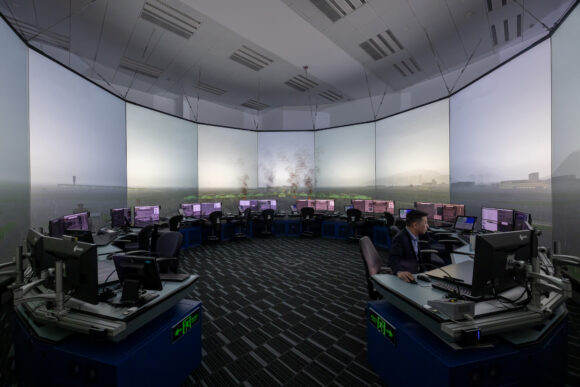
The airport’s training simulator consists of 12 vast screens enveloping a room that can project almost any scenario in most weather conditions. In an extreme example shown to a visiting Bloomberg News reporter, a staffer generated an imaginary scene of maximum risk to demonstrate the system’s capabilities.
One virtual plane was ablaze on the runway and another was about to land on top of it. Two more computer-generated jets closer to the terminal were also burning, and plumes of smoke climbed into a foggy sky, impeding visibility.
The goal isn’t just to better respond to crises. AI and automation have emerged as key tools to help controllers manage growing volumes of normal landings and takeoffs without increasing risk. Hong Kong has the world’s fifth-busiest airport for international traffic, according to aviation data firm OAG.
In the Loop
Humans are still required in sensitive areas such as the cockpit for both ethical and safety reasons. Flight crews have campaigned against plans to operate services with just one pilot, even as flying becomes more automated.
Pilots argue that a lone person at the controls could be overwhelmed in an emergency, and that computers aren’t failsafe — even those driven by AI. After all, at least 50% of all generative AI projects fail due to poor data, inadequate controls, rising costs or unclear benefits, researcher Gartner said in January.
“You need the human component there,” said Mike Nakornkhet, San Francisco International Airport’s chief executive officer. “We need to introduce technology, to introduce AI, to find a way to assist a role a controller may have.”
An International Civil Aviation Organization working paper last year warned of the possible risks associated with integrating AI into commercial operations. Advanced automation, the paper said, can lead to “over-reliance on systems and lack of attention in emergency situations.”
The risk of AI becoming so good at certain tasks that humans lose key skill sets has been warned about in sectors like health care, where the use of cancer-detecting AI technology has stoked fears of human doctors becoming unable to diagnose problems without it.
But ICAO, which sets the standards for global aviation, said in the working paper it also recognizes the benefits of AI in a range of areas including air-traffic management, plane maintenance and safety.
“Technology would lessen the risk without a doubt,” Torbjorn Karlsson, senior client partner at Korn Ferry and a former aviation executive, said citing the aviation industry’s know-how to apply technology and improve safety. “AI, it could be a step change, as a solution to our problems.”
Older airports with legacy systems often have more difficulty adopting cutting-edge technologies. And in the U.S., airport functions are split up among the FAA, facility administrators and individual airlines, so there’s no single authority to easily push through complex, costly or controversial makeovers.
That contrasts with countries such as China, which has newer airports, bigger infrastructure budgets and more centralized control over aviation operations.
“In much of Asia, especially China, technology in aviation is treated as an instrument of state capacity and national competitiveness, whereas in many Western markets it is treated as one policy priority among many, competing for funding, regulatory approval and political attention,” said Linus Benjamin Bauer, founder of aviation advisory firm BAA & Partners.
The FAA, which is responsible for air traffic control in the U.S., has long struggled to obtain funding needed for system upgrades.
Washington lawmakers allocated $12.5 billion last year to carry out an air traffic control modernization project, including upgrading air field telecommunications systems by replacing old copper wire with modern fiber-optic cables. U.S. Transportation Secretary Sean Duffy said about 30% of the lines have been replaced, but $20 billion more is still needed for the overhaul.
AI Efficiencies
Beyond safety, airlines are increasingly using AI to squeeze out greater efficiencies. Take Hong Kong-based Cathay Pacific Airways Ltd. It developed an AI program that was first deployed in 2025 when Super Typhoon Ragasa barreled into southern China late last year.
That disruption management system crunches millions of options to redeploy its fleet and figure out which aircraft and passengers to prioritize.
It takes into account things like airport curfews, passenger compensation and hotel accommodation costs, available crew and delays to freight, and like most AI tools, it gets smarter each time it’s used.
In the past, that meant filling a room with more than 20 engineers, operations technicians and customer service specialists, where they would spend a minimum of 10 hours to plot out the airline’s initial recovery plan, according to the airline. But with AI, the airline can accomplish the same with little more than half a dozen people and a digital screen in about 90 minutes.
In Europe, Ryanair Holdings Plc and Wizz Air Holdings Plc are among carriers that have been embracing AI for efficiency gains.
And while AI is being deployed for things like route optimization, chatbots and air traffic management, adoption has a long way to go, according to Kim Macaulay, chief information and data officer at the International Air Transport Association.
“We are seeing it scale, but it’s not scaling as quickly as we would hope,” Macaulay said. “It’s heavily costly.”
But as the recent tragedy at LaGuardia has shown, companies and authorities should prioritize AI deployments toward enhancing aviation safety, according to Yung, the chief traffic controller in Hong Kong.
“It gives us all a kind of safety net,” said Yung, a three-decade veteran who credits AI for making flying safer. “Safety has been much enhanced using this technology. Multiple layers of safety net can really help to reduce accidents and incidents.”
Top photo: Control room of Integrated Airport Centre at Hong Kong International Airport. Photographer: Anthony Kwan/Bloomberg.
Copyright 2026 Bloomberg.

