
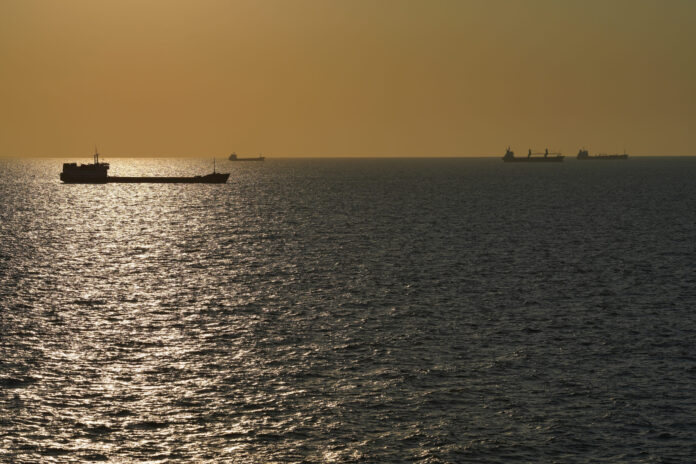
Commercial traffic through the Strait of Hormuz is at a virtual standstill on Monday after a brief and confused reopening over the weekend ended with the first US seizure of an Iranian vessel — underscoring just how difficult it will be to restore activity in the vital strait.
Transits through the waterway have reduced to a trickle over seven weeks of war in the Persian Gulf, as Iran tightens control in retaliation for U.S. and Israeli strikes. On Friday, that paralysis appeared to be at an end as Iran and the U.S. announced a reopening, prompting oil to plunge and vessels to rush for the crossing — only for the situation to rapidly unravel.
By Sunday, the U.S. navy had seized an Iranian cargo ship in waters off the Iranian port of Jask in the Gulf of Oman as it headed toward Hormuz — the first such move during this US blockade — raising the stakes for shipowners operating across the region and widening the area seen to be risky for transits. Benchmark oil has jumped in response, as a historic supply crisis begins to look even more prolonged.
Related: Secret Codes and Yuan Fees Get Ships Through Iran’s Hormuz Tollbooth
“The continued volatility will deter most, if not all shipowners, to adopt a cautious ‘wait and see’ approach,” said Ivan Mathews, head of APAC analysis at Vortexa Ltd.
One oil products tanker on the move, the Nova Crest, currently just south of the island of Larak and heading out of Hormuz into the Gulf of Oman, is a vessel that has been sanctioned by the U.K., the European Union and Switzerland over its involvement in the Russian oil trade. It is signaling its destination as Khor Fakkan in the United Arab Emirates.
Sailing in the opposite direction is Axon I, a U.S.-sanctioned liquefied petroleum gas carrier making its way into the strait from Fujairah, indicating Sharjah in the UAE as a destination. Next to it is a medium-range oil tanker, Starway, which is signaling the UAE’s Hamriyah as its next port of call.
Liquefied natural gas tankers had also approached the strait in the wake of the apparent opening, but ultimately also U-turned or are idling while waiting for clarity.
A fragile U.S.—Iran ceasefire is due to expire at the end of Tuesday. It is unclear whether that truce will be extended, or whether talks between U.S. and Iranian officials in Islamabad will go ahead later this week.
Top photo: Transits through the waterway have reduced to a trickle over seven weeks of war in the Persian Gulf. Photographer: Andreea Campeanu/Getty Images. Bloomberg.
Copyright 2026 Bloomberg.

Want to stay up to date?
Get the latest insurance news
sent straight to your inbox.

