
The European Union needs to implement comprehensive regulations to manage the growing security risks posed by intelligent vehicles, particularly Chinese cars that are increasingly popular with consumers, according to a think tank.
Intelligent cars, typically electric or hybrid vehicles, allow for expansive data to be collected including geospatial and personal data, Warsaw-based Center for Eastern Studies said. That leaves European countries vulnerable to cyberattack and exposed to the risk that information collected by cars can unintentionally reveal sensitive military and economic activities, it said.
“The need to put intelligent vehicles on a clear regulatory footing in Europe is becoming urgent, not least because the number of Chinese-made cars on the EU market is rising sharply,” said the group, which is known as OSW.
Still, the Center argued that China itself offers a “useful starting point” for Europe to build a legal framework to target cybersecurity and data risks. Chinese authorities require carmakers to obtain a data security certification, set out how information should be stored and handled, and has periodically banned Tesla Inc. from sensitive areas, it said.
Across the world, concerns about so-called spy cars are growing as more and more consumers buy vehicles equipped with advanced-driver assistance systems. While the technology is innocuous — it helps with speed control and parking in tight spaces — the cars’ sensors and high-definition cameras are constantly capturing real-time information about its location and surroundings.
Connected cars can collect as much as 1.4 terabytes of data per hour, according to industry estimates, the equivalent of more than 250 movies. Typically much of this data gets overwritten frequently due to the limited amount of storage on the vehicles, but some information can be sent to cloud-based servers.
China’s dominance of the new-energy vehicle market and the broad deterioration in its diplomatic ties with Europe and the US have made its cars the focal point for worries about what happens to that information. In December alone, Chinese automakers built nearly one in 10 passenger cars sold in Europe.
Some countries are already taking steps to curb security risks posed by smart cars. Poland may ban Chinese-made cars from entering military facilities to protect its security and the US has effectively banned personal smart cars from China and Russia.
Meanwhile, the Telegraph has reported that the UK government is concerned that EVs pose a potential national security threat and the German publication Handelsblatt said that officials have also warned of risks posed by digitally networked cars from China.
The EU currently lacks bloc-wide regulations, though a cybersecurity risk assessment of connected cars by the European Commission and the EU Data Act single out vehicles as a core category of connected products, OSW said.
But the surging popularity of EVs adds to the urgency of developing more comprehensive rules and OSW called for a “coalition of willing countries” should an EU-wide agreement be out of reach.
“The optimal response would be for the EU to introduce rules requiring car manufacturers to obtain additional security certification – with particular scrutiny being placed on manufacturers from third countries,” it said.
— Colum Murphy, Linda Lew, Maciej Martewicz.
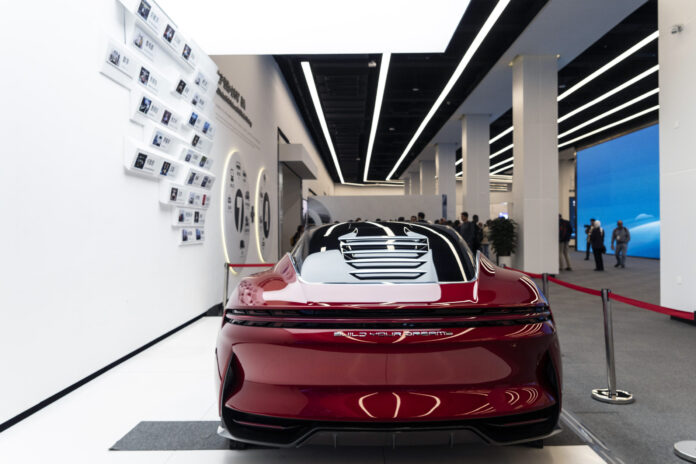
Photograph: A BYD Co. Han electric sedan in an exhibition area at the company’s headquarters in Shenzhen, China, on Monday, Jan. 15, 2024. Photo credit: Qilai Shen/Bloomberg
Copyright 2026 Bloomberg.
Topics
Cyber
Auto
Europe
China
Interested in Auto?
Get automatic alerts for this topic.

