
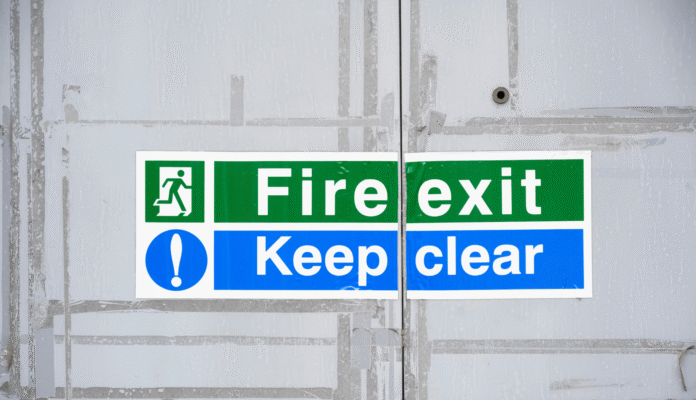
Fire door compliance is under greater scrutiny than ever, and expectations placed on duty holders continue to rise. Regulatory changes have sharpened the focus on accountability, while residents, stakeholders, and enforcement bodies increasingly expect clear evidence that fire safety measures are not only in place, but actively managed.
In this environment, a fragmented approach to fire door compliance is becoming harder to justify. Engaging separate providers for inspections, repairs, and installations often leads to delays, inconsistencies, and gaps in accountability. As a result, many organisations are rethinking how fire protection is delivered, moving towards a more joined-up, end-to-end model.
Defining an end-to-end approach
End-to-end fire protection brings together each stage of compliance into a single, coordinated process. Rather than treating inspections and remedial works as isolated activities, it connects them into a continuous cycle of assessment, action, and ongoing management.
A structured end-to-end model typically includes:
- Consultancy and planning to interpret regulatory requirements and assess building-specific risks
- Fire door inspections carried out by qualified professionals, supported by clear and consistent reporting
- Remedial works to address defects efficiently and in line with best practice
- Installation of certified fire doorsets where replacement is required
- Ongoing maintenance and monitoring, supported by accurate record-keeping and regular reviews
This approach ensures that issues identified during inspections are not left unresolved or passed between contractors. Instead, they are managed within a single framework, where responsibility is clear and progress is visible.
The risks of disconnected service delivery
When fire door compliance is handled across multiple providers, the challenges are often practical rather than theoretical. Recommendations may be interpreted differently, timelines can slip, and documentation may not align across contractors.
Over time, this can create:
- Incomplete or inconsistent audit trails
- Delays between identifying and resolving issues
- Reduced confidence during inspections or regulatory reviews
An end-to-end model addresses these challenges by creating continuity. The same organisation (or aligned group) oversees the process from initial assessment through to completion, reducing the likelihood of miscommunication or oversight.
The importance of visibility and data
Another defining feature of modern fire door compliance is the shift towards live data and digital oversight. Static reports, while still necessary, are no longer sufficient on their own. Organisations need to understand the status of their fire doors at any given time, particularly across large or complex estates.
With the right systems in place, duty holders can:
- Monitor the condition of fire doors across multiple sites
- Track outstanding actions and completed works
- Prioritise issues based on risk
- Access clear records for audits or regulatory inspections
This level of visibility supports better decision-making and reduces reliance on reactive processes.
Delivering at scale: the role of strategic growth
Providing a truly end-to-end service requires both breadth and depth of capability, alongside the infrastructure to deliver consistently across different regions and property types. Without that foundation, even well-intentioned compliance strategies can struggle to translate into consistent, high-quality delivery on the ground.
The merger between Total Fire Group and Ranger Fire and Security reflects this shift in the market. By bringing together expertise in consultancy, inspections, maintenance, and installation, the combined organisation is better positioned to support clients throughout the entire fire door compliance journey. As part of Ranger Fire and Security, we work alongside a growing group of industry experts who all function under the same company umbrella. This expanded capability enables a more consistent approach nationwide, ensuring that standards are maintained regardless of location. It also allows for a more integrated model of delivery, where the transition from inspection to remedial action is handled without unnecessary delay. With a single provider accountable for outcomes, responsibility is clearer, and coordination becomes more effective, particularly across complex or multi-site portfolios.
For clients, the result is a more straightforward process. Fewer handovers reduce the risk of miscommunication, lines of responsibility are easier to follow, and the path from identifying issues to resolving them becomes more reliable and easier to manage.
A more continuous model of compliance
The direction of travel is clear. Fire door compliance is no longer centred on periodic inspections alone, it is an ongoing process that requires active management and clear evidence at every stage.
An end-to-end approach supports this by linking each element of fire protection into a single, accountable framework. It allows organisations to move beyond reactive fixes and towards a more structured, consistent model of compliance.
As expectations continue to rise, the ability to demonstrate not just compliance, but control, will become increasingly important. End-to-end fire protection offers a practical way to achieve this, particularly when delivered by providers with the scale and capability to support clients nationwide.
For more information on how we can help your organisation, don’t hesitate to get in touch.

