
Ryan Stanton
mlive.com
(TNS)
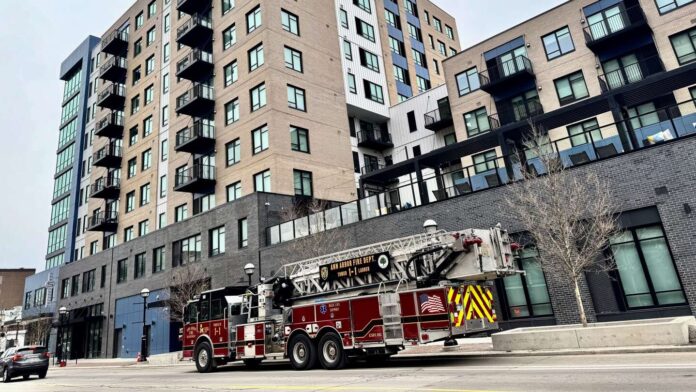
ANN ARBOR, MI — When the 19-story Legacy high-rise opened behind the Michigan Theater last August, it welcomed hundreds of University of Michigan students.
It also increased the workload of the Ann Arbor Fire Department, which has had to respond to dozens of calls there, including a number of false alarms requiring tenants to evacuate the building or go down to the lobby.
From Aug. 1 to Feb. 1, the fire department responded to 48 calls for service to the new apartment building at 616 E. Washington St., Fire Chief Mike Kennedy said.
| MORE: A practical blueprint for leading successful fire department change
That included two cooking fires, three emergency medical incidents, five cases of people trapped in elevators, one instance of carbon monoxide detection and five general assistance calls or cases where no incident was found. There also were 32 other calls for alarms going off due to malfunctions, drywall dust or other unintentional alarm activation, Kennedy said.
“That’s a building that we’re currently having a lot of challenges with,” he said. “And it’s not uncommon for new buildings for there to be some gremlins there, but we still have to respond out and make sure everything’s fine.”
A majority of the unintentional alarm activations were from cooking smoke and some were from people smoking in the building, according to representatives for The Legacy who say they’re working to address the issues.
In the same timeframe, the fire department responded to 27 calls for service at the new 13-story Verve high-rise, which opened Aug. 7 on Forest Avenue. That included nine emergency medical incidents, one carbon monoxide detection, three cases of people trapped in elevators, seven other service calls and seven other alarms where no fire or smoke was found.
Kennedy cites those numbers to show as Ann Arbor is growing denser with more high-rises, and several more coming in the next couple years, it pulls on fire department resources.
“We are in high-rises all day, every day, for medicals, elevator emergencies, careless cooks,” he said.
“And it’d be one thing if the city just had like one that went up — well, we could absorb that. It’s just this density is really starting to catch up.”
The chief told City Council in a budget presentation two years ago the city will need to think about eventually adding a dedicated high-rise unit to the downtown fire station with 12 additional firefighters, four per shift.
He estimates just the extra staffing is going to cost about $1.2 million annually, and the unit would need a specialized fire engine with additional pump capacity and other equipment.
City Council adopts the annual budget in May, following recommendations by the city administrator in April.
City Administrator Milton Dohoney said the fire chief’s idea is still in the analysis phase. City service areas have not yet presented their budget requests to him, so he can’t say whether it will be considered this spring, he said.
“That aside, I do believe that as we densify, and if that densification is vertical in nature, we will need to be prepared for serving the community both from a medical response and fire suppression perspective,” Dohoney said. “Exactly what that looks like will need to be thought through.”
As Ann Arbor has grown denser, it has seen a reduction in fire department staffing, Kennedy noted.
In the late 1990s, the fire department had 115 firefighters. As of 2011, it was down to 89.
The fire department now has 88 budgeted full-time equivalent positions, counting five in administration, four in fire prevention, two in emergency management, one handling emergency medical services, one in training with two recruits and one in logistics.
Kennedy said the department has 72 firefighters assigned to daily operations, three shifts of 24, but usually it’s down to a minimum of 18 per shift due to employee time off.
There’s been growth across the city, but especially downtown the vertical growth is a challenge, Kennedy said. Fighting a fire on a 10th floor is much different than in a single-family home, he said.
“We obviously need people and equipment for both, but that reflex time to get to those upper stories is much more staffing dependent,” he said.
Kennedy said he didn’t have exact figures for how many fires there have been in downtown high-rises in recent years, but there’s usually about one or two serious ones per year where firefighters have to go inside and hook up hoses to standpipe systems in stair towers to fight them. Some smaller kitchen fires can be put out with fire extinguishers, he said.
Fortunately, a lot of the times with modern building systems, the fire department receives quick notifications, and sprinkler systems help control fires, Kennedy said. Even so, firefighters are spending a lot of time making sure fires are out and shutting off sprinklers to prevent water damage, and they’re time-intensive calls that can tie up crews for a couple hours, he said.
That makes crews not available for other calls, requiring other units from across the city to respond to stacked calls downtown more frequently, pulling them away from their stations and neighborhoods, Kennedy said.
“It creates gaps in coverage across the city and then longer response times to those outward parts of the city,” he said.
Kennedy said he understands there’s a lot of competing priorities for city dollars, but with all the growth the city is seeing there’s a real need for an additional firefighting team that could handle high-rises and other calls.
“There’d be some other tools and equipment on there that would be more in line with dealing with high-rise emergencies,” he said. “But I want to be super clear, that unit would be part of our overall operations, so if there was an apartment fire on the west side, we would still be able to use the firefighters on that, and that would help out with our overall on-duty staffing.”
Ann Arbor’s tallest building, the 26-story Tower Plaza on William Street, was built in the 1960s and the fire department doesn’t have a ladder truck that can reach the top of it, Kennedy said.
“There’s not a fire department in the United States that has a ladder that could reach that,” he said. “So, that’s where it really becomes where it’s such staffing dependent, because in those situations we’re having to fight the fire from the inside.”
The city has seen over a dozen new high-rises around eight to 14 stories since the early 2000s and several newer ones being built or in the works are 15 to 20 stories. Downtown could see even taller buildings under future zoning reforms.
Firefighters usually try to take a high-rise elevator to two floors below a fire, Kennedy said.
“That’s assuming that the elevators are still functional,” he said. “Sometimes if water gets in the elevator shaft, we’ll lose the ability to even use the elevators.”
The fire department’s current ladder truck — along with a new one on order — has a 100-foot reach, but angled diagonally it often can only reach about five to seven floors up, he said.
In some cases, going up more vertically, the ladder might reach eight or nine floors, he said, and it could potentially spray up to several additional floors with a hose at the top. But often it still requires getting inside, he said, and while one crew is doing fire attack, additional crews do search and rescue.
“It really becomes a simple numbers game of how many staff we have to be able to do all these different functions concurrently,” he said, noting it also requires the right gear.
“From an equipment standpoint, we’ve really spent a tremendous amount of money, time and effort the last five years with improving our high-rise operations,” he said, saying the department was not trained or prepared enough before.
That’s been a big focus for the department and it has become one of the leading departments in Michigan when it comes to high-rise operations, Kennedy said. The department has brought in instructors from Chicago, Denver and Toronto to look at its operations and help train firefighters and make equipment recommendations, he said.
“From the training and equipment perspective, we’re really in good shape and we’re following national best practices,” he said “It’s just having the staffing available to be able to do those things.”
Any building over five stories presents an added logistical challenge for fighting fires and there are dozens of those buildings now, Kennedy said, and the challenges start to compound when getting up to 10, 15 or 20 stories.
As for the 19-story Legacy high-rise, Kennedy said the fire department is working with the building’s management to try to address the sensitivity of the fire alarm system and making suggestions like shifting locations of smoke detectors in kitchen areas to reduce the number of false alarms.
It’s a huge inconvenience for the 500-plus tenants when alarms go off for the entire building from too much smoke from cooking in one apartment, said Howard Frehsee, co-developer of The Legacy. They’ve been working with the fire alarm system manufacturer to come up with a solution to improve the ability to just alert management and the apartment where there’s an issue without getting everybody else involved, he said.
They still need to follow required regulations, and alarms will alert the entire building in case of actual fires, Frehsee said.
“Our team is all over it, because we know it’s a problem and we know that it’s a disruption,” he said of the alarm system’s sensitivity. “It’s extremely sensitive for the protection of people, but in this case it’s too sensitive.”

Officials say the NIOSH-led registry is now the nation’s largest firefighter cancer cohort, using service histories linked to state cancer data to better track risk and guide prevention

The year-long program will deploy remotely launched drones to 911 scenes to provide live video, boost responder safety and potentially deliver critical medical supplies

Wallingford firefighters faced heavy fire on the second floor of a home, pulled a dog to safety, and cleared a mayday after a firefighter rapidly exited via ladder

The FDNY says an unpermitted basement unit in a multi-family building led to a rapidly spreading blaze that killed a 34-year-old mother and her 17-day-old daughter
©2026 Advance Local Media LLC.
Visit mlive.com.
Distributed by Tribune Content Agency, LLC.

Hexagon’s next-generation platform provides faster, smarter emergency response

