
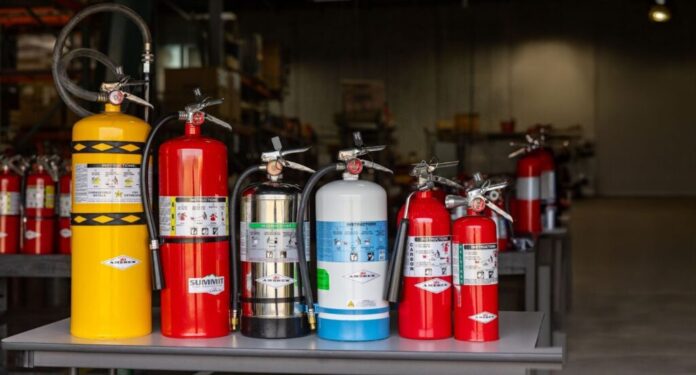
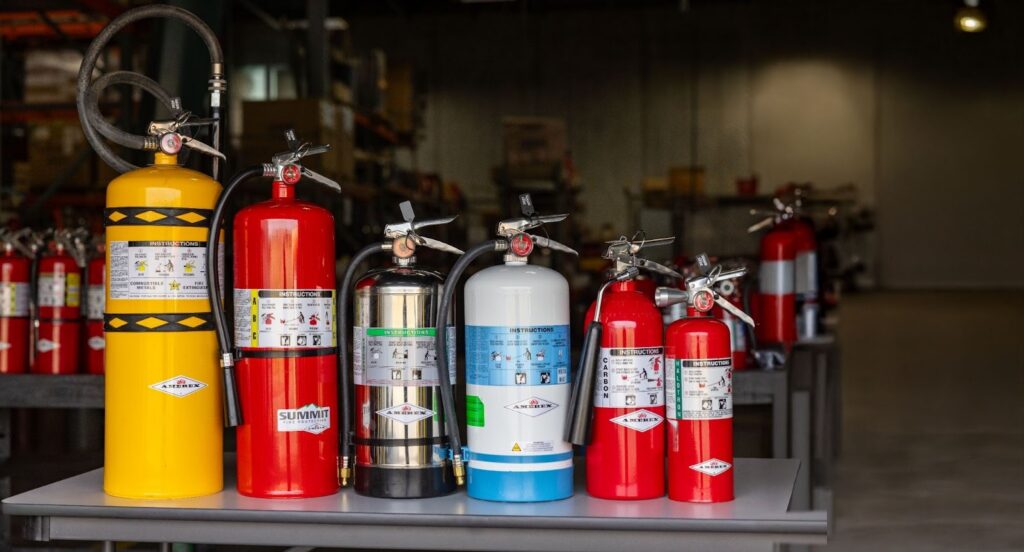
When a fire breaks out, portable fire extinguishers are often the difference between a minor incident and a major disaster. But grab the wrong one and you could make a dangerous situation even worse — because different fires require fundamentally different approaches to put them out. The type of fuel that’s burning determines what extinguishing agent will actually be effective, which means the extinguishers in your buildings need to match the fire risks specific to those environments. Understanding what types you need, and being able to identify what you already have, is a critical part of keeping your buildings and occupants safe.
In this post, we’ll look at how the National Fire Protection Association (NFPA) classifies fires and which extinguishing agents work for each. We’ll also show you how to quickly tell what kind of extinguisher you have.
Classes of Fire
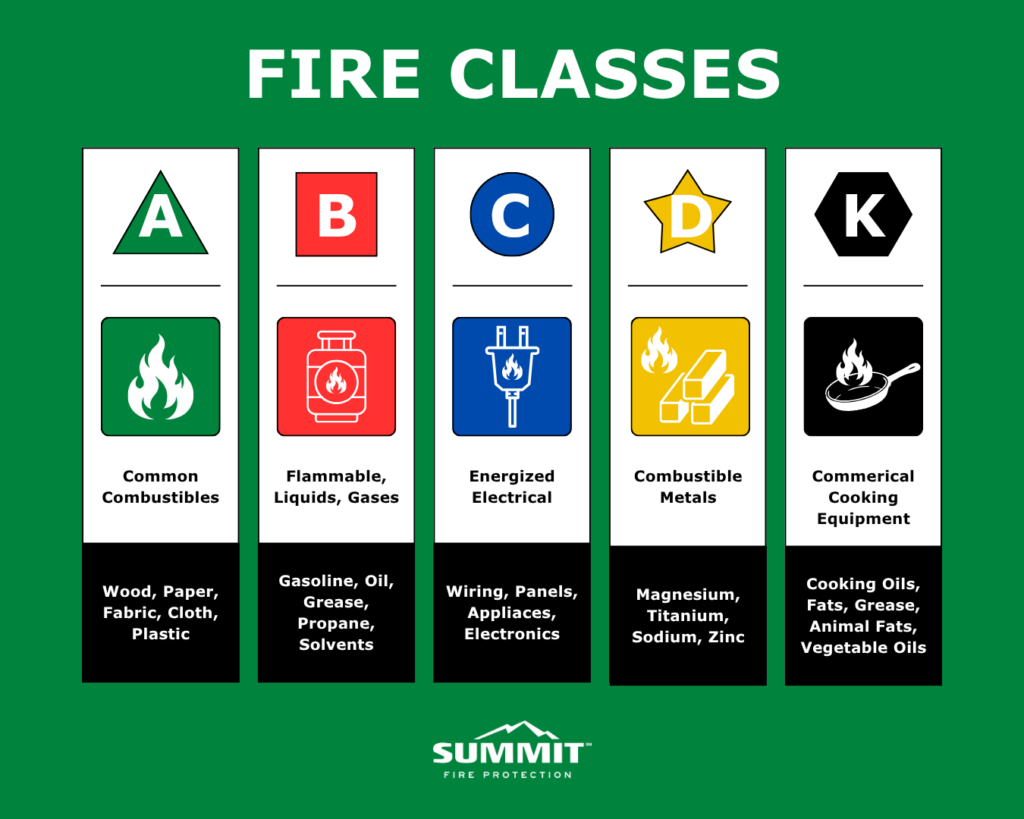
The class of a fire is determined by the type of fuel that’s burning. That’s because the fuel type dictates the best way to put the fire out.
Consider a few examples. If someone tosses a cigarette into a trash can and it ignites a pile of paper and rubbish, you could safely douse it with water. But pour water on an electrical fire and you risk a severe electrical shock. Pour water on a cooking oil fire and you’ll trigger an immediate, violent reaction that splatters hot, flaming oil in every direction. An extinguishing agent that works in one situation can make things dramatically worse in another.
Understanding fire classes isn’t just academic — it directly determines which extinguishers are required in specific areas of your property. A commercial kitchen, for example, presents very different fire hazards than a server room or a storage warehouse, and fire codes reflect that. NFPA standards specify which extinguisher types are required based on the hazards present in a given space, which is why you’ll see different extinguisher types in different areas of the same building.
The NFPA recognizes five classes of fire:
- Class A fires involve ordinary combustibles like wood, paper, cloth, and trash — the most common type of fire in everyday settings.
- Class B fires involve flammable liquids and gases, such as gasoline, oil, propane, and paint.
- Class C fires involve energized electrical equipment. Once the power is cut, the fire may be reclassified as A or B depending on what’s burning.
- Class D fires involve combustible metals such as magnesium, titanium, and sodium. These are rare outside of certain industrial and manufacturing environments.
- Class K fires involve cooking oils and fats at high temperatures — the kind of fires that occur in commercial kitchen equipment.
Now let’s take a look at the most commonly used extinguishing agents and the types of fires they’re rated for.
Dry Chemical Extinguishers
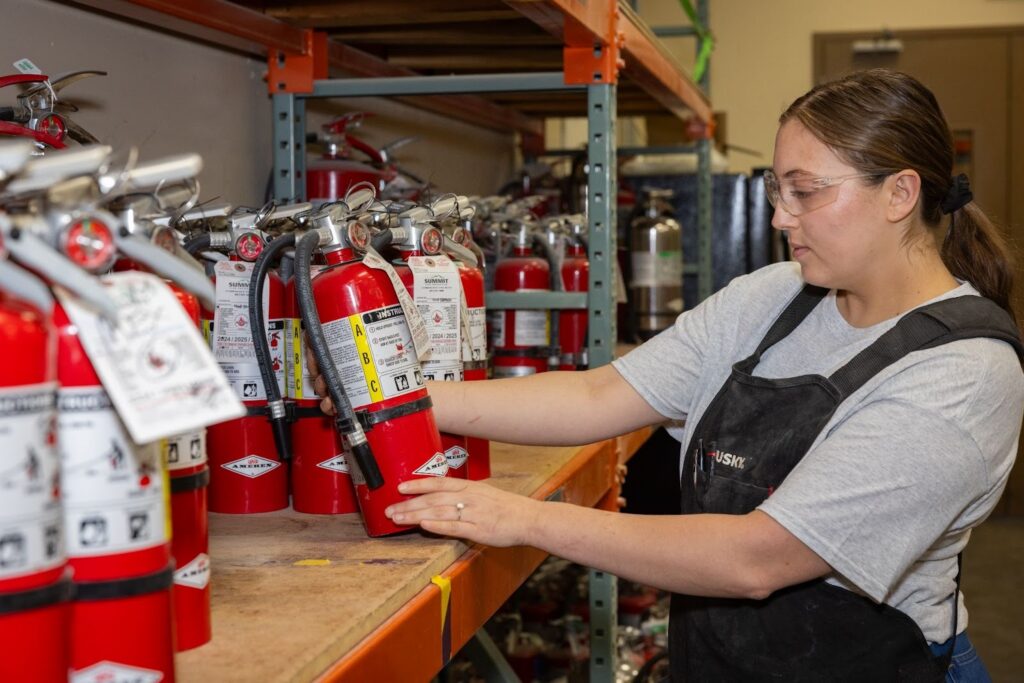
Dry chemical extinguishers are the most widely used type in commercial and multi-family residential buildings. They work by interrupting the chemical chain reaction that sustains a fire, and they come in two main varieties.
Multipurpose Dry Chemical (ABC)
Multipurpose dry chemical extinguishers are by far the most common type you’ll encounter. As the name suggests, they’re rated for Class A, B, and C fires, making them suitable for the widest range of fire scenarios. Their versatility makes them the go-to choice for general coverage throughout office spaces, warehouses, hallways, common areas, and most other commercial and residential spaces.
BC (Ordinary) Dry Chemical
BC dry chemical extinguishers are rated for Class B and C fires but not Class A. They predate the multipurpose ABC formulation and were once widely used, but they’ve become less common as multipurpose extinguishers have taken over. You may encounter them referred to as “ordinary dry chemical” in NFPA literature and fire protection documentation. Today they’re still found in some industrial settings where flammable liquid and electrical hazards are the primary concern, but for most applications the ABC variant is the more practical choice.
Carbon Dioxide (CO₂) Extinguishers
Carbon dioxide extinguishers are rated for Class B and C fires. They work by displacing the oxygen that a fire needs to sustain itself. One of their biggest advantages is that they leave no residue behind — no powder, no foam, nothing to clean up afterward. That makes them particularly well-suited for environments where cleanup would be disruptive or damaging, such as server rooms, electrical panels, laboratories, and offices with sensitive equipment.
Wet Chemical Extinguishers (Class K)
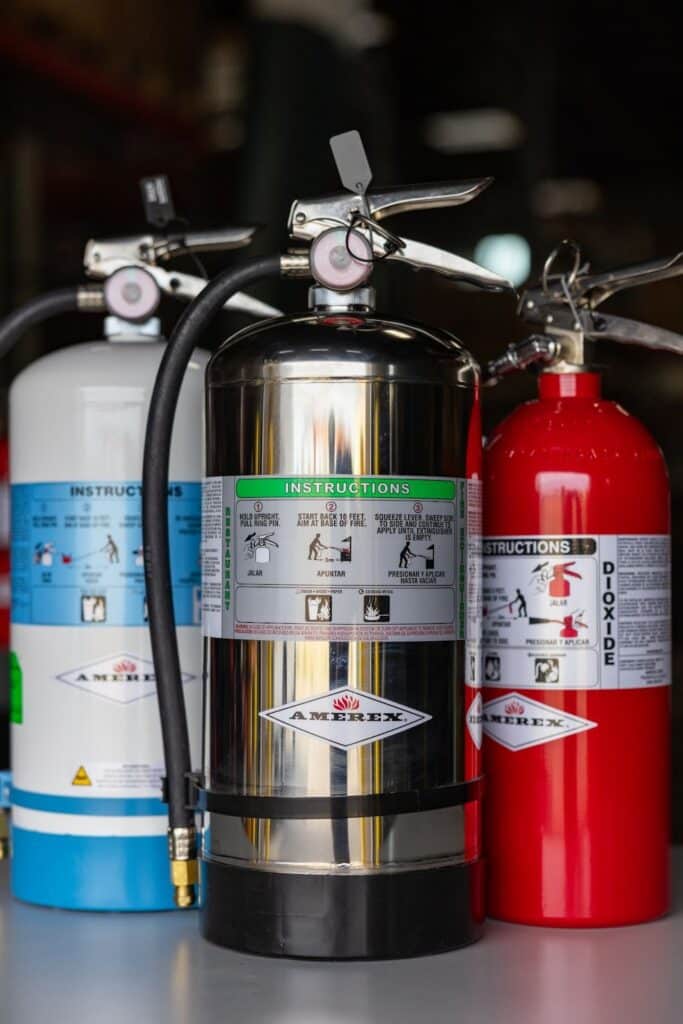
Wet chemical extinguishers are specifically engineered for Class K fires — fires involving cooking oils and fats at high temperatures. They work through a two-part process: the agent cools the burning oil while simultaneously reacting with it to form a soapy foam layer that seals the surface and prevents re-ignition.
Wet chemical is the only agent rated for Class K fires, and NFPA standards require these extinguishers in commercial kitchens wherever deep fryers and other high-temperature cooking equipment are present. If your building has a restaurant, hotel kitchen, cafeteria, or any other commercial cooking operation, wet chemical extinguishers are a code requirement, not an option.
Specialized Extinguishing Agents
The agents covered above handle the vast majority of fire scenarios in commercial and multi-family residential buildings. But there are additional types designed for more specific applications worth knowing about.
Dry Powder
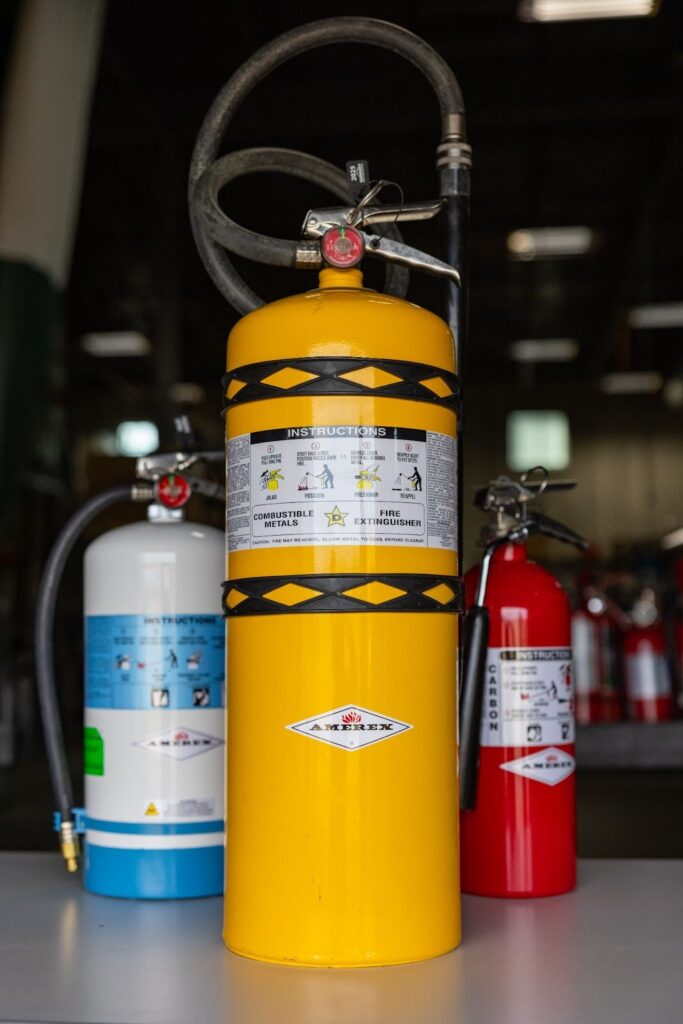
Dry powder extinguishers are designed exclusively for Class D fires involving combustible metals. They are not the same as dry chemical extinguishers, and the two terms should not be used interchangeably. Dry powder agents are formulated to smother and absorb the heat of burning metals like magnesium, titanium, and sodium. Outside of certain manufacturing, metalworking, and chemical processing environments, you’re unlikely to encounter them.
Film-Forming Foam (AFFF)
Film-forming foam extinguishers are rated for Class A and B fires. They work by forming a thin film over the surface of a burning liquid, cutting off its oxygen supply and suppressing vapors. They’re most commonly found in environments with significant flammable liquid hazards — aircraft hangars, fuel storage facilities, and certain industrial settings — rather than in typical commercial office buildings or apartment complexes.
Halogenated Agents (Clean Agents)
Halogenated or “clean agent” extinguishers work by chemically interrupting the combustion process. Like CO₂, they leave no residue, making them valuable around electronics and sensitive equipment. Modern clean agents were developed largely as replacements for Halon, which was phased out due to its ozone-depleting properties. Clean agent extinguishers and suppression systems are found in data centers, telecommunications facilities, and other environments where equipment protection is a high priority.
Water
Water is the backbone of sprinkler systems and municipal fire department operations, but water extinguishers in portable form have significant limitations. They’re only effective on Class A fires, and they can be actively dangerous on electrical and cooking oil fires. Water mist variants do exist and have some specialized applications, but for most commercial and apartment building environments, other agent types are more practical and versatile choices for portable extinguishers.
How to Tell What Kind of Extinguisher You Have
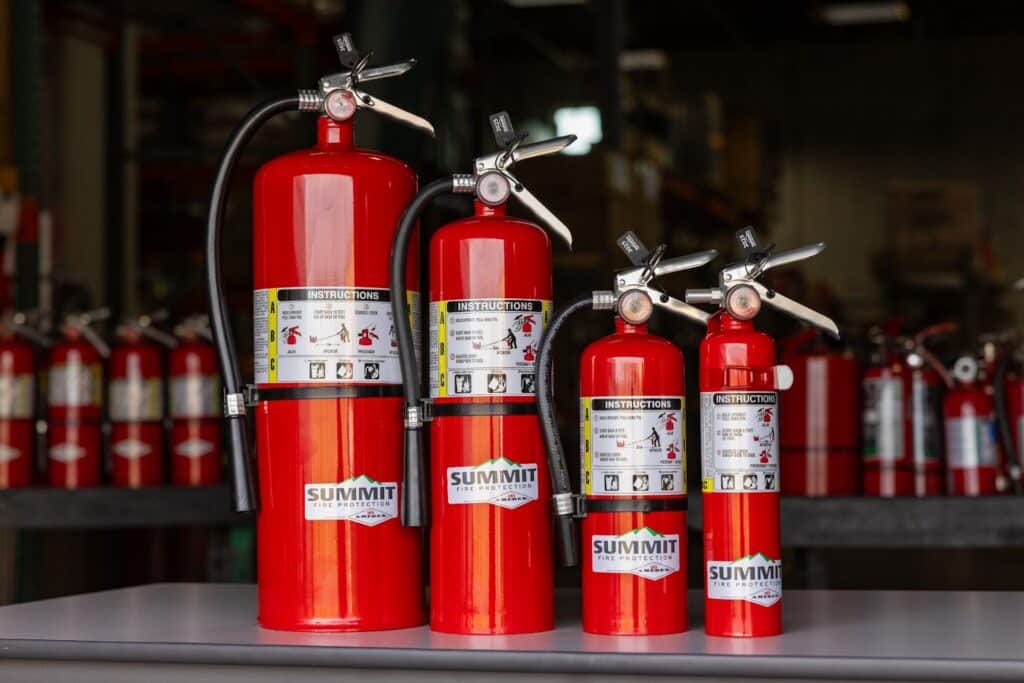
The good news is that you don’t need to memorize the physical appearance of every extinguisher type — it’s all on the label. NFPA standards require that portable fire extinguishers be clearly labeled with the classes of fire they’re rated for, using both letter designations (A, B, C, D, K) and pictograms that illustrate appropriate and inappropriate uses. The label will also identify the extinguishing agent. Any time you’re unsure about an extinguisher in your building, start with the label before anything else.
Make Sure Your Buildings Have the Right Protection
Different fires require different extinguishers, and having the wrong type in the wrong place is as much of a liability as having no extinguisher at all. The right mix of extinguisher types depends on what’s in your building — your cooking equipment, your electrical infrastructure, your storage, and your occupancy type all factor into what NFPA codes require and where.
To make sure you’re up to code and have the right extinguishers in the right locations, it’s a good idea to consult a professional. With decades of experience in fire protection for commercial and multi-family properties, Summit can help you assess your buildings and ensure you have the coverage you need.

