
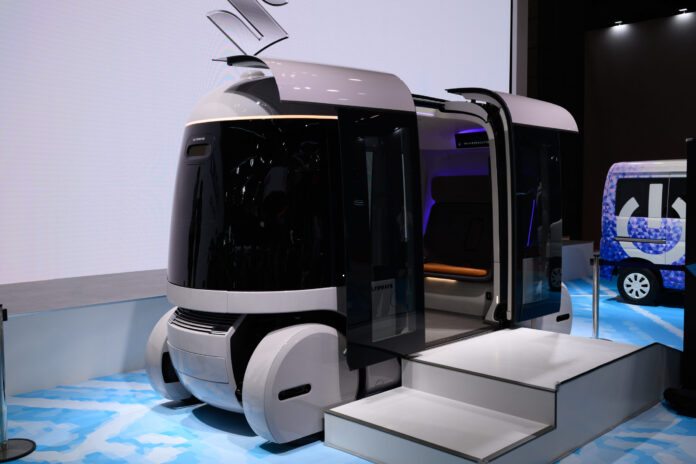
Glydways Inc., the robocar startup backed by Sam Altman, is in talks to raise an additional $250 million on the heels of a roughly $170 million Series C round, underlining the high hopes and daunting hurdles of developing closed-loop self-driving car systems.
The company, backed also by Khosla Ventures, is seeking a valuation of more than $1 billion for its next round, founder and co-Chief Executive Officer Mark Seeger said in an interview. Glydways’ capital-intensive development plans span more than 20 potential projects under negotiation globally, and it’s drawn particular interest in Japan, with new backer Obayashi Corp. joining Suzuki Motor Corp. and Mitsui Chemicals Inc. in seeking to tap a hot autonomous-driving arena.
Related: Uber to Invest up to $1.25 Billion in Rivian as Part of Robotaxi Deal
The startup is pitching a future of podlike vehicles that provide on-demand rides on dedicated two-meter-wide expressways. The vision of taxi-like service without the congestion helped Glydways to raise money at a valuation of $350 million to $400 million in 2024.
“In many markets, particularly in the Middle East and Asia, the dialogue has moved from skepticism to deployment,” Seeger said. The company’s in talks on multiple projects, with each requiring its own financing structure and presenting its own regulatory hurdles. “We keep getting more customers, which means we need to scale the business faster.”
The San Francisco-based company is one of many startups backed by Altman, a prolific investor who led incubator Y Combinator before becoming OpenAI’s CEO. Glydways broke ground this year on a public system in South Metro Atlanta, Georgia, aiming for pilot operations near Atlanta’s Hartsfield-Jackson Airport by year-end.
Projects in the Middle East are moving at an accelerated pace, Seeger said. Abu Dhabi and Dubai each signed separate agreements with Glydways to explore self-driving public transportation systems, with the latter targeting commercial operation in 2027.
Related: Nuro’s Self-Driving Car Tech Hits Tokyo Streets in First International Deployment
The ongoing military conflict in the region poses risks to those plans, however. President Donald Trump is ratcheting up threats after the US and Iran failed to reach a peace deal over the weekend.
The ensuing rising materials costs are squeezing companies in resource-poor Japan — Honda Motor Co. is expected to log its first quarterly operating loss in five years and scrapped plans to jointly develop an EV with Sony Group Corp. — and spurring investment in new infrastructure-related ventures such as Glydways. Suzuki, which has been rewarded for its early foray into India, will manufacture the startup’s cars, but the partners involved in constructing expressways and access points will vary from project to project.
“Japan, along with a small set of forward-looking partners globally, was one of the first places where the conversation clicked,” Seeger said, noting that Osaka-based used-car dealer Heiwa Auto Co.’s former CEO, Masatoshi Abe, was one of Glydways’ seed investors in 2017. “Japan has always treated infrastructure as a platform for society. That makes it more natural to think about transportation as a system, not just as vehicles.”
To oversee the many projects across the globe, the company plans to double the number of its staff of 270 over the next two years. Seeger said Glydways is focused now on readying the enormous infrastructure its vision entailed.
“That first wave of customers, that’s a lot of capital. That’s a lot of infrastructure. It’s a lot of risk to do that,” Seeger said.
Top photo: A Glydcar displayed at the Japan Mobility Show in Tokyo. Bloomberg.
Copyright 2026 Bloomberg.

Want to stay up to date?
Get the latest insurance news
sent straight to your inbox.

