
By Hannah Shields
Daily Inter Lake
BIGFORK, Mont. — Ferndale Fire Chief Shawn Devlin remembers the call coming in over the radio: Bigfork first responders dispatched to St. Patrick’s Episcopal Church for a possible cardiac arrest. Callers reported that a woman had fainted.
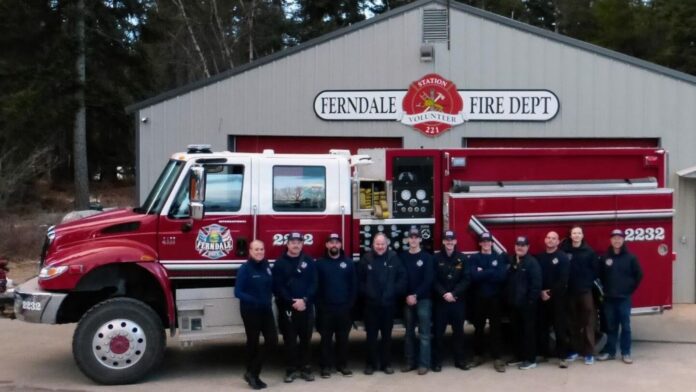
An ambulance from Station 31 at 810 Grand Drive in Bigfork arrived about five minutes later. But the church sits less than 300 feet from the Ferndale Fire Department.
| BETTER EVERY SHIFT: Captain Marc Wysocki talks mental health as operational readiness
“We had no idea until I heard it on the radio that Bigfork was being paged for a cardiac arrest at the Episcopalian church,” Devlin said last month. “We could have been there doing CPR five minutes ahead of them, could have responded in 30 seconds to that call.”
The woman died from the heart attack, he said. Devlin believes that a quicker response could have increased her chances of survival.
“[Dispatchers] were just told the woman had fainted,” he said. “It’s not something that we are dispatched for.”
Volunteers at the Ferndale Fire Department have long been frustrated by their inability to respond to medical emergencies. They were dispatched only after emergency responders paged them for help, and their services were limited to CPR, lift assists and motor vehicle accidents.
Department officials were stoked, then, when the agency finally gained status as a Quick Response Unit on Feb. 13. The designation allows the agency’s trained personnel to respond to medical calls. They could finally fill a gap in emergency services for their rural community.
“One thing that’s not really understood around here, from the community perspective, is just how isolated or how difficult a proper response can be,” Devlin said. “Folks that live at the southern end of our district have to wait for an ambulance to come all the way from Bigfork, which could be 20 minutes.”
Ferndale Fire Department’s 71-square-mile district overlaps Lake and Flathead counties. Its northern boundary starts where Montana 86 curves into Montana 83 in Flathead County and follows the state highway about 10 miles deep into Lake County. It’s bordered by Montana 209 to the west and Swan River to the east.
Emergency responders from Lakeside QRU are dispatched if Bigfork’s two ambulances are tied up on another call, increasing response times to 45 minutes, Devlin said.
For someone who is internally bleeding or suffering from a head wound, those wait times can be fatal.
“If it’s a significant bleed, they may have 10 minutes before they’re in a very bad situation,” Devlin said. “That 10 minutes to them, or 40 minutes, can feel like days.”
Ferndale Fire Department Chief EMS Coordinator Carolyn Snow, who has more than 35 years’ experience working in emergency rooms, said delayed treatment for internal injuries often leads to extended hospital stays. Excessive bleeding can lead to long-term impacts, such as brain injury or kidney failure, if not addressed immediately.
SNOW HAS pushed to certify the department as a Quick Response Unit since 2018, when she joined it after moving to Montana from San Diego. Her initial offer to provide emergency medical service training was turned down.
“It was the original idea that we fight fire,” Snow said. “It’s, ‘We really don’t want to get into that.’”
The Quick Response Unit certification process hit a wall for years, running into a lack of support from department administration and funding limitations. The volunteer agency was founded in 1950 as a true fire service, Snow said.
When fire departments evolved some 30 years later to include medical responses, which today average 70% of annual call volumes, Ferndale’s services remained limited. Investing in the necessary equipment to become certified was out of the question.
The agency’s annual Bison Barbeque is its only source of fundraising, bringing in $11,000 to $19,000 every summer. All the money went toward the department’s operating expenses.
But things changed after Devlin took over as fire chief in June 2025. Volunteer firefighters were already on board to get medically certified, and the department’s membership had expanded to include a few EMTs.
“Once people got enthused about it, it was pretty easy,” Devlin said.
A local nonprofit, Friends of Ferndale MT Fire, helped the department conquer the financial barrier. The group formed in early 2023 to raise funds for the agency, and both Snow and Devlin spoke highly of the nonprofit’s contributions.
When Friends of Ferndale hosted the Bison Barbeque for the first time last year, the fundraiser racked up $37,000. This allowed the department to purchase medical bags, radios and updated equipment required to become a Quick Response Unit, with enough funds leftover to go toward annual operating expenses.
“Our only fundraising mechanism was this barbeque,” Devlin said. “It would have been really, really tough to raise those funds on our own.”
Ferndale Fire Department’s next Bison Barbeque is July 11, hosted at the fire station and open to the public.
Barely A week after the state approved Ferndale Fire Department’s new emergency response status, medically trained volunteers were dispatched on their first medical call. A woman broke her leg after falling at her home outside Bigfork.
The fire department was hosting one of its scheduled trainings when 911 dispatchers radioed in the call.
Ferndale’s EMTs reached the woman about 10 minutes before Bigfork’s ambulance showed up, Devlin said.
“Most of our calls are going to be medical, now that we have this set up,” he said. “That’s what the need is in the community.”
Bigfork Fire Department had a record-breaking call volume in 2025, the busiest year in that department’s history. It is one of the main medical service providers in the Bigfork, Ferndale and Swan Valley area, with two ambulances staffed with two emergency medical responders each.
In 2025, the fire department received 1,332 calls, 80% of which were medical emergencies. That works out to three to four calls per day, said spokesperson Al Benitez.
Turnaround times for ambulances average three to four hours, he said. That’s how long it takes for dispatched responders to reach the patient, transport them to the hospital, clean and restock the ambulance, and return to the station.
If there’s a medical emergency in Swan Valley, and the ambulances are in Kalispell, it can take responders 30 to 40 minutes to arrive, depending on traffic and weather, Benitez said.
Bigfork Fire Department was aware that Ferndale was working on its Quick Response Unit certification and supported the rural volunteer fire department throughout the process.
“From a public standpoint,” Benitez said, “that is obviously a good thing.”

Video posted to social media showed three firefighters bailing out from the second floor at the Falls of Point West Apartments

Engine 10 carries 950’ of 2-1/2” reduced down to a 100’ 1-3/4” bundle load, with a breakaway nozzle

Whether you’re starting from scratch or looking to enhance your existing routine, these free tools can help you stay fit and ready for the demands of your job

Therapy dogs from the nonprofit Go Team give first responders, dispatchers a chance to decompress from the emotional toll of emergency calls
© 2026 the Daily Inter Lake (Kalispell, Mont.).
Visit www.dailyinterlake.com.
Distributed by Tribune Content Agency, LLC.

New mission mode provides simpler and more intuitive sampling of hazardous vapors

