
COLUMBIA, Md. — UL Research Institutes’ Fire Safety Research Institute has released a new technical report examining how firefighters can better coordinate search, suppression and ventilation during residential fires.
The report is part of the institute’s Study of Fire Service Residential Home Size-up and Search & Rescue Operations project. According to the institute, the latest publication builds on earlier findings and introduces three new tactical considerations.
| SURVEY: Take the newest What Firefighters Want survey focused on training
Additional experiments led researchers to identify three new tactical considerations (TCs) intended to help firefighters, company officers and incident commanders make more informed, evidence-based decisions on the fireground:
- With enough staffing, consider a simultaneous exterior and interior fire attack on arrival at a fully developed fire with exterior extension.
- Ventilate rooms away from the fire as soon as possible, isolating them first if ventilation happens before suppression.
- After knockdown, consider hydraulic ventilation to clear combustion gases, using multiple hoselines if staffing allows.
The additional guidance is based on further analysis of full-scale residential fire experiments designed to address key operational questions for the fire service. Researchers said the work is intended to help departments better understand how fireground tactics interact during search and rescue operations.
“Seconds count on the fireground. Our goal was to simulate the residential fire environment under controlled conditions, measure the impact from firefighting tactics to victim survivability, and give the fire service simple, trustworthy guidance they can use on their next call,” Principal Research Engineer Keith Stakes said.
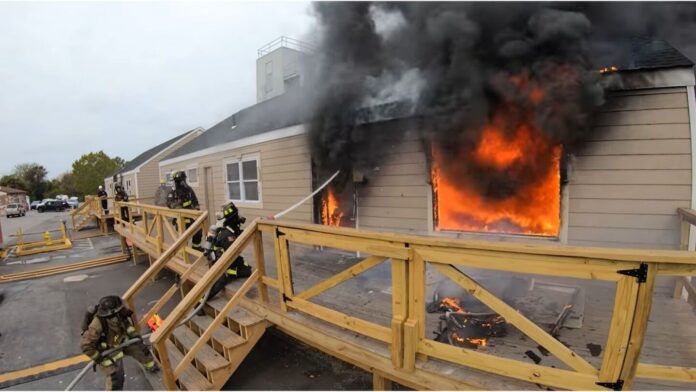
Researchers conducted 10 experiments in purpose-built, fully furnished single-story homes designed to reflect modern residential layouts. Each structure included four bedrooms, two bathrooms, an open kitchen and living area, and an HVAC system to study how smoke and heat move throughout a home.
Researchers instrumented each burn to track conditions throughout the home while varying search, suppression and ventilation tactics.
The tactical considerations are intended to turn the findings into practical guidance for firefighters, company officers and incident commanders, helping departments apply evidence-based strategies on the fireground and in SOP development.
The report is also expected to inform an updated Search and Rescue Tactics in Single-Story, Single-Family Residential Structures course scheduled to launch later this spring.
Tell us how your department is using UL Research Institutes’ fireground research to shape your SOPs.

Authorities say an armed man rammed a vehicle into Temple Israel in West Bloomfield Township before being fatally shot by security

Engine 10 carries 950’ of 2-1/2” reduced down to a 100’ 1-3/4” bundle load, with a breakaway nozzle

The state is sending funding to 114 volunteer fire companies to help pay for wildfire gear, equipment, communications tools and training ahead of peak spring fire season.

A five-alarm fire tore through a Brooklyn warehouse, injuring two firefighters as fireboats and firefighters flowed 15,000 gallons a minute

New mission mode provides simpler and more intuitive sampling of hazardous vapors

