
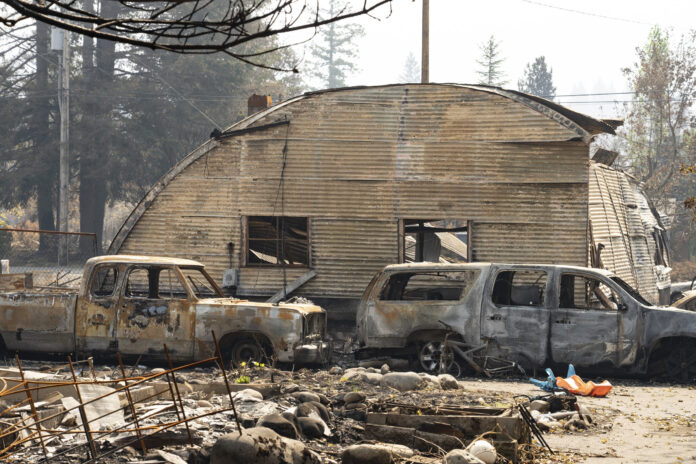
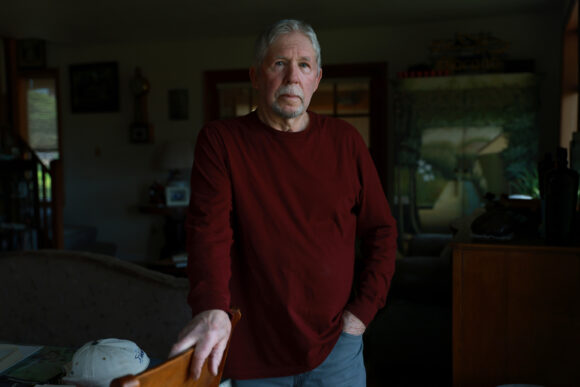
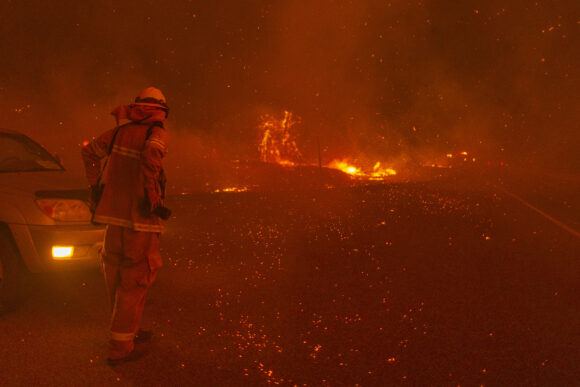
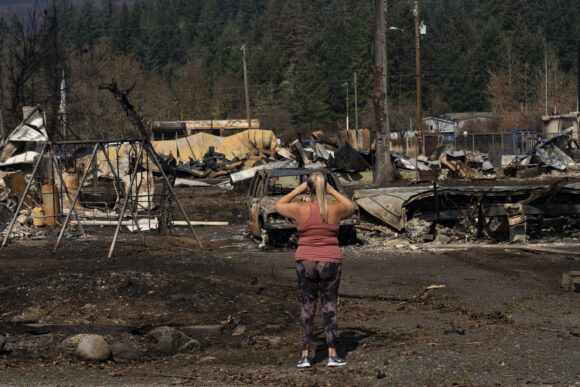
When smoke rapidly engulfed his home in Oregon, retired firefighter Fred Cuozzo rushed away in his pickup truck and nearly died from swerving around flames. All but one structure on his rural 16-acre lot was destroyed by the 2020 fire.
Five and a half years later, Cuozzo, 80, is still waiting for more than $6 million that was awarded by a jury that determined Berkshire Hathaway Inc. utility PacifiCorp’s equipment caused the fire. Cuozzo’s award is a tiny part of billions of dollars in damage claims that followed Oregon’s so-called Labor Day fires, which burned thousands of properties and rank among the state’s biggest and most destructive.
Related: Berkshire’s PacifiCorp Paying $575M to Settle Claims for Oregon and California Wildfires
“You know who owns PacifiCorp: Warren Buffett, Berkshire Hathaway,” Cuozzo said in an interview. “We know how much money he has – it’s not going to break them by any means.”
PacifiCorp has embarked on an all-out effort to curb the firm’s wildfire liabilities — both present and future. The company, which bills itself as the largest electric grid operator in the western US, has been lobbying across multiple states for laws that would effectively cap payouts to fire victims. It’s also keen to pass on fire-related losses to its customers. In court, meanwhile, PacifiCorp is appealing jury verdicts for Cuozzo and scores of others.
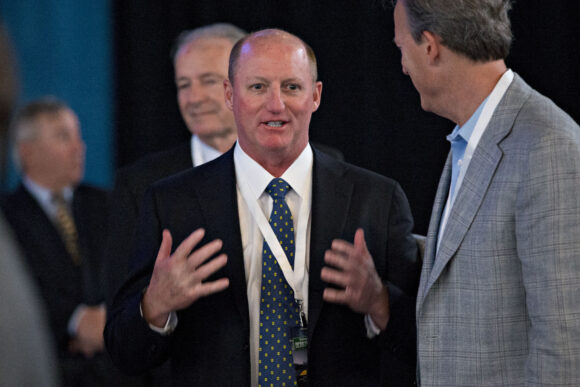
The breadth of the company’s campaign underscores the massive threat wildfires have become for PacifiCorp and utilities across the American west. In fact, utility-ignited wildfires have become one of the thorniest issues facing Buffett’s successor Greg Abel as he begins his reign as Berkshire’s top boss.
The company already has reached settlements totaling about $2.2 billion and Berkshire estimates PacifiCorp faces about $55 billion in claims related to western US wildfires. PacifiCorp, whose credit rating fell last year to just one rung above junk territory at S&P Global Ratings, has warned investors of potentially more trouble ahead.
Berkshire declined to comment.
From California to Texas, utilities are struggling to manage mounting fire risk in a warming climate. They are spending more than ever before on lawsuits and settlements, as well as on preventative measures, such as undergrounding lines. To protect their finances, they’re seeking to offload the increased cost of doing business on electric ratepayers, wildfire victims, insurers and states – with some success.
Related: Buffett Utility Reaches Oregon Wildfire Deal With Nearly 1,500 Victims
And they’re just getting started. Across the American west, utilities have devised something of a playbook, secured some key legislative wins, and are now moving to compel sweeping policy changes in state capitols.
Buffett acknowledged in his February 2024 annual letter to Berkshire shareholders that he made a “costly mistake” in failing to anticipate the escalating financial and regulatory risks of wildfires. He even warned that the liabilities could threaten the survival of utilities in some states, saying bankruptcy was a possibility. Though Berkshire can sustain financial surprises, “we will not knowingly throw good money after bad,” he wrote at the time.
“We shouldn’t be in the business of taking your money, investors’ money, and tackling things that we don’t have a solution for,” Buffett said at the conglomerate’s annual meeting the following year.
‘Fear of God’
Just three years ago, a jury found PacifiCorp grossly negligent for failing to turn off power lines amid dangerous wildfire conditions. It was a landmark decision. Indeed, never before had a utility accused of causing a large fire taken the risk of defending itself in front of a jury instead of settling ahead of trial.
To date, juries have socked PacifiCorp with more than $1 billion in damages for about 145 fire victims – and at the rate the awards have been piling up, the total tab could be almost 10 times as large for about 1,400 remaining victims, swallowing almost all the company’s $11 billion shareholder equity. The lion’s share of the awards have been for so-called non-economic damages, with victims winning, on average, more than $5 million a head to compensate them for pain and suffering, or emotional distress. (Berkshire’s market value is about $1.08 trillion.)
“That is what put the fear of God in all the states across the west” and what led the utilities to start pushing for more protections, said Michael Wara, director of the Climate and Energy Policy Program at Stanford University.
PacifiCorp is appealing the 2023 court verdict, arguing that individual fire victims in separate blazes and varying circumstances should not have been allowed to join together in a class action case that exponentially raised the company’s legal exposure.
A three-judge panel that heard arguments this month appeared to be on the fence about upholding the historic verdict and may take months to issue a decision.
Related: Utilities’ Extreme Plan to Stop Wildfires: Shut Off the Power
Meanwhile, the company has embraced what Abel has called “legislative and regulatory reform across the PacifiCorp states.” Working with legislators, the utility has pushed for limits on wildfire liability and for the creation of state funds to support wildfire victims.
Utility lobbying bonanzas aren’t new. Berkshire is following a script crafted by publicly traded, investor-owned power companies in California, the first state to navigate the fallout from large-scale, utility-sparked wildfires.
After a series of devastating blazes in 2017 and 2018, California passed a law that required utilities to file wildfire mitigation plans, set rules on how they recover wildfire costs from customers and allocated funding for fire prevention work, among other measures. The state’s utility regulator created a wildfire safety division, and hired staff to examine what utilities were doing by way of prevention, from trimming overgrown trees near transmission lines to establishing power shutoff protocols.

California’s legislative overhaul advanced even further after Oakland-based PG&E Corp. was found responsible for the 2018 Camp Fire, the deadliest in state history, and was driven into bankruptcy the following year while facing more than $30 billion in liabilities. That episode spurred the passage of a landmark bill establishing a $21 billion wildfire fund to help stabilize utilities’ finances and limit shareholder losses.
Underwritten by ratepayers and shareholders, the fund acts like insurance: After a fire, a utility covers the first $1 billion in liabilities and then can draw from the fund; as long as the company is found to have operated prudently, it doesn’t have to pay reimbursement.
In Oregon, PacifiCorp’s legislative foray last year did not go well for it. One bill backed by the company would have created a wildfire safety certification process; another would have established an emergency fund for victims who agree not to sue whichever utility they believe is responsible for a fire.
Critics led by trial attorneys assailed the proposals, saying they’d be used as a “get-out-of-jail-free card” for utilities. Both bills died without even getting a full floor vote in the state capitol.
‘Dreadful’ Timing
In hindsight, a state lawmaker who co-authored the measures, Pam Marsh, said emotions were still too raw following the devastation of the 2020 fires and the company’s pitched court battle.
“Our timing was dreadful,” Marsh said, adding that “anger” at PacifiCorp’s local unit “was simply more than we could combat in the legislative process.”
But in other states, PacifiCorp made headway, as have other investor-owned utilities.
In 2025 alone, Arizona, Hawaii, Idaho, Montana, North Dakota, Texas and Wyoming all enacted laws that provided some form of liability protection for investor-owned utilities. The measures include setting a cap on how much wildfire victims can recover, establishing a recovery fund that utilities can draw from to pay damages and giving utilities legal protection if they follow an approved safety plan.
Outside of Oregon, “they’ve been highly effective in the states in which they operate in getting changes made,” said Stanford’s Wara.
States that had not yet suffered the devastation of a massive utility-sparked wildfire turned out to be more receptive to utility-backed bills.
“You build momentum that can even help in those states where the environment may not be as forgiving,” said Denni Ritter, vice president of state government relations for the American Property Casualty Insurance Association, or APCIA, which often opposes utility-sponsored bills as they tend to shift wildfire costs off utilities and onto insurers and homeowners.
Abel has called one state the “gold standard” for utility-protecting legislation: Utah. The state passed laws that cap damages for wildfire victims, created a wildfire fund and provided liability shields for utilities that submit an approved fire plan.
‘Shamelessly Focused’
Fire-victim advocates are wary of PacifiCorp’s agenda.
“We actually think it’s wise for states to adopt regulatory changes to respond to the risk of catastrophic wildfires,” said Eli Wade-Scott, global managing partner at Edelson PC, whose law firm represents Oregon plaintiffs suing PacifiCorp. “But PacifiCorp is shamelessly focused on immunizing itself.”
Lee Ann Alexander, a vice president for policy at APCIA, said she expects the utility legislative push to continue, both in statehouses where bills have previously failed and in new states. “We’ll see everything again on the table,” she said. “I don’t think the utilities are giving up by any means.”
California, the trend setter, is a case in point. The state boosted its utility wildfire fund by $18 billion after local utilities voiced concerns that one of the devastating fires in the Los Angeles area in January 2025 could strain the fund.
And there’s more on the California utilities’ wish list. They’re also advocating for a permanent wildfire fund and for replacing litigation altogether with a streamlined compensation model.
In Oregon, Marsh said she’s hopeful utility-sponsored legislation will be revisited in the next regular legislative session in 2027.
“It is very likely that we will have fires in the future,” she said. “Just by the nature of their very high-risk infrastructure, fires start. So how do we all bear the risk of that and the responsibilities for that?”
‘A Mistake’
Buffett’s push in the utilities business, starting with the acquisition of MidAmerican Energy Holdings Co. in 1999, was emblematic of his investing philosophy: seek out companies in regulated businesses with high barriers to entry and which deliver stable returns. But in recent years, the growing headache at PacifiCorp, which Berkshire bought in 2005, illustrates the complication of running a utility in a warming climate.
“We made a mistake by not carving it up into the seven states that we were buying,” Buffett said at the firm’s annual meeting last May. “There’s a lot of states that so far have been very good, decent to operate in and there are some now that are rat poison.”
Berkshire’s newly-minted chief executive officer knows this problem all too well.

Abel, 63, rose through the ranks at Berkshire’s utility business, a unit he ended up overseeing until last year. In past shareholder meetings, he has explained how growing wildfire risk has forced the company to make operational changes, including the policy adopted by PacifiCorp to shut off electricity in areas near an active fire to avoid contributing to it.
Like his boss, Abel lamented that PacifiCorp has been cast as a villain, in particular after a report by the Oregon Department of Forestry didn’t find evidence that the firm was to blame for one of the Labor Day fires.
“We just can’t be responsible for everything that happens in a state,” he said last year.
The protracted litigation already has battered PacifiCorp’s finances as well as Berkshire’s returns.
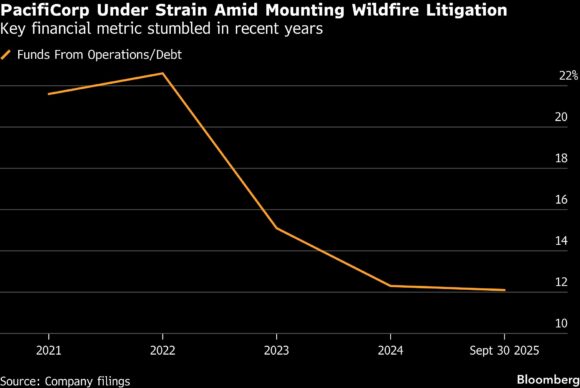
Even after pausing dividends to Berkshire to retain some cash, PacifiCorp’s balance sheet is facing increasing stress. Its funds from operations to debt ratio, a key measure of financial strength closely watched by ratings firms, dropped by almost half from 2022 to 12.1% at the end of September.
“The Street hasn’t paid enough attention to this,” said Cathy Seifert, an analyst who covers Berkshire Hathaway at CFRA Research.
Still, “they obviously have the resources if they need to bolster things,” she said. For her, the company’s current messaging is mostly strategic. “You don’t want to show your deep pockets – everyone knows you have them.”
James Balfour, a senior portfolio manager at LOM Financial, which holds a PacifiCorp bond, also believes a bankruptcy is unlikely.
“There is at least a financial backer that could come in to support if fully required,” he said.
‘Too Narrow’
This much is clear: As climate change has made wildfires more frequent and destructive across the American west, the issue of who pays for their costs has come to a head.
For Stanford’s Wara, the question of whether it’s fair for electric utilities to bear those costs on their own is “too narrow a lens.”
“The right lens is how society is going to afford it,” Wara said. If utility shareholders are asked to shoulder too much of the burden in wildfire-related liabilities, that would limit utilities’ ability to attract investment and increase borrowing costs, making electricity rates higher for everyone. But if utilities limit how much homeowners and their insurers can sue them for, that could raise insurance rates for homeowners. In either case, “people are going to pay.”
In the meantime, Oregon wildfire victims like Cuozzo are left in limbo as PacifiCorp refuses to surrender in court. As an octogenarian, he doesn’t see himself restoring his home to what it was before the wildfire destroyed it.
“I’m a pretty strong guy. I went through Vietnam, was shot at and all that,” said Cuozzo. Still, he is haunted by the 2020 fire. “If I start thinking about it, I still get emotional.”
Top photo: Burnt vehicles sit parked in front of a warehouse destroyed by wildfires in Gates, Oregon, U.S., on Sunday, Sept. 20, 2020. Wildfires have burned nearly 5 million acres, killed at least 27 people, and forced hundreds of thousands to evacuate up and down the West Coast. Bloomberg.
Copyright 2026 Bloomberg.

