
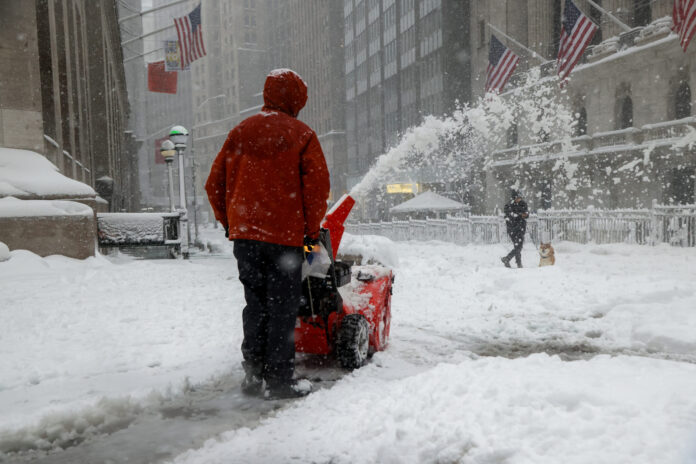
Two days before New York’s biggest snowstorm in a decade began, forecasters were still unsure how much snow would fall. One traditional U.S. model had consistently predicted a major hit, while newer artificial intelligence systems weren’t so certain.
The long-running Global Forecast System, or GFS, signaled the storm would be a whopper for much of the Northeast. Because of lingering skepticism about the GFS’ past performance — and the fact that it stood alone in predicting massive impacts — many forecasters waited until Friday afternoon before declaring the possibility of more than a foot of snow for parts of New York.
Related: NYC Travel Snarled by Snow as Central Park Gets 15 Inches
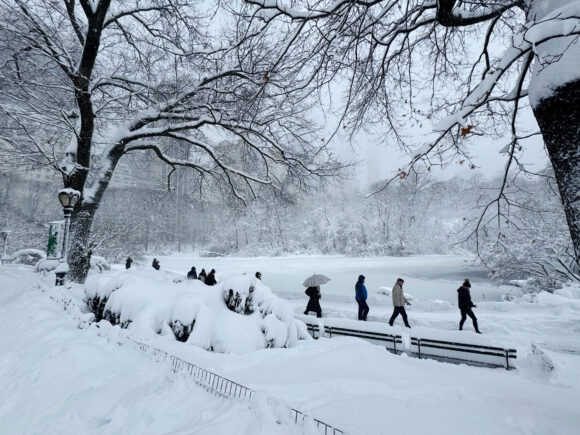
The totals reported by the U.S. National Weather Service have been staggering: Central Park saw nearly 20 inches, one of its biggest snowstorms on record. On Long Island, snowfall measured at more than two feet.
Forecasting powerful winter storms is a distinctive challenge, scientists said. Unlike hurricanes, which form at sea and spend days barreling toward land, nor’easter storms often build and strike the East Coast within 24 hours. Providing advance warning for this week’s storm meant forecasting where incoming waves of cold air and moisture would land and interact with a streak of low pressure in the jet stream, days in advance.
So far, AI models haven’t made that task much easier, said Bob Oravec, a senior branch forecaster for the U.S. Weather Prediction Center in Maryland.
“There’s no perfect model yet,” Oravec said. “That’s the problem.”
In the U.S., storm warnings and alerts are issued by the National Weather Service and redistributed by commercial forecasters. A local office in Upton, New York, was responsible for safety advisories spanning New York City and parts of New Jersey and Connecticut. Forecaster David Stark said staff waited to issue the first alerts until Friday due to lingering uncertainty about the storm’s path.
“We don’t like to put out warnings early and give a false sense of alarm if it’s not needed,” Stark said.
Related: Nvidia Unveils AI Models for Faster, Cheaper Weather Forecasts
While the GFS – developed by the National Oceanic and Atmospheric Administration, a federal science agency – was ultimately correct about the storm’s impacts on New York City, scientists said it overstated the threat in parts of the Mid-Atlantic and was slightly off on the storm’s duration.
Those mixed results are giving forecasters pause as the GFS now sees the possibility of another significant storm early next week.
At times, the GFS has predicted heavy wintry precipitation in the Northeast beginning early next week. A similar signal has been picked up by a traditional European forecast model, which is generally considered the best of its kind. But as of Tuesday morning, a powerful new European AI model sees a lower threat.
Though the models may continue to shift in the coming days, Columbia Climate School researcher Andrew Kruczkiewicz said he’s watching how forecasters prioritize AI predictions before warning the public about incoming storms.
“We’re so trained to think anything AI is better,” said Kruczkiewicz. “Even if models are considered better or high quality, decision-making is not necessarily simplified.”
Top photo: A worker clears snow near the New York Stock Exchange during a winter storm in New York on Feb. 23. Photographer: Michael Nagle/Bloomberg.
Copyright 2026 Bloomberg.

Want to stay up to date?
Get the latest insurance news
sent straight to your inbox.

