
By Tim Rockey
Anchorage Daily News
WASILLA, Alaska — A half-dozen teenagers noisily crawled on their hands and knees through a dark, empty building. Large steel tools clanged off the walls and floors, alarm bells beeped and blared continuously, and mask-muffled hollers resonated from every corner of the building.
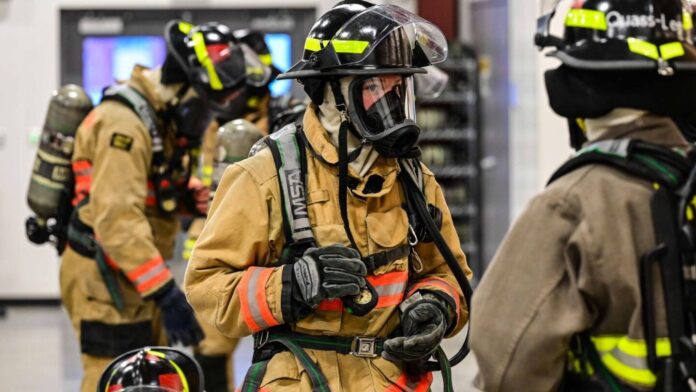
These teens weren’t getting into trouble, but rather learning how they would get someone out of it. The chaotic sights and sounds of the training tower were part of a carefully orchestrated exercise helping students enrolled in Wasilla High School’s fire science class learn search and rescue techniques.
| READ NEXT: Gen Z job satisfaction: Strategies to recruit and retain our youngest members
The class is unique among career and technical education courses in Alaska. Instructor Gabe Bailey said no other high school in the state prepares students for careers as structural firefighters. It has already produced a handful of graduates who work at local fire departments.
Bailey started offering the class for juniors and seniors in the Matanuska-Susitna Borough School District four years ago. The two-year course prepares cadets to take firefighting exams, and it’s gaining interest among youths looking for a path to public service.
Brayden Vinson-Stith, an 18-year-old senior at Wasilla who took classes with Bailey previously, said each Bailey class feels like a family.
“I wanted to do state trooper work and I figured there’s no state trooper class, but there’s a fire one,” Vinson-Stith said. “I figured this would be a cool step in the door, but I ended up liking this a lot more.”
Vinson-Stith plans to attend college at the University of Alaska Fairbanks in the fall and join a fire department in the area.
The family atmosphere in Bailey’s fire science class is intentional. He wants the group to experience what it’s like to live and work with other firefighters, developing trust and camaraderie through shared adversity.
“Everyone has their walls built up, but by the end of the first year it’s the same thing that happens in the fire service, you become like a dysfunctional family,” Bailey said. “It’s really a family bond and that’s part of doing all this high-stress training together.”
John Beebe, assistant fire chief with the Central Mat-Su Fire Department, also helps teach the program. Beebe makes dinner for the families at Station 6-2 before the school year and explains what their children will learn throughout the year, including the inherent risks. Before students can enroll, they must pass an interview and a physical test. The program is physically grueling, and Bailey said the interviews are meant to ensure students are self-motivated enough to make it.
Beebe said the volunteer and part-time workforce most Mat-Su fire departments rely on has become less reliable in recent years.
“There’s a great need for firefighters in the Mat-Su,” Beebe said. “We’re already seeing the benefits to the community from the program.”
Station days
While most of the class takes place at Wasilla High School, once a month students travel from Palmer, Houston and as far as Caswell Lakes down Knik-Goose Bay Road to Central Mat-Su Fire Station 6-2 for training.
There, they spend more than seven hours working out, testing and retesting to prove they can put on all their gear in under two minutes, and putting other skills they’ve learned in the classroom to use in the training towers at Station 6-2.
On Monday afternoon, Bailey, Beebe and Training Captain Josh Kahler ran students through drills reviewing search and rescue techniques and initial fire attack strategies.
One group of students worked on a simulated fire, moving the hose through several rooms, down a flight of stairs and back out before their self-contained breathing apparatuses ran out of air. While the fire students sought wasn’t real — yet — the water in the hose was. Students struggled to maneuver the leaky, rigid hose through the tower as the plugged nozzle clunked along. Kahler reminded the students to communicate and be aware of friction points that can slow the hose.
“Don’t pause the nozzle, that’s where a lot of things get twisted up,” Kahler told the students after the first drill.
A second group of students practiced rescue techniques in the bottom floor of the same training tower, scooting from room to room searching for the “victim” — a rubber dummy — in the dark. Bailey demonstrated how they would safely enter a burning building to find a victim in a low-visibility environment.
“I’m here on the wall and I’m searching, OK. I’m using the handle of my tool to search for victims,” Bailey said. “We’re going to go closest to the fire because that’s where the biggest risk is of somebody being hurt, somebody being trapped.”
Near the end of the school year, first-year students will put all their skills to the test on a live fire.
“They get to experience the heat of a real fire. They get to experience firsthand some of the fire behavior that they learned in the classroom, and they get to put a real fire out,” Bailey said. “It’s pretty cool.”
Anya Quass-Lee is a 17-year-old senior at Wasilla who decided to take the class after watching fire cadets demonstrate putting out a car fire last year. She plans to put her skills to use as wildland firefighter after graduation.
“I just thought what they did was cool, putting out the fire, and there’s not a lot of girls in the program,” Quass-Lee said. “I thought it would be cool to be one of the girls in the program.”
Morgan Mahoney, a junior at Wasilla High, signed up for the class because it counts as a science credit, and because Quass-Lee was taking it. They call themselves the “dream team.”
“We’re better than most of the boys in the class,” Mahoney said.
Like several other cadets, Mahoney comes from a family of firefighters. But when she signed up for the class, her father Matt Mahoney — who worked as a hotshot wildland firefighter in Alaska for four seasons in the 1990s — said she was on her own. He told her she’d be responsible for her own gear and waking up on time for station days.
“What I really like about the class is the captain who’s running it, he sets a pretty high expectation of these kids,” Matt Mahoney said. “It’s good training and he holds them accountable. They’re expected to be to class on time, they’re expected to listen and to push themselves, and to be honest, I don’t see that expectation in school often. It’s nice to see somebody holding kids accountable and pushing them hard, I think they need it.”
Mahoney said his daughter typically grumbles and complains the night before station days, but returns home with a new attitude each time.
“She’s always super excited and super exhausted, and I like that, because that means it’s hard work. And she knows it’s going to be hard work, but she really enjoys it and she feels a sense of accomplishment when she’s done,” Matt Mahoney said. “It’s been exciting for me to see her enthusiasm for the class and it’s been exciting for me to see her kind of step up to the challenge of doing it.”
Palmer High School senior James Simono is the son of military parents, but wants to serve his community as a firefighter after graduation. After James Simono decided against joining the armed forces, his father, Jeff Simono, was happy to see his son choose a career path that motivates him.
“I’m very grateful that this program exists because my son was smart and athletic and he had a great head on his shoulders, but he didn’t have a clear path of what he was going to do after high school, and that’s scary. We all know how that is, and it gave him a path to follow,” Jeff Simono said. “The last two years, that’s all he talks about is his future. He wants to be a firefighter.”
‘In it to help people’
Logan Jacobson is one of a half-dozen of Bailey’s former students who work as firefighters around the state, after joining part-time with Central Mat-Su last fall. Jacobson’s buddy told him he should try the fire science class, so he did.
“I decided why not, I’ll give it a shot. I didn’t think I’d actually go into firefighting afterwards, but going through the class, I loved it,” Jacobson said. “I’m just in it to help people.”
While the Wasilla High School fire science course is unique, it’s not the only chance for students to train as first responders in career and technical education programs in Alaska high schools. Students in the Natural Resources class at Career Tech High School in Wasilla can earn their red card as wildland firefighters, and King Tech High School students in Anchorage can take the Emergency Medical Technology course to prepare for careers as emergency medical technicians.
Students taking the fire science class can earn dual credit from the University of Alaska Fairbanks, like Vinson-Stith.
Bailey said he has yet to respond to a call alongside one of his former students, but that won’t be the case forever.
“I feel like we’re attracting the right kids from across the Valley and it’s great to see kids go into the fire service from the class. It’s really rewarding,” Bailey said. “It’s just a great opportunity to give back to the community that they came from.”

Coeur d’Alene Engineer David Tysdal, who warned crews of an active shooter despite life-threatening injuries, continues working to regain the use of his legs

The proposed Halo Act would criminalize interfering with Kentucky firefighters, EMTs and law enforcement within 25 feet after a warning

A three-alarm blaze in Monson forced firefighters to rely on tanker shuttles as limited water access hampered suppression efforts

Paulding County officials say placing paramedics on Engine 13 will reduce response gaps and strengthen countywide medical coverage
© 2026 Anchorage Daily News.
Visit www.adn.com.
Distributed by Tribune Content Agency, LLC.

The discount is 10% off the total order and can be reused on future purchases

