
By Justin Faulconer
The News & Advance
BEDFORD COUNTY, Va. — A community risk assessment and standards of cover study to evaluate Bedford County fire and emergency medical services operations received the county board of supervisors’ unanimous approval on Tuesday.
In meeting the goal of providing reliable, timely and effective fire and EMS services, the study identifies opportunities to improve response reliability, reduce delays and establish a baseline level of service while supporting the existing volunteer system that anchor fire and rescue stations. The study outlines prioritized recommendations to enhance service delivery for county residents and visitors now and into the future.
| MORE: 10 ways fire departments can go beyond ‘good enough’
“The study examined response times, deployment, staffing models, administrative capacity, community risk, and identified opportunities to improve service reliability while continuing to support the volunteer system,” a report from Janet Blankenship, chief of Bedford County fire and rescue, to the board states.
Providing adequate services
The first phase focuses on stabilizing service delivery through staffing enhancements, operational process improvements, system support functions and implementation of one 12-hour peak ambulance.
“These actions are intended to assist in reducing response delays, improve reliability during peak demand, and establish measurable performance benchmarks,” Blankenship’s report states.
The second phase recommendations include addressing service gaps for fire suppression and setting up four staffed locations. The purpose of the study largely is motivated to evaluate the current response model and develop a master plan to serve as a guide for the county in determining the adequacy of current fire prevention/suppression and EMS, according to the report.
The plan enables the county to provide adequate future services in response to ongoing population growth and development. Analyses culminated in a comprehensive deployment and staffing plan referred to as a Standards of Response Coverage (SOC) and a comprehensive assessment of risks and demand was completed.
“Overall, Bedford County has benefitted from the volunteer Fire and Rescue /Squad departments that has served it well over the decades,” the report states. “This study assists in evaluating the need for investments to assist in the long-term sustainability of services in a dynamic and growing community.”
Current fire and rescue administrative capacity and career EMS deployment is lean and need additional investments, according to county documents. All efforts are incremental strategies designed to supplement long-term system success.
More peak-hour help
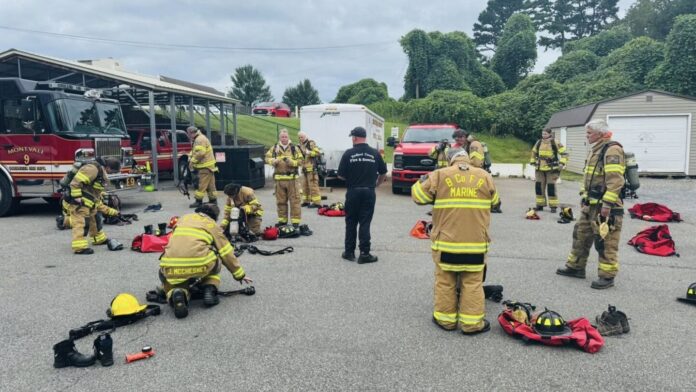
Bedford County Fire & Rescue is an umbrella agency under which 12 volunteer fire departments, nine volunteer rescue squads and career staff.
Key study findings show:
- response time delays are primarily driven by a volunteer-dependent dispatch process relying on member availability
- career EMS resources account for 83.4% of EMS responses reflecting reliance on career units to meet current demand
- current EMS deployment average of four units per day is insufficient to meet call volume demands and travel benchmarks
- fire suppression gaps exist due to inconsistent staffing of response apparatus
- optimal station locations identified and station development necessary to support long-term sustainability of services.
The first phase of immediate stabilization recommends addition of a peak-hour ambulance from 8 a.m. to 8 p.m., add a second field lieutenant position, implement a dedicated logistics position and a data analyst/grant position, put in place an incremental increase of the Medicare billing rate and develop an improved funding plan for staffing two volunteer fire stations.
The peak-hour ambulance and associated staffing is estimated at $191,620 and will come to the board of supervisors as a request in the upcoming fiscal year 2026-27 county budget. Other positions planned to enhance services total about $353,500 and are identified to be covered in the department’s current budget.
The second phase introduces a career-staffed engine company to begin achieving recommended fire response baseline capability in areas where more volunteer support is necessary, according to Blankenship’s presentation. The estimated cost of the second phase is roughly $582,300.
Supervisor Charla Bansley said she loves hearing about cost-saving measures outlined in the plan.
“That’s music to my ears,” Bansley said.
The county fire and rescue department staffs six full-time medic units and one peak-hour ambulance currently. Abbey Johnston, deputy chief operations, spoke during the presentation of staffing levels.
“We’re very excited to report that in the last six months, we hired somewhere between eight and 10 full-time employees, which for a department our size is pretty significant, and we are staffing a minimum of five and, pretty consistently, all six trucks every day now,” Johnston said. “That’s a huge improvement. We’re seeing a big relief on our folks that are working because the call volume never slowed down. It’s just a matter of how many trucks you have in service to absorb that call volume, and we see that that takes quite a toll on our staff and fatigue and whatnot.”
Johnston said it has been a real blessing to bring on more staff to get more trucks in service.
“Now we’re ready to move forward with what the study is recommending … putting another peak hour truck in service to absorb that increasing call volume that’s coming in,” Johnston said. “Putting that additional lieutenant in service every day is critical. Right now, we have one lieutenant, so that’s one field supervisor for the entire county each day. ‘
And it just seems as though whenever that person is needed in Forest, they’re in Stewartsville, or when they’re needed in Huddleston, they’re in Big Island and so just by the geography of our county and the time it takes to travel it would be incredibly advantageous to have a second supervisor in service, not just to improve their span of control with the number of personnel they’re supervising and giving them the attention they need, but our lieutenants also are advanced practice paramedics. They have a higher level of skill and medication opportunities for treatment for patients, and so that would be a huge improvement for a number of reasons.”
Volunteers remain critical
Blankenship said the fire stations in Forest and the town of Bedford are very well staffed with volunteers and the focus is on stations across the county that need more manpower resources.
“Where we really want to focus is on the stations that need additional staffing,” Blankenship said.
The study and its findings have been shared with the county’s volunteers and Blankenship said she hasn’t heard any negative feedback and mainly questions wanting clarity.
“It’s been very positive thus far,” Blankenship said.
Supervisor Mickey Johnson said the investment is hopeful to produce a lot quicker response time for citizens and more resources for services.
Blankenship said the department’s goal is to improve the current 20-minute response range for fielding calls.
“We want to drive that down to 18 minutes,” Blankenship said, adding the study will help fire and rescue fine tune its operations to improve on cutting it down even more over time.
The study’s purpose is to improve a consistent set of metrics for standards and try to get as close as maintaining those as possible and support the resources currently in place, Johnston said.
“We have a lot of thriving volunteer departments, and we have some that are struggling,” Johnston said. “It stands to reason that even in some areas where you provide some supplemental career staff, you might even see a little bit of an improvement…”
Blankenship emphasized during the presentation the second phase will not eliminate any volunteer stations. Volunteer agencies continue to play a critical role in the county, she said.
“We can’t do this without our volunteers,” Blankenship said. “We still need them to continue the jobs that they’re doing … if not, then it’s going to cost us.”
Blankenship said volunteers are working to recruit more among their ranks and this spring billboards will go up in attempts to attract more for those agencies.
Filling in gaps
The phased approach for carrying out the plan spreads costs over time, avoids one-time large expenditures, allows the board of supervisors to assess the return on investment and aligns staffing decisions, the report states.
“We want to make sure there’s actual service demand and performance data to support any of our future decisions and, of course … identify gaps in coverage as we move forward,” Blankenship said.
Supervisor Bod Davis said he is glad the fire and rescue department proceeded with the study.
“I was pleased with it…. I think we need to be more forward-thinking as this county grows,” Davis said. “I think that before we, before someone plans a community somewhere, that we need to make sure that we have the fire/EMS services available to serve that because some of the traffic in this county is getting really, really congested.”

The proposed Halo Act would criminalize interfering with Kentucky firefighters, EMTs and law enforcement within 25 feet after a warning

Coeur d’Alene Engineer David Tysdal, who warned crews of an active shooter despite life-threatening injuries, continues working to regain the use of his legs

Paulding County officials say placing paramedics on Engine 13 will reduce response gaps and strengthen countywide medical coverage

Lacking bandages, Glenn Narodowy improvised bleeding control and began triaging victims where they fell
© 2026 The News & Advance, Lynchburg, Va.
Visit www.newsadvance.com.
Distributed by Tribune Content Agency, LLC.

FirstNet is powering a resilient connectivity plan to keep first responders mission ready throughout every moment of the Big Game

