
The independent federal agency that provides Alaska with utilities, infrastructure and economic support is considering a number of new environmental hazards as it updates its statewide threat assessment.
In 2019, the Denali Commission published a detailed listing of climate change-related threats to communities around the state. The document, written for the commission by experts from the U.S. Army Corps of Engineers and the University of Alaska Fairbanks, scored 187 communities according to the threats they faced from flooding, erosion, permafrost thaw or a combination of those impacts.
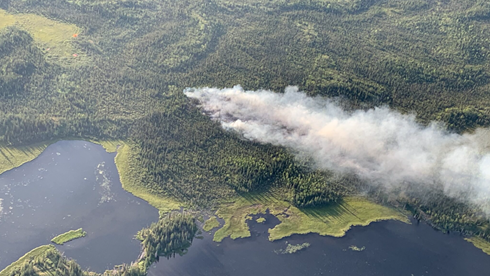
Now an updated report is in the works, with five more hazards added to the analysis: landslides, tsunamis, wildfires, earthquakes and volcanoes.
Experts working on the updated Denali Commission report outlined the project at a panel discussion held Wednesday at the Alaska Forum on the Environment, a weeklong conference underway in Anchorage.
“It didn’t make sense to just look at permafrost thaw, erosion and flooding when there are new hazards that our communities are facing,” said Courtney Brozovsky, a geographic information systems specialist with a consulting firm contracted by the Corps of Engineers.
The list of new hazards can be further expanded or defined. “We’re also talking about ways that we can incorporate some other additional hazards such as glacial outburst flooding, typhoon and drought,” Jessica Evans, an environmental planner with the same contractor, AECOM, told the gathering.
The Denali Commission, an independent federal agency established by Congress in 1998, coordinates investments in rural Alaska infrastructure, economic development and public health. The 2019 threat assessment has been used to help guide those investments. The commission continues to function, despite attempts by the Trump administration to abolish it.
Of the new hazards that are slated to be added to the updated assessment, three have connections or possible connections to climate change. Landslides of different types are occurring around Alaska and are tied to forces like glacial retreat, permafrost thaw and heavier precipitation events. A University of Alaska Fairbanks and National Weather Service study published in November correlates the increase in reported Alaska landslides to reported average temperature increases of 1.2-3.4 degrees Celsius — roughly 2-6 degrees Fahrenheit — and 3-27% increases in precipitation over the last 50 years across Alaska.

