
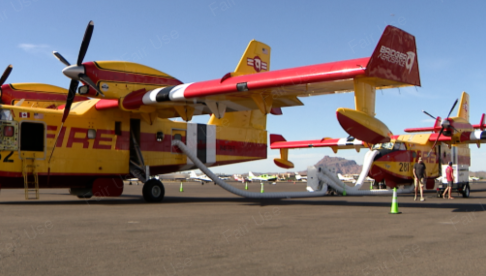
VIDEO: Fighting and understanding wildfires, like the Jones Fire, isn’t just something that’s done on the ground but also in the air through Super Scoopers that release water and aircraft that map the fire.
Bridger Aerospace is using the aircraft for the wildfire in Wickenburg. So, how does it work? The water goes through a probe, takes about 10 to 12 seconds to scoop up the water, and— when they’re ready to release it, goes through a door. This whole process takes about 10 minutes.
“When we head over to the fire, when we’re ready to drop, we use this button,” Scott Blue, the captain of the CL-215T Super Scooper, said. “It’s entirely up to the fire officials. We’re directed on where to drop the water, and we try to get it exactly where they want it every time,” he said.
But factors like the fire’s smoke and wind make a difference.
“If the wind is coming from the left-hand side, we’re going to stagger the plane a little bit more to the left so when the water comes out, it drifts to the right. Vice versa. Of course, forward and back depending on a headwind versus a tailwind,” Blue said.
For the Jones Fire, Blue says they had clearance to drop the water. “Made sure that the area was completely clear of anybody, and, of course, it’s in a city, so you’re watching out for power lines and anything like that,” he said.
The tanks that hold the water hold 1,400 gallons. He said so far, they’ve released 6,000 gallons in Wickenburg. When they drop the water, it’s at least 150 feet above the fire.
“It’s half on the flames, and half on the green, or the burnt area right beside the flames, to kind of slow down the spread of it and then knock down the fire itself,” Blue said.

