
By Derrick Perkins
Daily Inter Lake
KALISPELL, Mont. — Alan “Gus” Gustafson was on a mission.
The energetic 80-year-old strode through Kalispell’s Public Safety Building on a damp April morning, looking for the 2,200-pound bell that once hung from the Fire Department’s hose tower, ready to summon firefighters in an emergency.
The retired firefighter’s first stop was the first-floor offices of the Kalispell Police Department. When that proved fruitless, he headed across the lobby, where he said the bell was once put on display, to question the staff at Kalispell Municipal Court.
| READ NEXT: The firehouse is not the ‘Joe Rogan Experience’
They couldn’t remember a bell either.
A few minutes and one flight of stairs later, Gustafson was in Fire Chief Jay Hagen’s office, asking if he knew of the bell’s whereabouts. Hagan shook his head. He did not.
“OK, I’m going to find it,” Gustafson replied.
Hagen agreed that he would.
“When he sets his mind to it, it’s going to happen,” Hagen said from behind his desk.
Gustafson, who still serves as the department’s historian, more than 20 years into his retirement, had a personal connection to the bell (he later located it around the corner at the Northwest Montana History Museum ). Firefighters were still ringing it when he joined the department in 1971, just not for its original purpose.
“After I started, the bell was used to call curfew,” he said. “Every night at a certain time we would ring the bell.”
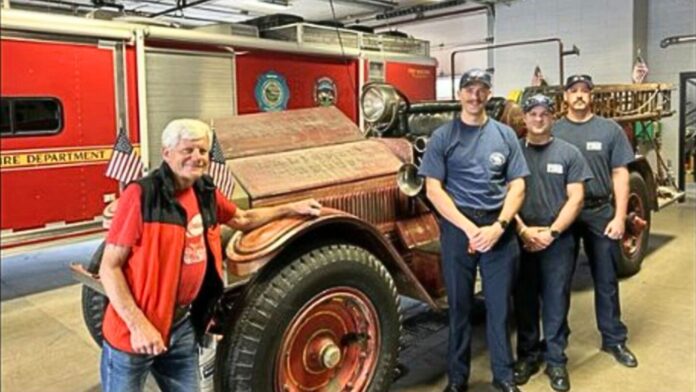
THE BELL isn’t the only piece of the department’s history that Gustafson enjoys a personal connection with. The crown jewel of its historical collection, a 1925 American LaFrance fire engine, was still in service when he first donned turnout gear.
Screaming down city streets on the back of the open-air vehicle was a thrill, he said. You just had to watch out if you were on the engine’s rear end.
“As a tailboard man, you stood in the back — on the tailboard — and hung on for dear life,” Gustafson said. “If you hit a bump, the engine didn’t have much suspension. You had to really be hanging on.”
“One day I ended up in the bed from being thrown in there,” he added.
Other items in the collection include metal helmets, axes, lanterns, leather buckets and one of the fire alarm boxes installed on telephone poles across the city in the first half of the 20th century. In case of fire, a bystander could alert the department by pushing down a lever on the box. Back in the fire station, a ticker tape machine would begin running. Holes punched out in the material denoted a number that corresponded with a location in the city.
The department removed them in the 1980s, Gustafson recalled. Only two real fire calls came in during all the years the boxes were situated around town, he said.
Gustafson remembered one instance where a drunk had activated one of the boxes on his way home. Fresh snow that day allowed firefighters to follow the footprints from the box to a house to confront the prankster, he said.
The department had no historian when Gustafson joined it. And there didn’t seem to be much interest in hanging onto worn-out or obsolete gear, either.
About five years into his career, Gustafson — who collects and builds vintage and custom motorcycles and cars in his spare time — started hanging onto pieces of the department’s past.
“If I don’t save it, no one else will. No one will ever know what we used to have here,” he said. “This is basically what every collector has in his mind.”
WORKING HIS way around the 1925 American LaFrance, Gustafson rattled off a string of facts about the machine and its time responding to fires in Kalispell.
The city acquired the 1,000-gallon-a-minute pumper April 1, 1925, under the tenure of Mayor A.E. Boorman. It came equipped with two sources of ignition, magneto and electric, in case one failed and was outfitted with a honeycomb radiator. Every inch of it was painted by a hand holding a brush, he said.
Opening the elongated hood, Gustafson paused for a moment. Something was off.
“Somebody’s been playing with the truck,” he said. “They’ve got the nobs backwards.”
Saving the more than a century-old engine, which makes the modern apparatus overshadowing it in the station’s garage look mammoth by comparison, is a point of pride for Gustafson. He tried convincing the department to sell it to him for safekeeping and when that failed to go anywhere, he found a home for it in a storage building near the city shop, he said.
Not long after he retired in 2002, he got a call from a friend, who told the Bigfork resident to head into Kalispell.
“They put your engine out in a snowbank,” the friend said.
Sure enough, the American LaFrance had been left out in the cold. An incensed Gustafson turned up the heat in response.
“I came down to the department and raised holy hell,” Gustafson recalled.
Eventually, he found someone to work on it and these days the engine is serviced by city mechanics who have taken an interest in the piece of history.
“We’re in good shape now as long as you don’t abuse it,” he said of the American LaFrance.
Though in good shape, Gustafson has four members of the department in training to replace him as historian when he’s ready to hang up the title. They’ve learned to drive it under his watchful gaze, and he expects they will care for it in the future.
All of them have an interest in the piece of history and, more importantly, how it runs, he said.
He credits the American LaFrance with landing him the title of fire department historian.
“There was no such thing as a fire department historian. It didn’t exist. It was just me collecting junk and my love for the fire engines,” Gustafson said. “I just didn’t want to see this thing die or get sold.”

Officials called the fire and explosion at Robbins Lumber a mass-casualty event in Searsmont

A medical transport plane crashed in rugged terrain near Ruidoso,and starting a wildfire that quickly spread in dry, windy conditions

The resignation of Santa Fe’s Alternative Response Unit behavioral health manager leaves concerns over staffing cuts, reduced call volume and the removal of EMS captains

Annapolis and Anne Arundel County officials are proposing a jointly funded peak-time medic unit to handle growing EMS demand
© 2026 the Daily Inter Lake (Kalispell, Mont.).
Visit www.dailyinterlake.com.
Distributed by Tribune Content Agency, LLC.

Communities across America united May 2-3 in honor of fire heroes lost in the line of duty

