
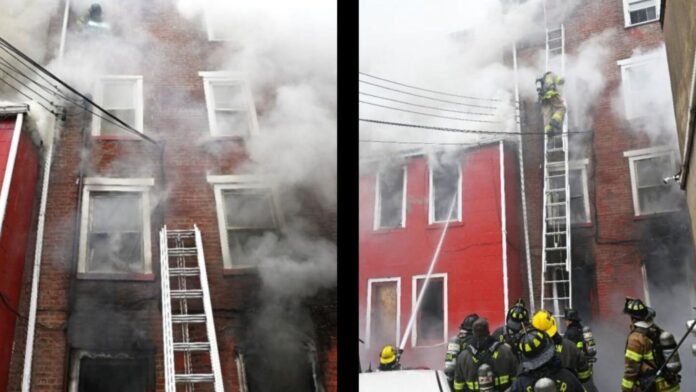
EASTON, Pa. — A career firefighter was seriously injured after falling from a ground ladder while attempting to self-extricate during a multi-occupancy boarding house fire in Pennsylvania. The Feb. 20, 2026, incident began as a reported basement electrical fire but quickly escalated, with fire extending to upper floors and multiple occupants requiring rescue.
Crews advanced lines and initiated searches amid worsening smoke conditions and reports of trapped occupants. As conditions deteriorated, firefighters operating on an upper floor attempted to exit via ground ladders placed for rescue. During this high-stress, rapidly evolving phase, one firefighter fell from a ladder while escaping the structure, sustaining serious injuries.
| NEXT: How to introduce mayday training to new recruits
The incident underscores persistent fireground challenges: coordinating rescue and suppression in high-occupancy buildings, maintaining crew integrity, and ensuring ladders are properly positioned and used under extreme conditions.
Key contributing factors
One contributing factor was the rapid escalation from a basement fire to upper-floor involvement in a high-occupancy structure. Fire extending beyond the initial compartment increased urgency for both suppression and rescue, placing crews in a complex, high-risk environment with competing priorities.
Breakdown in crew integrity during search operations also played a role. Firefighters became separated while conducting primary search, which reduced situational awareness and complicated accountability as interior conditions deteriorated and escape routes became more critical.
The presence of multiple trapped occupants created intense time pressure. Firefighters directed civilians to self-evacuate while continuing searches, increasing cognitive load and potentially diverting attention from maintaining orientation and egress planning.
Ground ladder use during self-extrication was a critical factor. Ladders were deployed for rescue, but under rapidly changing smoke and heat conditions, the injured firefighter’s descent was compromised, resulting in a fall. This highlights the risks associated with emergency ladder egress when visibility, coordination and positioning are degraded.
Finally, fireground communication and coordination challenges contributed to the incident. Multiple reports of entrapment across different sides of the structure created a dynamic and potentially fragmented operational picture, making it harder to maintain consistent command and control.
Recommendations for fire departments
Ensure strict adherence to crew integrity during interior operations. Operating in teams maintains accountability and improves decision-making under stress, aligning with NFPA 1500 requirements for personnel safety and accountability.
Strengthen training on ground ladder deployment and emergency egress. Proper ladder angle, placement and firefighter movement on ladders are essential skills reinforced in NFPA 1932 and NFPA 1001, especially when used for rapid self-rescue.
Enhance size-up and ongoing risk assessment in high-occupancy structures. Early recognition of life hazard and fire spread supports better strategic decisions, consistent with NFPA 1561 incident management principles.
Improve fireground communication discipline and command structure. Clear, consistent updates on conditions and assignments help prevent task saturation and confusion, supporting safer operations under NFPA 1561.
Train for simultaneous rescue and suppression operations under high-stress conditions. Scenario-based training prepares crews to manage competing priorities without compromising safety, reinforcing principles in NFPA 1407 for rapid intervention and firefighter survival.
Training discussion questions
- How does crew separation during primary search increase risk, and what safeguards can prevent it?
- What factors should influence the decision to use ground ladders for self-extrication versus interior egress routes?
- How can incident command better manage multiple simultaneous rescue reports without overwhelming crews?

Download your copy of the Guide, featuring a BC’s mayday experience, mayday training resources, and guidance for running command at a mayday event

The actor’s hands-on FDNY challenge raises hundreds of thousands to help fire departments struggling to afford equipment and training

A 1998 bushfire in Australia led to a day honoring firefighter sacrifice and service worldwide

Lake Valley Fire Protection District Fire Engineer Neil Schnaible suffered a heart attack and fell, striking his head

The right messaging and training can give community members the confidence to step up during emergencies

Each year, the NFFF carries out a responsibility entrusted to it by Congress: honoring America’s fallen firefighters and standing alongside the families they leave behind. In 2026, that mission is at risk.

